
// JEE (Main) / 2023
JEE (Main) 2023 Session 1, 1 February 2023, Shift 2 — Paper 1 (B.E / B.Tech) Chemistry
Chemistry · B.E / B.Tech
Questions
29 + 1
Has an official figure
Withheld — the source figure is not published, so the question is stored with the paper and not served
Work through the questions
29 questions
Take a moment to try each question before opening the available answer or solution.
The complex cation which has two isomers is :
- A[Co(NH₃)₅NO₂]²⁺
- B[Co(H₂O)₆]³⁺
- C[Co(NH₃)₅Cl]⁺
- D[Co(NH₃)₅Cl]²⁺
View answer or solution
Answer
[Co(NH₃)₅NO₂]²⁺
Organic Compounds Containing Nitrogen
Given below are two statements : Statement I : Sulphanilic acid gives esterification test for carboxyl group. Statement II : Sulphanilic acid gives red colour in Lassaigne's test for extra element detection. In the light of the above statements, choose the most appropriate answer from the options given below :
- AStatement I is incorrect but Statement II is correct
- BBoth Statement I and Statement II are incorrect
- CStatement I is correct but Statement II is incorrect
- DBoth Statement I and Statement II are correct
View answer or solution
Answer
Statement I is incorrect but Statement II is correct
Given below are two statements : one is labelled as Assertion (A) and the other is labelled as Reason (R). Assertion (A) : Cu²⁺ in water is more stable than Cu⁺. Reason (R) : Enthalpy of hydration for Cu²⁺ is much less than that of Cu⁺. In the light of the above statements, choose the correct answer from the options given below :
- A(A) is not correct but (R) is correct
- BBoth (A) and (R) are correct but (R) is not the correct explanation of (A)
- C(A) is correct but (R) is not correct
- DBoth (A) and (R) are correct and (R) is the correct explanation of (A)
View answer or solution
Answer
Both (A) and (R) are correct and (R) is the correct explanation of (A)
Which one of the following sets of ions represents a collection of isoelectronic species ? (Given : Atomic Number : F : 9, Cl : 17, Na = 11, Mg = 12, Al = 13, K = 19, Ca = 20, Sc = 21)
- ABa²⁺, Sr²⁺, K⁺, Ca²⁺
- BN³⁻, O²⁻, F⁻, S²⁻
- CK⁺, Cl⁻, Ca²⁺, Sc³⁺
- DLi⁺, Na⁺, Mg²⁺, Ca²⁺
View answer or solution
Answer
K⁺, Cl⁻, Ca²⁺, Sc³⁺
Organic Compounds Containing Oxygen
Which element is not present in Nessler's reagent ?
- AIodine
- BMercury
- CPotassium
- DOxygen
View answer or solution
Answer
Oxygen
Organic Compounds Containing Oxygen
The structures of major products A, B and C in the following reaction are sequence.
- AA = cyanohydrin structure with OH, CN and H on chiral carbon, B = aldehyde structure with OH, CHO and H, C = carboxylic acid structure with OH, CO₂H and H, all on 3-methylpentyl backbone
- BA = cyanohydrin structure with OH, CN and H, B = amino alcohol structure with OH, CH₂NH₂ and H, C = carboxylic acid structure with OH, CO₂H and H, all on 3-methylpentyl backbone
- CA = hydroxysulfonic acid structure with OH, SO₃H and H, B = primary alcohol with HOCH₂ group on 3-methylpentyl backbone, C = sulfonyl chloride structure with OH, SO₂Cl and H on 3-methylpentyl backbone
- DA = sulfate ester structure with OSO₃Na and H on 3-methylpentyl backbone, B = secondary alcohol with OH and H, C = alkyl chloride with Cl and H, on 3-methylpentyl backbone
View answer or solution
Answer
A = cyanohydrin structure with OH, CN and H, B = amino alcohol structure with OH, CH₂NH₂ and H, C = carboxylic acid structure with OH, CO₂H and H, all on 3-methylpentyl backbone
The graph which represents the following reaction is : (C₆H₅)₃C−Cl →[OH⁻ / Pyridine] (C₆H₅)₃C−OH
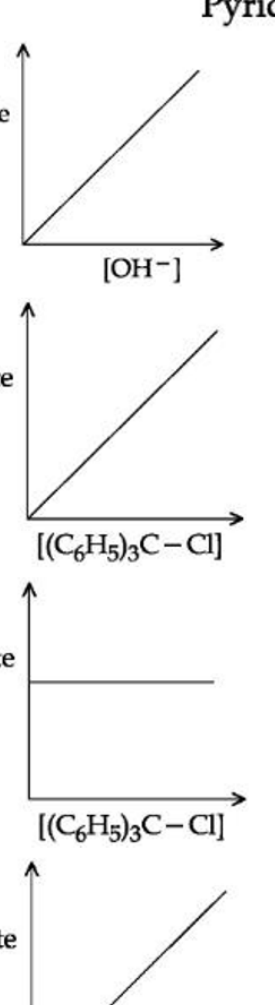
- Arate versus [OH⁻] graph: a straight line through the origin, rate increasing with [OH⁻]
- Brate versus [(C₆H₅)₃C−Cl] graph: a straight line through the origin, rate increasing with [(C₆H₅)₃C−Cl]
- Crate versus [(C₆H₅)₃C−Cl] graph: a horizontal line, rate constant as [(C₆H₅)₃C−Cl] increases
- Drate versus [Pyridine] graph: a straight line through the origin, rate increasing with [Pyridine]
View answer or solution
Answer
rate versus [(C₆H₅)₃C−Cl] graph: a straight line through the origin, rate increasing with [(C₆H₅)₃C−Cl]
The starting material for convenient preparation of deuterated hydrogen peroxide (D₂O₂) in laboratory is :
- ABaO
- B2-ethylanthraquinol
- CBaO₂
- DK₂S₂O₈
View answer or solution
Answer
K₂S₂O₈
'X' is : [benzene ring drawn as a hexagon with a circle inside] + [methylenecyclohexane drawn as a cyclohexane ring with an exocyclic double bond at its bottom vertex] →[HF / Δ] X Major product
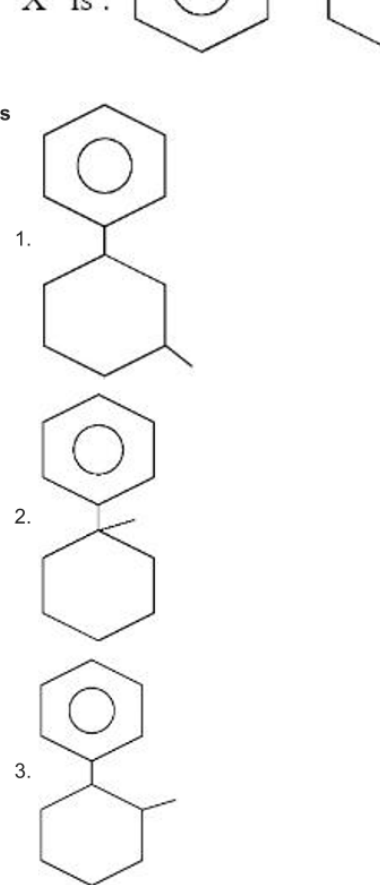
- A[benzene ring above joined by a single bond to a cyclohexane ring below, the cyclohexane bearing a methyl at its lower-right vertex]
- B[benzene ring above joined by a single bond to a cyclohexane ring below, the junction carbon of the cyclohexane also bearing a methyl pointing up-right]
- C[benzene ring above joined by a single bond to a cyclohexane ring below, the cyclohexane bearing a methyl at its upper-right vertex]
- D[benzene ring above bearing a methyl at its lower-right vertex, joined by a single bond from its bottom vertex to a cyclohexane ring below]
View answer or solution
Answer
[benzene ring above joined by a single bond to a cyclohexane ring below, the junction carbon of the cyclohexane also bearing a methyl pointing up-right]
Chemical Bonding and Molecular Structure
O − O bond length in H₂O₂ is X than the O − O bond length in F₂O₂. The O − H bond length in H₂O₂ is Y than that of the O − F bond in F₂O₂. Choose the correct option for X and Y from those given below :
- AX - shorter, Y - longer
- BX - longer, Y - longer
- CX - shorter, Y - shorter
- DX - longer, Y - shorter
View answer or solution
Answer
X - longer, Y - shorter
The correct order of bond enthalpy (kJ mol⁻¹) is :
- AC − C > Si − Si > Sn − Sn > Ge − Ge
- BSi − Si > C − C > Sn − Sn > Ge − Ge
- CSi − Si > C − C > Ge − Ge > Sn − Sn
- DC − C > Si − Si > Ge − Ge > Sn − Sn
View answer or solution
Answer
C − C > Si − Si > Ge − Ge > Sn − Sn
Given below are two statements : one is labelled as Assertion (A) and the other is labelled as Reason (R). Assertion (A) : Gypsum is used for making fireproof wall boards. Reason (R) : Gypsum is unstable at high temperatures. In the light of the above statements, choose the correct answer from the options given below :
- ABoth (A) and (R) are correct but (R) is not the correct explanation of (A)
- BBoth (A) and (R) are correct and (R) is the correct explanation of (A)
- C(A) is correct but (R) is not correct
- D(A) is not correct but (R) is correct
View answer or solution
Answer
Both (A) and (R) are correct but (R) is not the correct explanation of (A)
Given below are two statements : one is labelled as Assertion (A) and the other is labelled as Reason (R). Assertion (A) : An aqueous solution of KOH when used for volumetric analysis, its concentration should be checked before the use. Reason (R) : On aging, KOH solution absorbs atmospheric CO₂. In the light of the above statements, choose the correct answer from the options given below :
- ABoth (A) and (R) are correct and (R) is the correct explanation of (A)
- BBoth (A) and (R) are correct but (R) is not the correct explanation of (A)
- C(A) is not correct but (R) is correct
- D(A) is correct but (R) is not correct
View answer or solution
Answer
Both (A) and (R) are correct and (R) is the correct explanation of (A)
Some Basic Concepts in Chemistry
In figure, a straight line is given for Freundrich Adsorption (y = 3x + 2.505). The value of 1/n and log K are respectively.
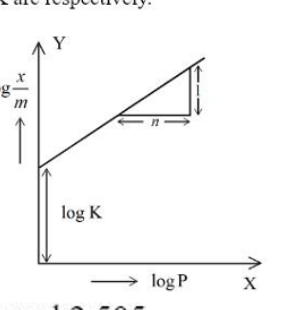
- A3 and 2.505
- B0.3 and 0.7033
- C0.3 and log 2.505
- D3 and 0.7033
View answer or solution
Answer
3 and 2.505
Classification of Elements and Periodicity in Properties
For electron gain enthalpies of the elements denoted as ΔₑgH, the incorrect option is :
- AΔₑgH (Se) < ΔₑgH (S)
- BΔₑgH (Te) < ΔₑgH (Po)
- CΔₑgH (Cl) < ΔₑgH (F)
- DΔₑgH (I) < ΔₑgH (At)
View answer or solution
Answer
ΔₑgH (Se) < ΔₑgH (S)
Organic Compounds Containing Oxygen
In a reaction, reagents ‘X’ and ‘Y’ respectively are :
- A(CH₃CO)₂O/H⁺ and (CH₃CO)₂O/H⁺
- BCH₃OH/H⁺, Δ and (CH₃CO)₂O/H⁺
- C(CH₃CO)₂O/H⁺ and CH₃OH/H⁺, Δ
- DCH₃OH/H⁺, Δ and CH₃OH/H⁺, Δ
View answer or solution
Answer
(CH₃CO)₂O/H⁺ and CH₃OH/H⁺, Δ
Organic Compounds Containing Oxygen
Given below are two statements : one is labelled as Assertion (A) and the other is labelled as Reason (R). Assertion (A) : α-halocarboxylic acid on reaction with dil NH₃ gives good yield of α-amino carboxylic acid whereas the yield of amines is very low when prepared from alkyl halides. Reason (R) : Amino acids exist in zwitter ion form in aqueous medium. In the light of the above statements, choose the correct answer from the options given below :
- A(A) is not correct but (R) is correct
- BBoth (A) and (R) are correct but (R) is not the correct explanation of (A)
- CBoth (A) and (R) are correct and (R) is the correct explanation of (A)
- D(A) is correct but (R) is not correct
View answer or solution
Answer
Both (A) and (R) are correct and (R) is the correct explanation of (A)
Some Basic Concepts in Chemistry
The industrial activity held least responsible for global warming is :
- Asteel manufacturing
- BElectricity generation in thermal power plants
- CIndustrial production of urea
- Dmanufacturing of cement
View answer or solution
Answer
Industrial production of urea
All structures given below are of vitamin C. Most stable of them is :
- AVitamin C structure 1: five-membered lactone with exocyclic side chain HOCH₂-CH(OH)-, keto groups at 3- and 4- positions, dashed stereochemistry at side chain and ring junction
- BVitamin C structure 2: five-membered lactone with side chain HOCH₂-CH(OH)-, keto at 3-position and enol OH at 4-position, dashed stereochemistry
- CVitamin C structure 3: five-membered lactone with side chain HOCH₂-CH(OH)-, enediol double bond with OH at both 3- and 4-positions, dashed stereochemistry – ascorbic acid form
- DVitamin C structure 4: five-membered lactone enol ether with side chain HOCH₂-CH(OH)-, keto at 3-position and enol OH at 4-5 double bond, dashed stereochemistry
View answer or solution
Answer
Vitamin C structure 3: five-membered lactone with side chain HOCH₂-CH(OH)-, enediol double bond with OH at both 3- and 4-positions, dashed stereochemistry – ascorbic acid form
A → B The above reaction is of zero order. Half life of this reaction is 50 min. The time taken for the concentration of A to reduce to one-fourth of its initial value is ____________ min. (Nearest integer)
View answer or solution
Answer
75
Organic Compounds Containing Nitrogen
Among the following, the number of tranquilizer/s is/are ____________. A. Chloroliazepoxide B. Veronal C. Valium D. Salvarsan
View answer or solution
Answer
3
Redox Reactions and Electrochemistry
1 × 10⁻⁵ M AgNO₃ is added to 1 L of saturated solution of AgBr. The conductivity of this solution at 298 K is ____________ × 10⁻⁸ S m⁻¹. [Given : Kₛₚ(AgBr) = 4.9 × 10⁻¹³ at 298 K λ⁰_{Ag⁺} = 6 × 10⁻³ S m² mol⁻¹ λ⁰_{Br⁻} = 8 × 10⁻³ S m² mol⁻¹ λ⁰_{NO₃⁻} = 7 × 10⁻³ S m² mol⁻¹]
View answer or solution
Answer
14
Some Basic Concepts in Chemistry
The molality of a 10% (v/v) solution of di-bromine solution in CCl₄ (carbon tetrachloride) is ‘x’. x = ____________ × 10⁻² M. (Nearest integer) [Given : molar mass of Br₂ = 160 g mol⁻¹ atomic mass of C = 12 g mol⁻¹ atomic mass of Cl = 35.5 g mol⁻¹ density of dibromine = 3.2 g cm⁻³ density of CCl₄ = 1.6 g cm⁻³]
View answer or solution
Answer
139
The spin only magnetic moment of [Mn(H₂O)₆]²⁺ complexes is ______ B.M. (Nearest integer) (Given: Atomic no. of Mn is 25)
View answer or solution
Answer
6
Among following compounds, the number of those present in copper matte is ____________. A. CuCO₃ B. Cu₂S C. Cu₂O D. FeO
View answer or solution
Answer
1
20% of acetic acid is dissociated when its 5 g is added to 500 mL of water. The depression in freezing point of such water is ____________ × 10⁻³°C. Atomic mass of C, H and O are 12, 1 and 16 a.m.u. respectively. [Given : Molal depression constant and density of water are 1.86 K kg mol⁻¹ and 1 g cm⁻³ respectively.]
View answer or solution
Answer
372
Testosterone, which is a steroidal hormone, has the following structure. The total number of asymmetric carbon atom/s in testosterone is ____________.

View answer or solution
Answer
6
Some Basic Concepts in Chemistry
A metal M crystallizes into two lattices :- face centred cubic (fcc) and body centred cubic (bcc) with unit cell edge length of 2.0 and 2.5 Å respectively. The ratio of densities of lattices fcc to bcc for the metal M is ____________. (Nearest integer)
View answer or solution
Answer
4
0.3 g of ethane undergoes combustion at 27°C in a bomb calorimeter. The temperature of calorimeter system (including the water) is found to rise by 0.5°C. The heat evolved during combustion of ethane at constant pressure is ____________ kJ mol⁻¹. (Nearest integer) [Given : The heat capacity of the calorimeter system is 20 kJ K⁻¹, R = 8.3 JK⁻¹ mol⁻¹. Assume ideal gas behaviour. Atomic mass of C and H are 12 and 1 g mol⁻¹ respectively]
View answer or solution
Answer
1006