
// JEE (Main) / 2023
JEE (Main) 2023 Session 1, 1 February 2023, Shift 1 — Paper 1 (B.E / B.Tech) Chemistry
Chemistry · B.E / B.Tech
Questions
29 + 1
Has an official figure
Withheld — the source figure is not published, so the question is stored with the paper and not served
Work through the questions
29 questions
Take a moment to try each question before opening the available answer or solution.
A solution of FeCl₃ when treated with K₄[Fe(CN)₆] gives a prussiun blue precipitate due to the formation of
- AFe₄[Fe(CN)₆]₃
- BFe[Fe(CN)₆]
- CFe₃[Fe(CN)₆]₂
- DK[Fe₂(CN)₆]
View answer or solution
Answer
Fe₄[Fe(CN)₆]₃
Classification of Elements and Periodicity in Properties
Choose the correct statement(s): A. Beryllium oxide is purely acidic in nature. B. Beryllium carbonate is kept in the atmosphere of CO₂. C. Beryllium sulphate is readily soluble in water. D. Beryllium shows anomalous behavior. Choose the correct answer from the options given below:
- AA and B only
- BB, C and D only
- CA only
- DA, B and C only
View answer or solution
Answer
B, C and D only
Some Basic Principles of Organic Chemistry
Match List I with List II Test | Functional group / Class of Compound (A) Molisch's Test | (I) Peptide (B) Biuret Test | (II) Carbohydrate (C) Carbylamine Test | (III) Primary amine (D) Schiff's Test | (IV) Aldehyde Choose the correct answer from the options given below:
- A(A) – III, (B) – IV, (C) – II, (D) – I
- B(A) – II, (B) – I, (C) – III, (D) – IV
- C(A) – I, (B) – II, (C) – III, (D) – IV
- D(A) – III, (B) – IV, (C) – I, (D) – II
View answer or solution
Answer
(A) – II, (B) – I, (C) – III, (D) – IV
Redox Reactions and Electrochemistry
Highest oxidation state of Mn is exhibited in Mn₂O₇. The correct statements about Mn₂O₇ are (A) Mn is tetrahedrally surrounded by oxygen atoms. (B) Mn is octahedrally surrounded by oxygen atoms. (C) Contains Mn-O-Mn bridge. (D) Contains Mn-Mn bond. Choose the correct answer from the options given below:
- AB and C only
- BA and D only
- CA and C only
- DB and D only
View answer or solution
Answer
A and C only
Given below are two statements: one is labelled as Assertion A and the other is labelled as Reason R Assertion A: Hydrogen is an environment friendly fuel. Reason R: Atomic number of hydrogen is 1 and it is a very light element. In the light of the above statements, choose the correct answer from the options given below
- AA is false but R is true
- BBoth A and R are true but R is NOT the correct explanation of A
- CBoth A and R are true and R is the correct explanation of A
- DA is true but R is false
View answer or solution
Answer
Both A and R are true but R is NOT the correct explanation of A
Organic Compounds Containing Oxygen
In the following reaction, 'A' is (CH₃)₂CH–CH(NH₂)–CH₂OH —(EtO–C(=O)–OEt)→ 'A' Major product
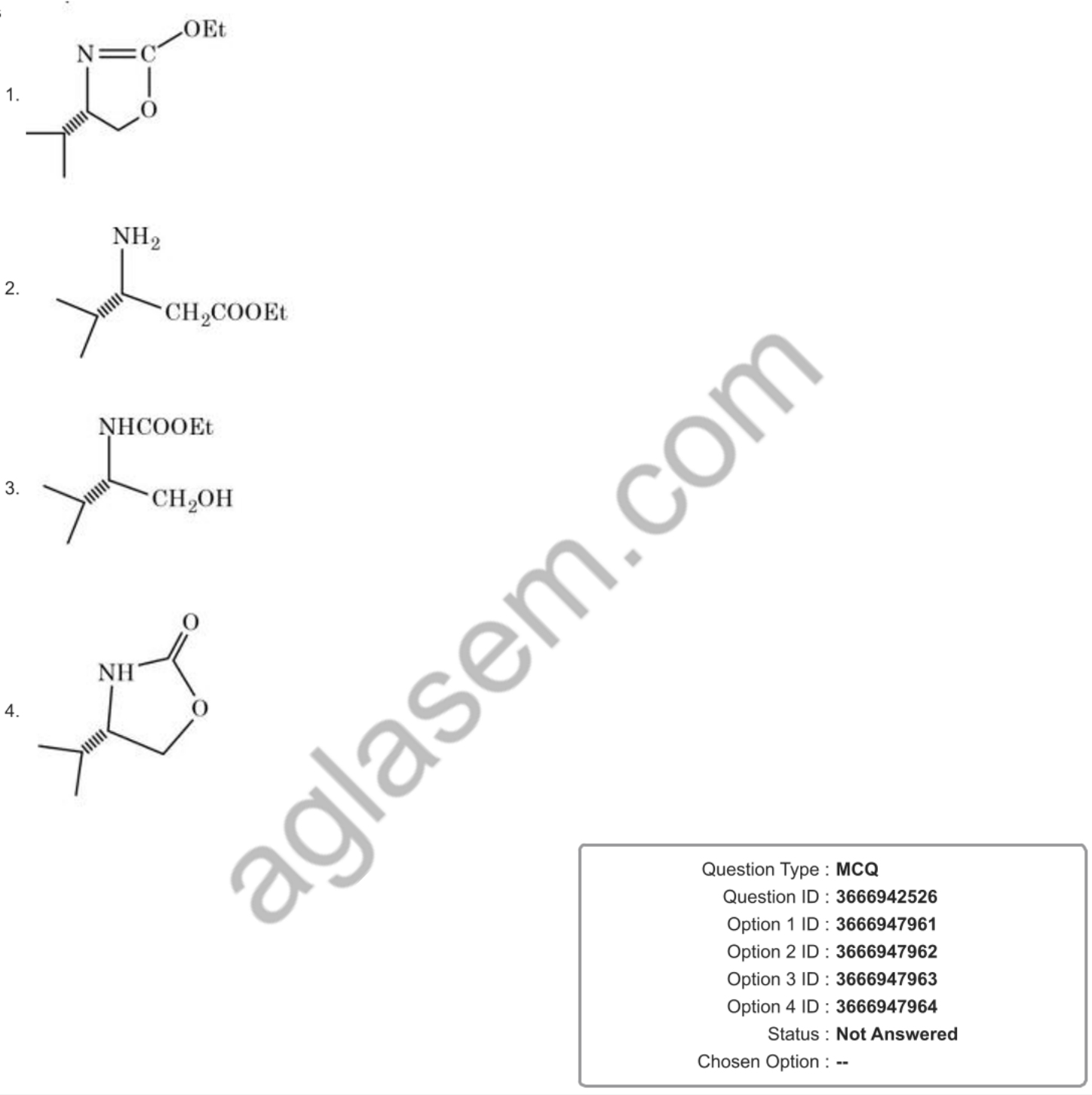
- AA five-membered oxazoline ring with 'N' at the upper-left vertex, 'C' at the upper-right vertex bearing 'OEt' and double-bonded to 'N', 'O' at the lower-right vertex, and an isopropyl group (CH(CH₃)₂) on the lower-left vertex with hashed stereochemistry at that vertex
- B(CH₃)₂CH–CH(NH₂)–CH₂COOEt with isopropyl on the lower left, NH₂ above and CH₂COOEt to the right, and a hashed wedge bond to the isopropyl group
- C(CH₃)₂CH–CH(NHCOOEt)–CH₂OH with isopropyl on the lower left, NHCOOEt above and CH₂OH to the right, and a hashed wedge bond to the isopropyl group
- DA five-membered oxazolidin-2-one ring with 'NH' at the upper-left vertex, 'C(=O)' at the upper-right vertex with 'O' double-bonded above, 'O' at the lower-right vertex, and an isopropyl group on the lower-left vertex with hashed stereochemistry
View answer or solution
Answer
A five-membered oxazolidin-2-one ring with 'NH' at the upper-left vertex, 'C(=O)' at the upper-right vertex with 'O' double-bonded above, 'O' at the lower-right vertex, and an isopropyl group on the lower-left vertex with hashed stereochemistry
Identify the incorrect option from the following:

- A(CH₃)₃C–CH₂–Br (neopentyl bromide drawn as a branched skeletal chain) + KOH (alc) → (CH₃)₃C–CH₂–OH (neopentyl alcohol drawn similarly) + KBr
- BChlorobenzene (a benzene ring with Cl on the upper-right vertex) —[(i) NaOH, 623 K, 300 atm, (ii) HCl]→ Phenol (a benzene ring with OH on the upper-right vertex)
- CCH₃–CH₂–CH₂–Br (1-bromopropane drawn as a zigzag chain) + KOH (aq) → CH₃–CH₂–CH₂–OH (1-propanol drawn similarly) + KBr
- DChlorobenzene (a benzene ring with Cl at the top vertex) + H₃C–C(=O)–Cl (acetyl chloride with O above the carbonyl carbon) —(anhyd. AlCl₃)→ o-chloroacetophenone (a benzene ring with Cl at the top vertex and C(=O)CH₃, O above, CH₃ to the right, on the adjacent upper-right vertex) + HCl
View answer or solution
Answer
(CH₃)₃C–CH₂–Br (neopentyl bromide drawn as a branched skeletal chain) + KOH (alc) → (CH₃)₃C–CH₂–OH (neopentyl alcohol drawn similarly) + KBr
The correct representation in six membered pyranose form for the following sugar [X] is Fischer projection of Sugar [X]: CHO at the top, HO–H, HO–H, H–OH, H–OH, H₂COH at the bottom
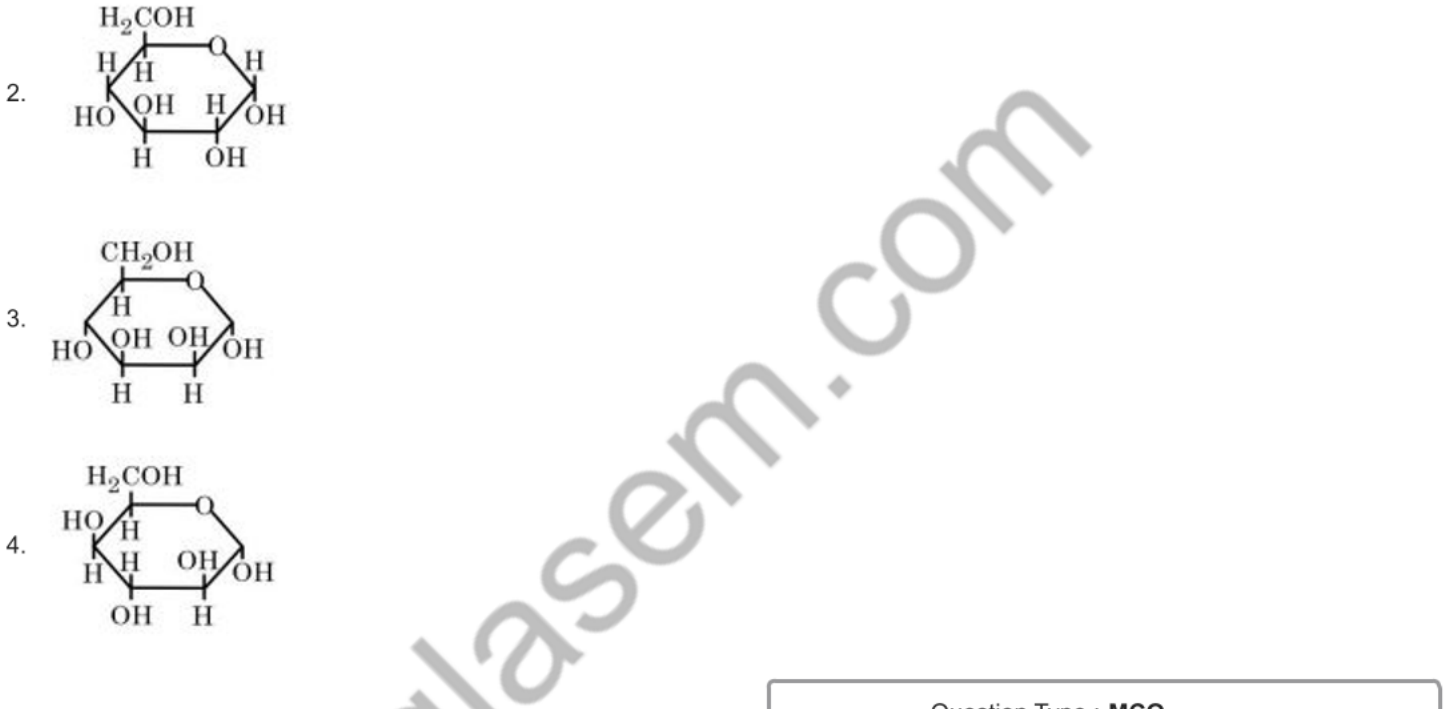
- ASix-membered pyranose ring with ring O at the top-right and 'CH₂OH' at the top, 'H' at the upper-left outside, 'HO' on the left, 'H' inside above the bottom-left carbon and 'OH' below it, 'OH' inside above the bottom-right carbon and 'H' below it, and at the anomeric carbon to the right of the ring O 'H' above and 'OH' on the right
- BSix-membered pyranose ring with ring O at the top-right and 'H₂COH' at the top, 'H' at the upper-left outside, 'HO' on the left, 'OH' inside above the bottom-left carbon and 'H' below it, 'H' inside above the bottom-right carbon and 'OH' below it, and at the anomeric carbon to the right of the ring O 'H' above and 'OH' on the right
- CSix-membered pyranose ring with ring O at the top-right and 'CH₂OH' at the top, 'H' inside below the top carbon, 'HO' on the left, 'OH' inside above the bottom-left carbon and 'H' below it, 'OH' inside above the bottom-right carbon and 'H' below it, and 'OH' on the right at the anomeric carbon with no 'H' above it
- DSix-membered pyranose ring with ring O at the top-right and 'H₂COH' at the top, 'HO' above 'H' on the left, 'H' inside above the bottom-left carbon and 'OH' below it, 'OH' inside above the bottom-right carbon and 'H' below it, and 'OH' on the right at the anomeric carbon
View answer or solution
Answer
Six-membered pyranose ring with ring O at the top-right and 'CH₂OH' at the top, 'H' inside below the top carbon, 'HO' on the left, 'OH' inside above the bottom-left carbon and 'H' below it, 'OH' inside above the bottom-right carbon and 'H' below it, and 'OH' on the right at the anomeric carbon with no 'H' above it
Redox Reactions and Electrochemistry
Given below are two statements: one is labelled as Assertion A and the other is labelled as Reason R Assertion A: In an Ellingham diagram, the oxidation of carbon to carbon monoxide shows a negative slope with respect to temperature. Reason R: CO tends to get decomposed at higher temperature. In the light of the above statements, choose the correct answer from the options given below
- AA is correct but R is not correct
- BBoth A and R are correct and R is the correct explanation of A
- CA is not correct but R is correct
- DBoth A and R are correct but R is NOT the correct explanation of A
View answer or solution
Answer
A is correct but R is not correct
How can photochemical smog be controlled?
- ABy complete combustion of fuel.
- BBy using catalyst.
- CBy using catalytic convertors in the automobiles/industry.
- DBy using tall chimneys.
View answer or solution
Answer
By using catalytic convertors in the automobiles/industry.
Chemical Bonding and Molecular Structure
Resonance in carbonate ion (CO₃²⁻) is Which of the following is true?
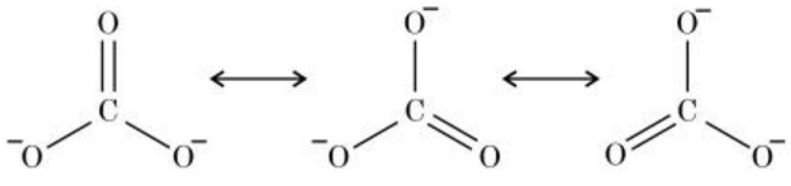
- AEach structure exists for equal amount of time.
- BIt is possible to identify each structure individually by some physical or chemical method.
- CAll these structures are in dynamic equilibrium with each other.
- DCO₃²⁻ has a single structure i.e., resonance hybrid of the above three structures.
View answer or solution
Answer
CO₃²⁻ has a single structure i.e., resonance hybrid of the above three structures.
Chemical Bonding and Molecular Structure
Which of the following represents the lattice structure of A₀.₉₅O containing A²⁺, A³⁺ and O²⁻ ions? ⊙ A²⁺ ⊙ A³⁺ ⊙ O²⁻ A. B. C.
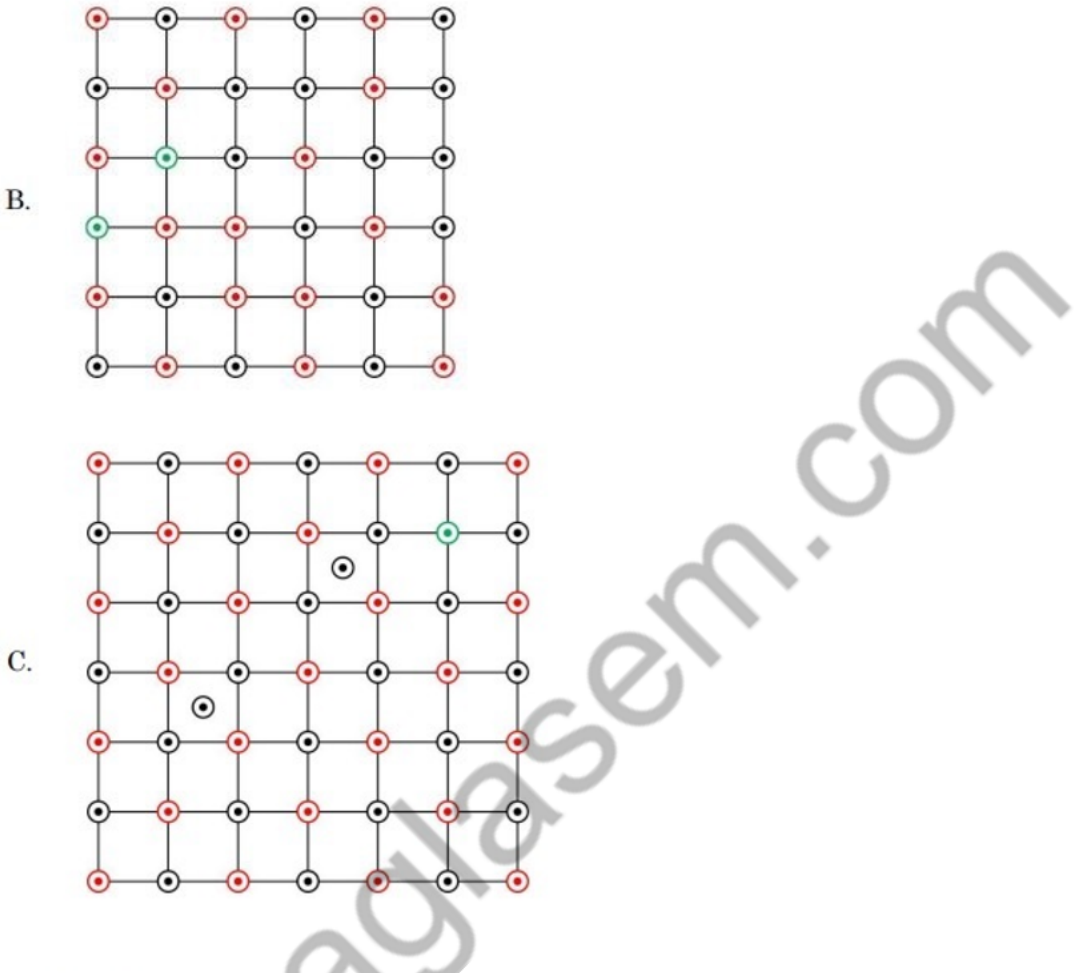
- AA only
- BB only
- CA and B only
- DB and C only
View answer or solution
Answer
A only
Classification of Elements and Periodicity in Properties
Given below are two statements: Statement I: Chlorine can easily combine with oxygen to form oxides; and the product has a tendency to explode. Statement II: Chemical reactivity of an element can be determined by its reaction with oxygen and halogens. In the light of the above statements, choose the correct answer from the options given below
- AStatement I is false but Statement II is true
- BBoth the Statements I and II are true
- CStatement I is true but Statement II is false
- DBoth the Statements I and II are false
View answer or solution
Answer
Both the Statements I and II are true
Which of the following complex will show largest splitting of d-orbitals?
- A[FeF₆]³⁻
- B[Fe(C₂O₄)₃]³⁻
- C[Fe(NH₃)₆]³⁺
- D[Fe(CN)₆]³⁻
View answer or solution
Answer
[Fe(CN)₆]³⁻
Which of the following are the example of double salt? A. FeSO₄.(NH₄)₂SO₄.6H₂O B. CuSO₄.4NH₃.H₂O C. K₂SO₄.Al₂(SO₄)₃.24H₂O D. Fe(CN)₂.4KCN Choose the correct answer
- AA and C only
- BA and B only
- CB and D only
- DA, B and D only
View answer or solution
Answer
A and C only
Match List I with List II List I (A) Tranquilizers (B) Aspirin (C) Antibiotic (D) Antiseptic List II (I) Anti blood clotting (II) Salvarsan (III) antidepressant drugs (IV) soframicine Choose the correct answer from the options given below:
- A(A) – II, (B) – I, (C) – III, (D) – IV
- B(A) – III, (B) – I, (C) – II, (D) – IV
- C(A) – II, (B) – IV, (C) – I, (D) – III
- D(A) – IV, (B) – II, (C) – I, (D) – III
View answer or solution
Answer
(A) – III, (B) – I, (C) – II, (D) – IV
Organic Compounds Containing Oxygen
Decreasing order of dehydration of the following alcohols is
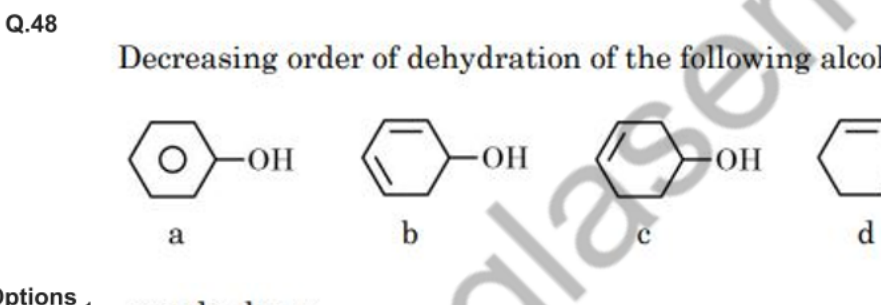
- Aa > d > b > c
- Bb > a > d > c
- Cd > b > c > a
- Db > d > c > a
View answer or solution
Answer
b > d > c > a
Principles Related to Practical Chemistry
Given below are two statements: One is labelled as Assertion A and the other is labelled as Reason R Assertion A: Amongst He, Ne, Ar and Kr; 1g of activated charcoal adsorbs more of Kr. Reason R: The critical volume V꜀ (cm³ mol⁻¹) and critical pressure P꜀ (atm) is highest for Krypton but the compressibility factor at critical point Z꜀ is lowest for Krypton. In the light of the above statements, choose the correct answer from the options given below
- ABoth A and R are true and R is the correct explanation of A
- BA is true but R is false
- CBoth A and R are true but R is NOT the correct explanation of A
- DA is false but R is true
View answer or solution
Answer
A is true but R is false
Match List I with List II LIST I A. Slaked lime B. Dead burnt plaster C. Caustic soda D. Washing soda LIST II I. NaOH II. Ca(OH)₂ III. Na₂CO₃.10H₂O IV. CaSO₄ Choose the correct answer from the options given below:
- AA-II, B-IV, C-I, D-III
- BA-III, B-IV, C-II, D-I
- CA-I, B-IV, C-II, D-III
- DA-III, B-II, C-IV, D-I
View answer or solution
Answer
A-II, B-IV, C-I, D-III
A and B are two substances undergoing radioactive decay in a container. The half life of A is 15 min and that of B is 5 min. If the initial concentration of B is 4 times that of A and they both start decaying at the same time, how much time will it take for the concentration of both of them to be same? __________ min.
View answer or solution
Answer
15
25 mL of an aqueous solution of KCl was found to require 20 mL of 1 M AgNO₃ solution when titrated using K₂CrO₄ as an indicator. What is the depression in freezing point of KCl solution of the given concentration? __________(Nearest integer). (Given: K_f = 2.0 K kg mol⁻¹) Assume 1) 100% ionization and 2) density of the aqueous solution as 1 g mL⁻¹
View answer or solution
Answer
3
Some Basic Concepts in Chemistry
The density of 3 M solution of NaCl is 1.0 g mL⁻¹. Molality of the solution is __________ × 10⁻² m. (Nearest integer). Given: Molar mass of Na and Cl is 23 and 35.5 g mol⁻¹ respectively.
View answer or solution
Answer
364
Redox Reactions and Electrochemistry
At what pH, given half cell MnO₄⁻ (0.1 M) | Mn²⁺ (0.001 M) will have electrode potential of 1.282 V? __________ (Nearest Integer) Given E°_MnO₄⁻|Mn²⁺ =1.54V, 2.303RT/F =0.059V
View answer or solution
Answer
3
(i) X(g) ⇌ Y(g) + Z(g) Kₚ₁ = 3 (ii) A(g) ⇌ 2B(g) Kₚ₂ = 1 If the degree of dissociation and initial concentration of both the reactants X(g) and A(g) are equal, then the ratio of the total pressure at equilibrium (p₁/p₂) is equal to x:1. The value of x is __________ (Nearest integer)
View answer or solution
Answer
12
Redox Reactions and Electrochemistry
Sum of oxidation states of bromine in bromic acid and perbromic acid is __________.
View answer or solution
Answer
12
Some Basic Concepts in Chemistry
Number of isomeric compounds with molecular formula C₉H₁₀O which (i) do not dissolve in NaOH (ii) do not dissolve in HCl. (iii) do not give orange precipitate with 2,4-DNP (iv) on hydrogenation give identical compound with molecular formula C₉H₁₂O is ___________.
View answer or solution
Answer
2
Some Basic Principles of Organic Chemistry
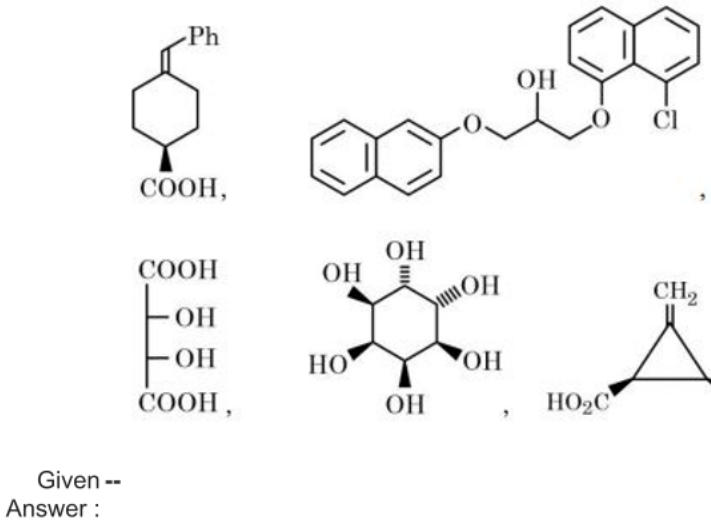
The total number of chiral compound/s from the following is ____________.
View answer or solution
Answer
2
Electrons in a cathode ray tube have been emitted with a velocity of 1000 m s⁻¹. The number of following statements which is/are true about the emitted radiation is ____________. Given : h = 6 × 10⁻³⁴ J s, mₑ = 9 × 10⁻³¹ kg. (A) The deBroglie wavelength of the electron emitted is 666.67 nm. (B) The characteristic of electrons emitted depend upon the material of the electrodes of the cathode ray tube. (C) The cathode rays start from cathode and move towards anode. (D) The nature of the emitted electrons depends on the nature of the gas present in cathode ray tube.
View answer or solution
Answer
2
At 25°C, the enthalpy of the following processes are given: H₂(g) + O₂(g) → 2OH(g) ΔH° = 78 kJ mol⁻¹ H₂(g) + ½O₂(g) → H₂O(g) ΔH° = -242 kJ mol⁻¹ H₂(g) → 2H(g) ΔH° = 436 kJ mol⁻¹ ½O₂(g) → O(g) ΔH° = 249 kJ mol⁻¹ What would be the value of X for the following reaction? ____________ (Nearest integer) H₂O(g) → H(g)+OH(g) ΔH° = X kJ mol⁻¹
View answer or solution
Answer
499