
// JEE (Main) / 2022
JEE (Main) 2022 Session 2, 28 July 2022, Shift 1 — Paper 1 (B.E / B.Tech) Chemistry
Chemistry · B.E / B.Tech
Work through the questions
30 questions
Take a moment to try each question before opening the available answer or solution.
Identify the incorrect statement from the following.
- AA circular path around the nucleus in which an electron moves is proposed as Bohr’s orbit.
- BAn orbital is the one electron wave function (ψ) in an atom.
- CThe existence of Bohr’s orbits is supported by hydrogen spectrum.
- DAtomic orbital is characterised by the quantum numbers n and l only.
View answer or solution
Answer
Atomic orbital is characterised by the quantum numbers n and l only.
Which of the following relation is not correct ?
- AΔH = ΔU − PΔV
- BΔU = q + W
- CΔS_sys + ΔS_surr ≥ 0
- DΔG = ΔH − TΔS
View answer or solution
Answer
ΔH = ΔU − PΔV
Redox Reactions and Electrochemistry
Match List - I with List - II.\n\nList - I\n\n(A) Cd(s) + 2Ni(OH)₃(s) → CdO(s) + 2Ni(OH)₂(s) + H₂O(l)\n\n(B) Zn(Hg) + HgO(s) → ZnO(s) + Hg(l)\n\n(C) 2PbSO₄(s) + 2H₂O(l) → Pb(s) + PbO₂(s) + 2H₂SO₄(aq)\n\n(D) 2H₂(g) + O₂(g) → 2H₂O(l)\n\nList - II\n\n(I) Primary battery\n\n(II) Discharging of secondary battery\n\n(III) Fuel cell\n\n(IV) Charging of secondary battery\n\nChoose the correct answer from the options given below :
- A(A) - (I), (B) - (II), (C) - (III), (D) - (IV)
- B(A) - (IV), (B) - (I), (C) - (II), (D) - (III)
- C(A) - (II), (B) - (I), (C) - (IV), (D) - (III)
- D(A) - (II), (B) - (I), (C) - (III), (D) - (IV)
View answer or solution
Answer
(A) - (II), (B) - (I), (C) - (IV), (D) - (III)
Match List - I with List - II.\n\nList - I (Reaction)\n\n(A) 4NH₃(g) + 5O₂(g) → 4NO(g) + 6H₂O(g)\n\n(B) N₂(g) + 3H₂(g) → 2NH₃(g)\n\n(C) C₁₂H₂₂O₁₁(aq) + H₂O(l) → C₆H₁₂O₆ (Glucose) + C₆H₁₂O₆ (Fructose)\n\n(D) 2SO₂(g) + O₂(g) → 2SO₃(g)\n\nList - II (Catalyst)\n\n(I) NO(g)\n\n(II) H₂SO₄(l)\n\n(III) Pt(s)\n\n(IV) Fe(s)\n\nChoose the correct answer from the options given below :
- A(A) - (II), (B) - (III), (C) - (I), (D) - (IV)
- B(A) - (III), (B) - (II), (C) - (I), (D) - (IV)
- C(A) - (III), (B) - (IV), (C) - (II), (D) - (I)
- D(A) - (III), (B) - (II), (C) - (IV), (D) - (I)
View answer or solution
Answer
(A) - (III), (B) - (IV), (C) - (II), (D) - (I)
Classification of Elements and Periodicity in Properties
In which of the following pairs, electron gain enthalpies of constituent elements are nearly the same or identical ?\n\n(A) Rb and Cs\n\n(B) Na and K\n\n(C) Ar and Kr\n\n(D) I and At\n\nChoose the correct answer from the options given below :
- A(A) and (B) only
- B(B) and (C) only
- C(A) and (C) only
- D(C) and (D) only
View answer or solution
Answer
(A) and (C) only
Which of the reaction is suitable for concentrating ore by leaching process ?
- A2Cu₂S + 3O₂ → 2Cu₂O + 2SO₂
- BFe₃O₄ + CO → 3FeO + CO₂
- CAl₂O₃ + 2NaOH + 3H₂O → 2Na[Al(OH)₄]
- DAl₂O₃ + 6Mg → 6MgO + 4Al
View answer or solution
Answer
Al₂O₃ + 2NaOH + 3H₂O → 2Na[Al(OH)₄]
Some Basic Concepts in Chemistry
The metal salts formed during softening of hardwater using Clark’s method are :
- ACa(OH)₂ and Mg(OH)₂
- BCaCO₃ and Mg(OH)₂
- CCa(OH)₂ and MgCO₃
- DCaCO₃ and MgCO₃
View answer or solution
Answer
CaCO₃ and Mg(OH)₂
Which of the following statement is incorrect ?
- ALow solubility of LiF in water is due to its small hydration enthalpy.
- BKO₂ is paramagnetic.
- CSolution of sodium in liquid ammonia is conducting in nature.
- DSodium metal has higher density than potassium metal.
View answer or solution
Answer
Low solubility of LiF in water is due to its small hydration enthalpy.
Match List - I with List - II, match the gas evolved during each reaction.\n\nList - I\n\n(A) (NH₄)₂Cr₂O₇ —(Δ)→\n\n(B) KMnO₄ + HCl →\n\n(C) Al + NaOH + H₂O →\n\n(D) NaNO₃ —(Δ)→\n\nList - II\n\n(I) H₂\n\n(II) N₂\n\n(III) O₂\n\n(IV) Cl₂\n\nChoose the correct answer from the options given below :
- A(A) - (II), (B) - (III), (C) - (I), (D) - (IV)
- B(A) - (III), (B) - (I), (C) - (IV), (D) - (II)
- C(A) - (II), (B) - (IV), (C) - (I), (D) - (III)
- D(A) - (III), (B) - (IV), (C) - (I), (D) - (II)
View answer or solution
Answer
(A) - (II), (B) - (IV), (C) - (I), (D) - (III)
Which of the following has least tendency to liberate H₂ from mineral acids ?
- ACu
- BMn
- CNi
- DZn
View answer or solution
Answer
Cu
Some Basic Concepts in Chemistry
Given below are two statements :\n\nStatement I : In polluted water values of both dissolved oxygen and BOD are very low.\n\nStatement II : Eutrophication results in decrease in the amount of dissolved oxygen.\n\nIn the light of the above statements, choose the most appropriate answer from the options given below :
- ABoth Statement I and Statement II are true
- BBoth Statement I and Statement II are false
- CStatement I is true but Statement II is false
- DStatement I is false but Statement II is true
View answer or solution
Answer
Statement I is false but Statement II is true
Match List - I with List - II.\n\nList - I\n\n(A) a five-membered ring with an O atom at the bottom vertex and two CH₂ groups at the two bottom vertices (tetrahydrofuran)\n\n(B) a cyclopropane ring with a methyl on each of two carbons and a bond between them (a bicyclic drawn with a triangle and crossing bonds)\n\n(C) a bicyclic structure drawn as two crossing diagonals with vertical bonds on the sides (bicyclo[1.1.1]pentane)\n\n(D) a five-membered ring with an O atom at the bottom vertex and two double bonds on the two upper sides (furan)\n\nList - II\n\n(I) Spiro compound\n\n(II) Aromatic compound\n\n(III) Non-planar Heterocyclic compound\n\n(IV) Bicyclo compound\n\nChoose the correct answer from the options given below :
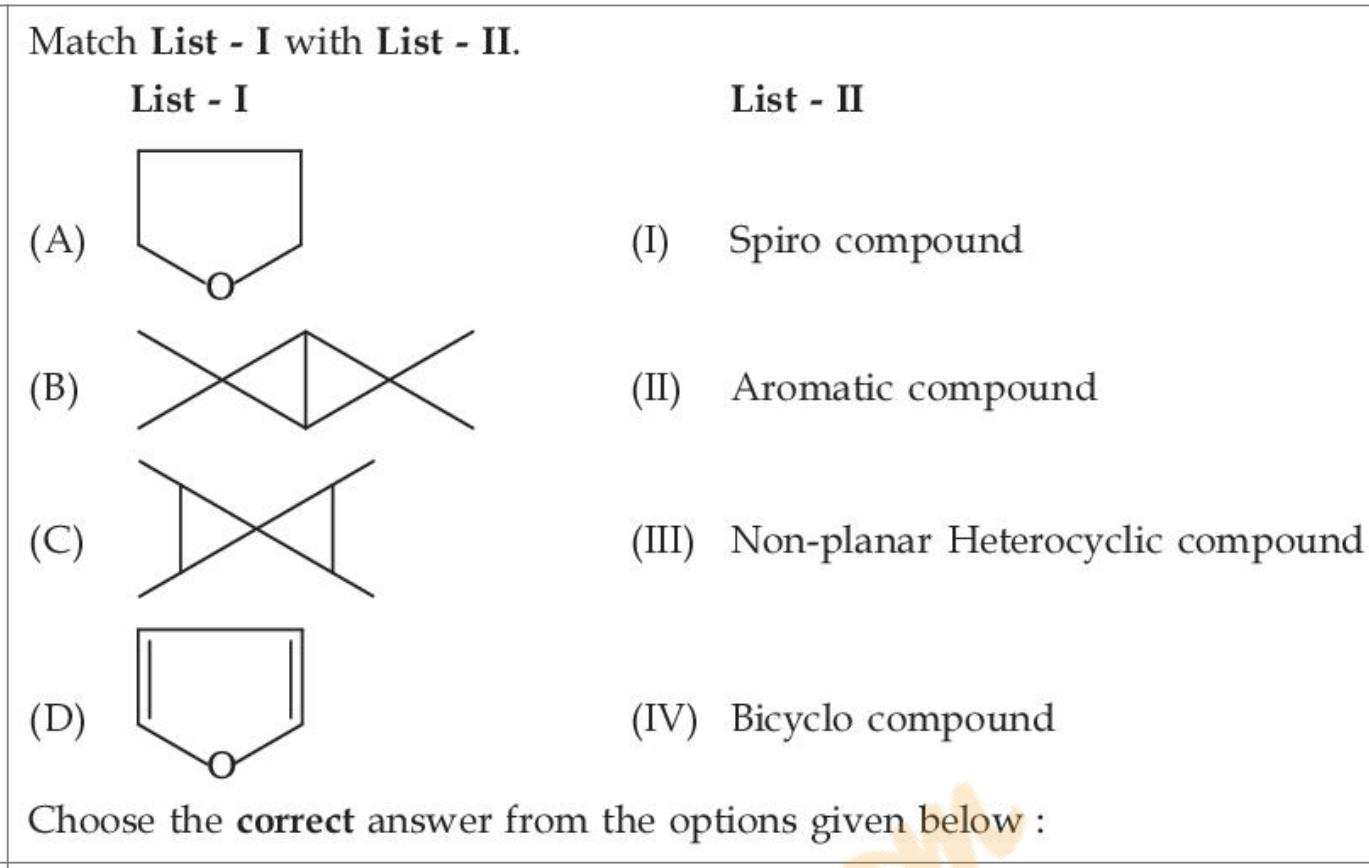
- A(A) - (II), (B) - (I), (C) - (IV), (D) - (III)
- B(A) - (IV), (B) - (III), (C) - (I), (D) - (II)
- C(A) - (III), (B) - (IV), (C) - (I), (D) - (II)
- D(A) - (IV), (B) - (III), (C) - (II), (D) - (I)
View answer or solution
Answer
(A) - (III), (B) - (IV), (C) - (I), (D) - (II)
Choose the correct option for the following reactions.\n\nB ←(BH₃)₂ / H₂O₂/OH⁻ — H₃C – C(CH₃)(CH₃) – CH = CH₂ —(Hg(OAc)₂, H₂O / NaBH₄)→ A
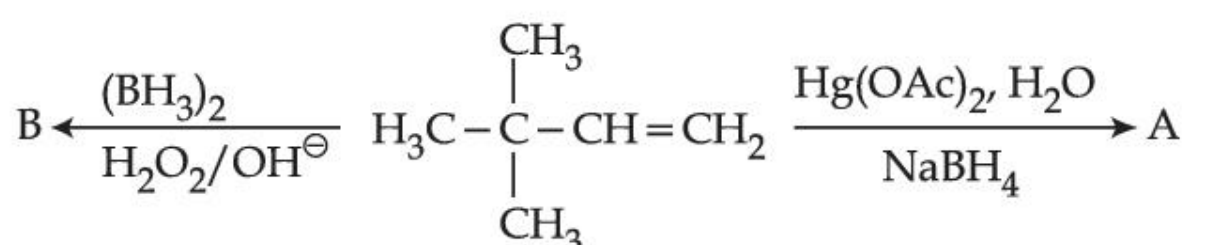
- A‘A’ and ‘B’ are both Markovnikov addition products.
- B‘A’ is Markovnikov product and ‘B’ is anti-Markovnikov product.
- C‘A’ and ‘B’ are both anti-Markovnikov products.
- D‘B’ is Markovnikov and ‘A’ is anti-Markovnikov product.
View answer or solution
Answer
‘A’ is Markovnikov product and ‘B’ is anti-Markovnikov product.
Among the following marked proton of which compound shows lowest pKₐ value ?
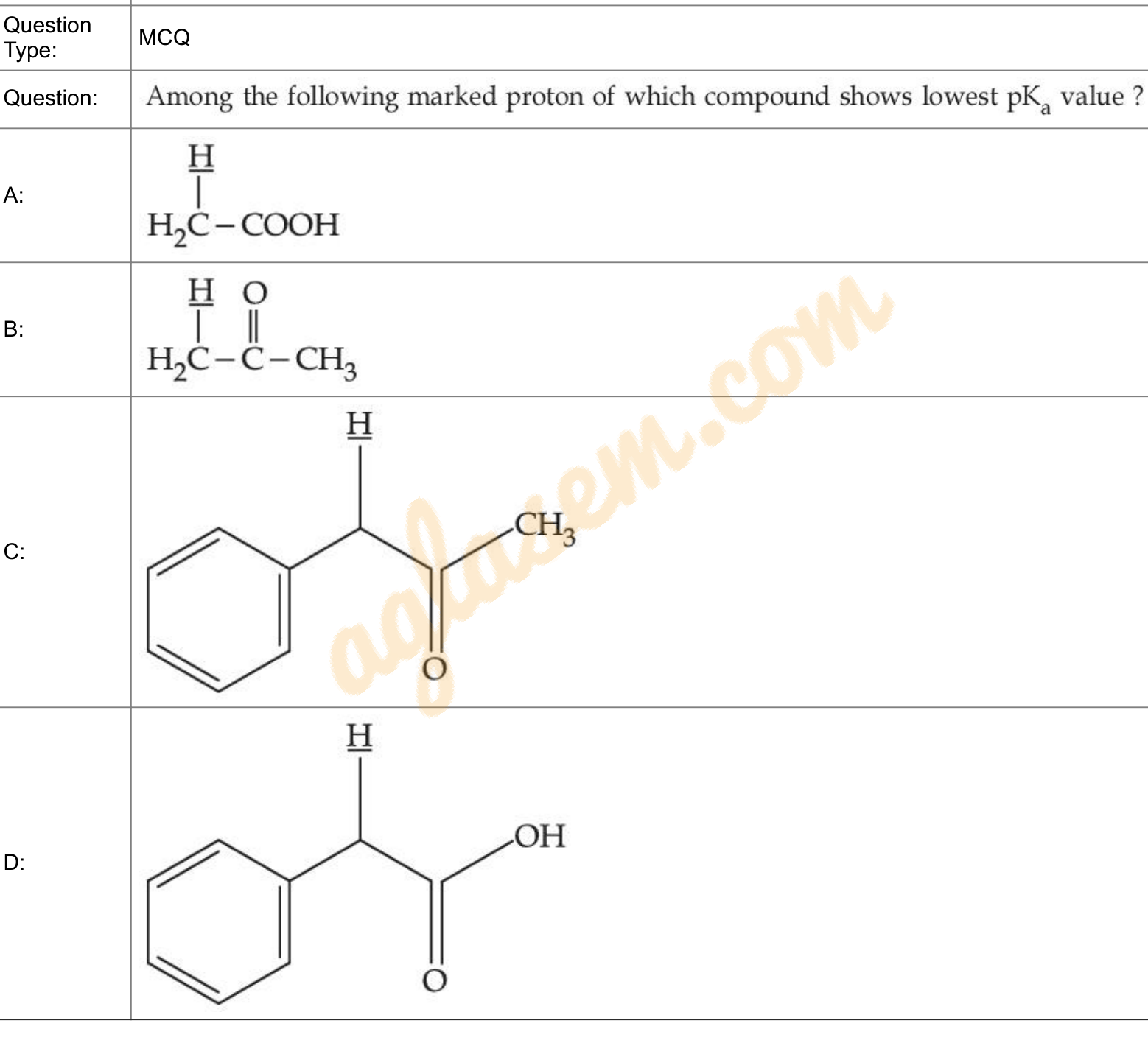
- AH₂C(–H)(–COOH) — the marked proton is on the CH₂ carbon of acetic acid
- BH₂C(–H)(–C(=O)–CH₃) — the marked proton is on the CH₂ carbon of acetone
- Ca benzene ring attached to CH(–H)(–C(=O)–CH₃) — the marked proton is on the α-carbon of a ketone bearing a phenyl group (1-phenylpropan-2-one)
- Da benzene ring attached to CH(–H)(–C(=O)–OH) — the marked proton is on the α-carbon of phenylacetic acid
View answer or solution
Answer
a benzene ring attached to CH(–H)(–C(=O)–CH₃) — the marked proton is on the α-carbon of a ketone bearing a phenyl group (1-phenylpropan-2-one)
Identify the major products A and B for the below given reaction sequence.\n\n[benzene] —(1) CH₃CHClCH₃, AlCl₃; (2) O₂; (3) H⁺, H₂O→ P —(Na₂Cr₂O₇/H₂SO₄)→ A\n\nP —(Br₂ in CS₂)→ B
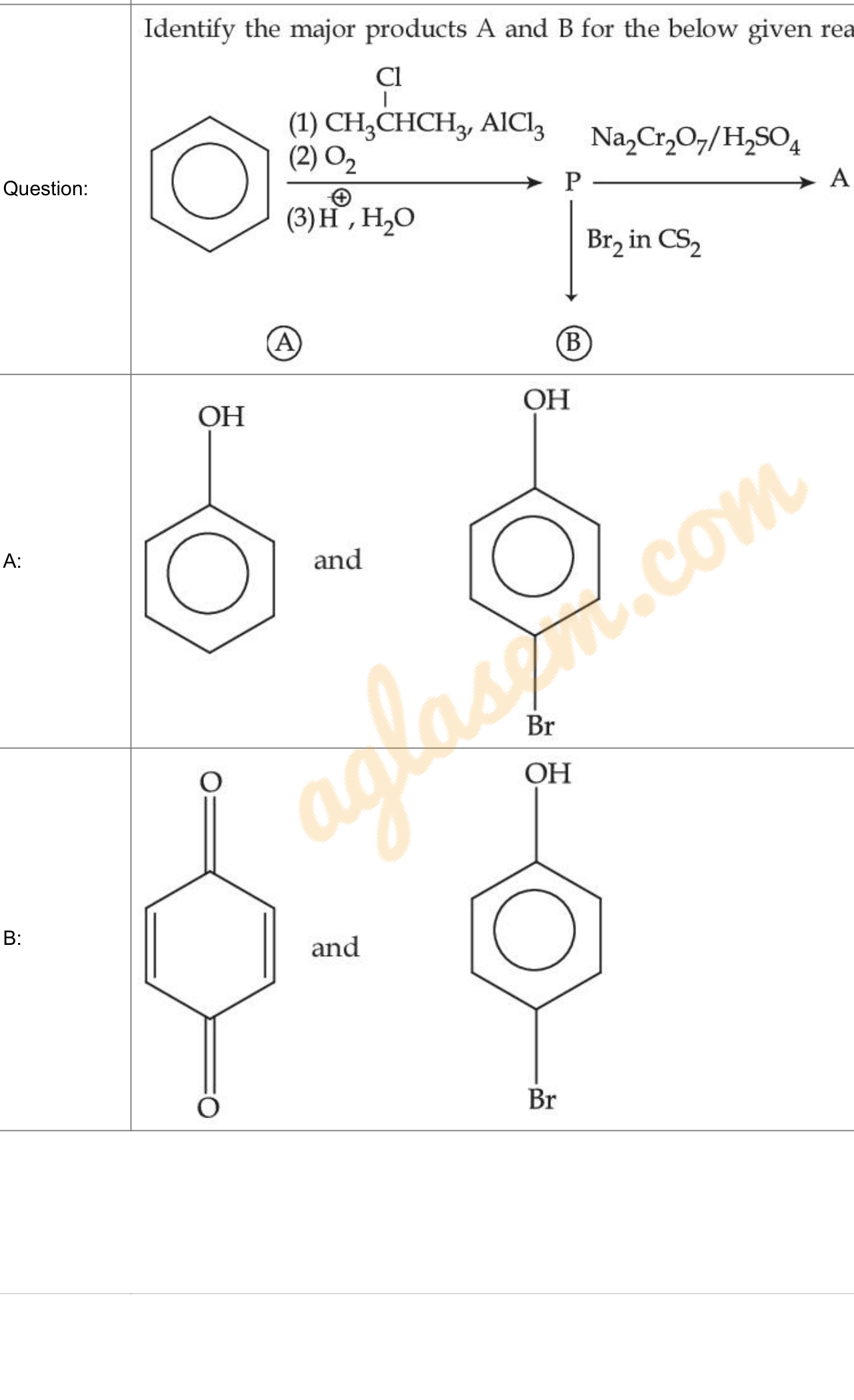
- AA = phenol (a benzene ring bearing OH at the top); B = p-bromophenol (a benzene ring bearing OH at the top and Br at the bottom)
- BA = p-benzoquinone (a ring with =O at the top vertex and =O at the bottom vertex and double bonds on the two sides); B = p-bromophenol
- CA = p-benzoquinone; B = 2,4,6-tribromophenol (a benzene ring bearing OH at the top and Br at the upper-left, upper-right and bottom positions)
- DA = phenol; B = 2,4,6-tribromophenol
View answer or solution
Answer
A = p-benzoquinone (a ring with =O at the top vertex and =O at the bottom vertex and double bonds on the two sides); B = p-bromophenol
Organic Compounds Containing Nitrogen
Identify the correct statement for the below given transformation.\n\nCH₃ – CH₂ – CH₂ – CH(N⁺(CH₃)₃) – CH₃ —(C₂H₅ONa / C₂H₅OH)→ A (Major) + B (Minor)
- AA - CH₃CH₂CH = CH - CH₃, B - CH₃CH₂CH₂CH = CH₂, Saytzeff products
- BA - CH₃CH₂CH = CH - CH₃, B - CH₃CH₂CH₂CH = CH₂, Hofmann products
- CA - CH₃CH₂CH₂CH = CH₂, B - CH₃CH₂CH = CHCH₃, Hofmann products
- DA - CH₃CH₂CH₂CH = CH₂, B - CH₃CH₂CH = CHCH₃, Saytzeff products
View answer or solution
Answer
A - CH₃CH₂CH₂CH = CH₂, B - CH₃CH₂CH = CHCH₃, Hofmann products
Terylene polymer is obtained by condensation of :
- AEthane-1,2-diol and Benzene-1,3 dicarboxylic acid
- BPropane-1,2-diol and Benzene-1,4 dicarboxylic acid
- CEthane-1,2-diol and Benzene-1,4 dicarboxylic acid
- DEthane-1,2-diol and Benzene-1,2 dicarboxylic acid
View answer or solution
Answer
Ethane-1,2-diol and Benzene-1,4 dicarboxylic acid
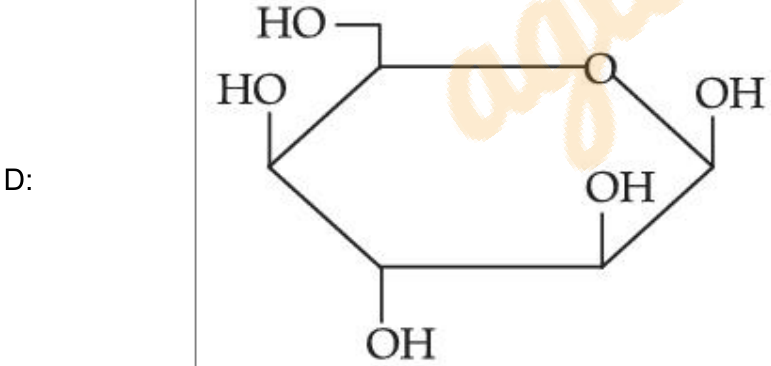
For the below given cyclic hemiacetal (X), the correct pyranose structure is :\n\nHO–C–H\nHO–C–H\nH–C–OH\nHO–C–H\nH–C–CH₂OH, with an O bridge joining the top carbon to the bottom carbon (cyclic sugar (X))
- Aa six-membered O-containing ring with HOCH₂ at the top-left, O at the top-right, OH at the right vertex, OH below-left, OH above-centre and OH at the bottom vertex (the ring OH groups at the positions as drawn)
- Ba six-membered O-containing ring with HOCH₂ at the top-left, O at the top-right, OH at the right vertex, OH at the right-middle vertex, HO at the left vertex and OH at the bottom vertex (the ring OH groups at the positions as drawn)
- Ca six-membered O-containing ring with HOCH₂ at the top-left, O at the top-right, OH at the right vertex, OH below the ring, HO at the left vertex and OH at the centre-left vertex (the ring OH groups at the positions as drawn)
- Da six-membered O-containing ring with HOCH₂ and HO at the top-left, O at the top-right, OH at the right vertex, OH at the right-middle vertex and OH at the left and bottom vertices (the ring OH groups at the positions as drawn)
View answer or solution
Answer
a six-membered O-containing ring with HOCH₂ and HO at the top-left, O at the top-right, OH at the right vertex, OH at the right-middle vertex and OH at the left and bottom vertices (the ring OH groups at the positions as drawn)
Statements about Enzyme Inhibitor Drugs are given below :\n\n(A) There are Competitive and Non-competitive inhibitor drugs.\n\n(B) These can bind at the active sites and allosteric sites.\n\n(C) Competitive Drugs are allosteric site blocking drugs.\n\n(D) Non-competitive Drugs are active site blocking drugs.\n\nChoose the correct answer from the options given below :
- A(A), (D) only
- B(A), (C) only
- C(A), (B) only
- D(A), (B), (C) only
View answer or solution
Answer
(A), (B) only
Principles Related to Practical Chemistry
For kinetic study of the reaction of iodide ion with H₂O₂ at room temperature :\n\n(A) Always use freshly prepared starch solution.\n\n(B) Always keep the concentration of sodium thiosulphate solution less than that of KI solution.\n\n(C) Record the time immediately after the appearance of blue colour.\n\n(D) Record the time immediately before the appearance of blue colour.\n\n(E) Always keep the concentration of sodium thiosulphate solution more than that of KI solution.\n\nChoose the correct answer from the options given below :
- A(A), (B), (C) only
- B(A), (D), (E) only
- C(D), (E) only
- D(A), (B), (E) only
View answer or solution
Answer
(A), (B), (C) only
Some Basic Concepts in Chemistry
In the given reaction,\n\nX + Y + 3Z ⇌ XYZ₃\n\nif one mole of each of X and Y with 0.05 mol of Z gives compound XYZ₃. (Given : Atomic masses of X, Y and Z are 10, 20 and 30 amu, respectively.) The yield of XYZ₃ is __________ g. (Nearest integer)
View answer or solution
Answer
2
Some Basic Concepts in Chemistry
An element M crystallises in a body centred cubic unit cell with a cell edge of 300 pm. The density of the element is 6.0 g cm⁻³. The number of atoms present in 180 g of the element is __________ × 10²³. (Nearest integer)
View answer or solution
Answer
22
Chemical Bonding and Molecular Structure
The number of paramagnetic species among the following is __________.\n\nB₂, Li₂, C₂, C₂⁻, O₂²⁻, O₂⁺ and He₂⁺
View answer or solution
Answer
4
150 g of acetic acid was contaminated with 10.2 g ascorbic acid (C₆H₈O₆) to lower down its freezing point by (x × 10⁻¹)°C. The value of x is __________. (Nearest integer)\n\n[Given K_f = 3.9 K kg mol⁻¹; molar mass of ascorbic acid = 176 g mol⁻¹]
View answer or solution
Answer
15
Kₐ for butyric acid (C₃H₇COOH) is 2 × 10⁻⁵. The pH of 0.2 M solution of butyric acid is __________ × 10⁻¹. (Nearest integer)\n\n[Given log 2 = 0.30]
View answer or solution
Answer
27
For the given first order reaction\n\nA → B\n\nthe half life of the reaction is 0.3010 min. The ratio of the initial concentration of reactant to the concentration of reactant at time 2.0 min will be equal to __________. (Nearest integer)
View answer or solution
Answer
100
The number of interhalogens from the following having square pyramidal structure is :\n\nClF₃, IF₇, BrF₅, BrF₃, I₂Cl₆, IF₅, ClF, ClF₅
View answer or solution
Answer
3
Redox Reactions and Electrochemistry
The disproportionation of MnO₄²⁻ in acidic medium resulted in the formation of two manganese compounds A and B. If the oxidation state of Mn in B is smaller than that of A, then the spin-only magnetic moment (μ) value of B in BM is __________. (Nearest integer)
View answer or solution
Answer
4
Total number of relatively more stable isomer(s) possible for octahedral complex [Cu(en)₂(SCN)₂] will be __________.
View answer or solution
Answer
3
Some Basic Concepts in Chemistry
On complete combustion of 0.492 g of an organic compound containing C, H and O, 0.7938 g of CO₂ and 0.4428 g of H₂O was produced. The % composition of oxygen in the compound is __________.
View answer or solution
Answer
46