
// THE QUESTION BANK
A little focus.
A better attempt.
Find your topic. Work through a few questions. Open the official answer when one is available.
Loading your next set of questions…
// THE QUESTION BANK
Find your topic. Work through a few questions. Open the official answer when one is available.
YOUR SELECTION
Showing 1–12 · 14 papers
Question 44
From JEE (Main) 2025 Session 1, 22 January 2025, Shift 2 — Paper 1 (B.E / B.Tech) Physics — 1 question withheld: source figures unavailable
A light source of wavelength λ illuminates a metal surface and electrons are ejected with maximum kinetic energy of 2 eV. If the same surface is illuminated by a light source of wavelength λ/2, then the maximum kinetic energy of ejected electrons will be (The work function of metal is 1 eV)
Choose an option first, then open the answer.
Question from the source paper. Answer from the official final answer key (the key rows carrying this paper's Question IDs), version of 2025-02-12. Published documents are listed by the exam body at its document index.
Question 42
From JEE (Main) 2025 Session 1, 23 January 2025, Shift 1 — Paper 1 (B.E / B.Tech) Physics — 1 question withheld: source figures unavailable
A sub-atomic particle of mass 10⁻³⁰ kg is moving with a velocity 2.21 × 10⁶ m/s. Under the matter wave consideration, the particle will behave closely like ______. (h = 6.63 × 10⁻³⁴ J.s)
Choose an option first, then open the answer.
Question from the source paper. Answer from the official final answer key (the key rows carrying this paper's Question IDs), version of 2025-02-12. Published documents are listed by the exam body at its document index.
Question 27
From JEE (Main) 2025 Session 1, 23 January 2025, Shift 2 — Paper 1 (B.E / B.Tech) Physics
In photoelectric effect an em-wave is incident on a metal surface and electrons are ejected from the surface. If the work function of the metal is 2.14 eV and stopping potential is 2V, what is the wavelength of the em-wave ? (Given hc = 1242 eVnm where h is the Planck's constant and c is the speed of light in vacuum.)
Choose an option first, then open the answer.
Question from the source paper. Answer from the official final answer key (the key rows carrying this paper's Question IDs), version of 2025-02-12. Published documents are listed by the exam body at its document index.
Question 36
From JEE (Main) 2025 Session 1, 24 January 2025, Shift 1 — Paper 1 (B.E / B.Tech) Physics
An electron of mass ‘m’ with an initial velocity v⃗ = v₀ î (v₀ > 0) enters an electric field E⃗ = −E₀ k̂. If the initial de Broglie wavelength is λ₀, the value after time t would be
Choose an option first, then open the answer.
Question from the source paper. Answer from the official final answer key (the key rows carrying this paper's Question IDs), version of 2025-02-12. Published documents are listed by the exam body at its document index.
Question 39
From JEE (Main) 2025 Session 1, 24 January 2025, Shift 2 — Paper 1 (B.E / B.Tech) Physics
In photoelectric effect, the stopping potential (V₀) v/s frequency (ν) curve is plotted. (h is the Planck's constant and φ₀ is work function of metal ) (A) V₀ v/s ν is linear. (B) The slope of V₀ v/s ν curve = φ₀/h (C) h constant is related to the slope of V₀ v/s ν line. (D) The value of electric charge of electron is not required to determine h using the V₀ v/s ν curve. (E) The work function can be estimated without knowing the value of h. Choose the correct answer from the options given below :
Choose an option first, then open the answer.
Question from the source paper. Answer from the official final answer key (the key rows carrying this paper's Question IDs), version of 2025-02-12. Published documents are listed by the exam body at its document index.
Question 48
From JEE (Main) 2025 Session 1, 24 January 2025, Shift 2 — Paper 1 (B.E / B.Tech) Physics
The ratio of the power of a light source S₁ to that the light source S₂ is 2. S₁ is emitting 2 × 10¹⁵ photons per second at 600 nm. If the wavelength of the source S₂ is 300 nm, then the number of photons per second emitted by S₂ is _______ × 10¹⁴.
This question was printed without answer options.
Open the answer when you are ready.
Question from the source paper. Answer from the official final answer key (the key rows carrying this paper's Question IDs), version of 2025-02-12. Published documents are listed by the exam body at its document index.
Question 41
From JEE (Main) 2025 Session 1, 28 January 2025, Shift 1 — Paper 1 (B.E / B.Tech) Physics
A proton of mass ‘m_p’ has same energy as that of a photon of wavelength ‘λ’. If the proton is moving at non-relativistic speed, then ratio of its de Broglie wavelength to the wavelength of photon is.
Choose an option first, then open the answer.
Question from the source paper. Answer from the official final answer key (the key rows carrying this paper's Question IDs), version of 2025-02-12. Published documents are listed by the exam body at its document index.
Question 33
From JEE (Main) 2025 Session 1, 29 January 2025, Shift 1 — Paper 1 (B.E / B.Tech) Physics — 1 question withheld: source figures unavailable
If λ and K are de Broglie wavelength and kinetic energy, respectively, of a particle with constant mass. The correct graphical representation for the particle will be
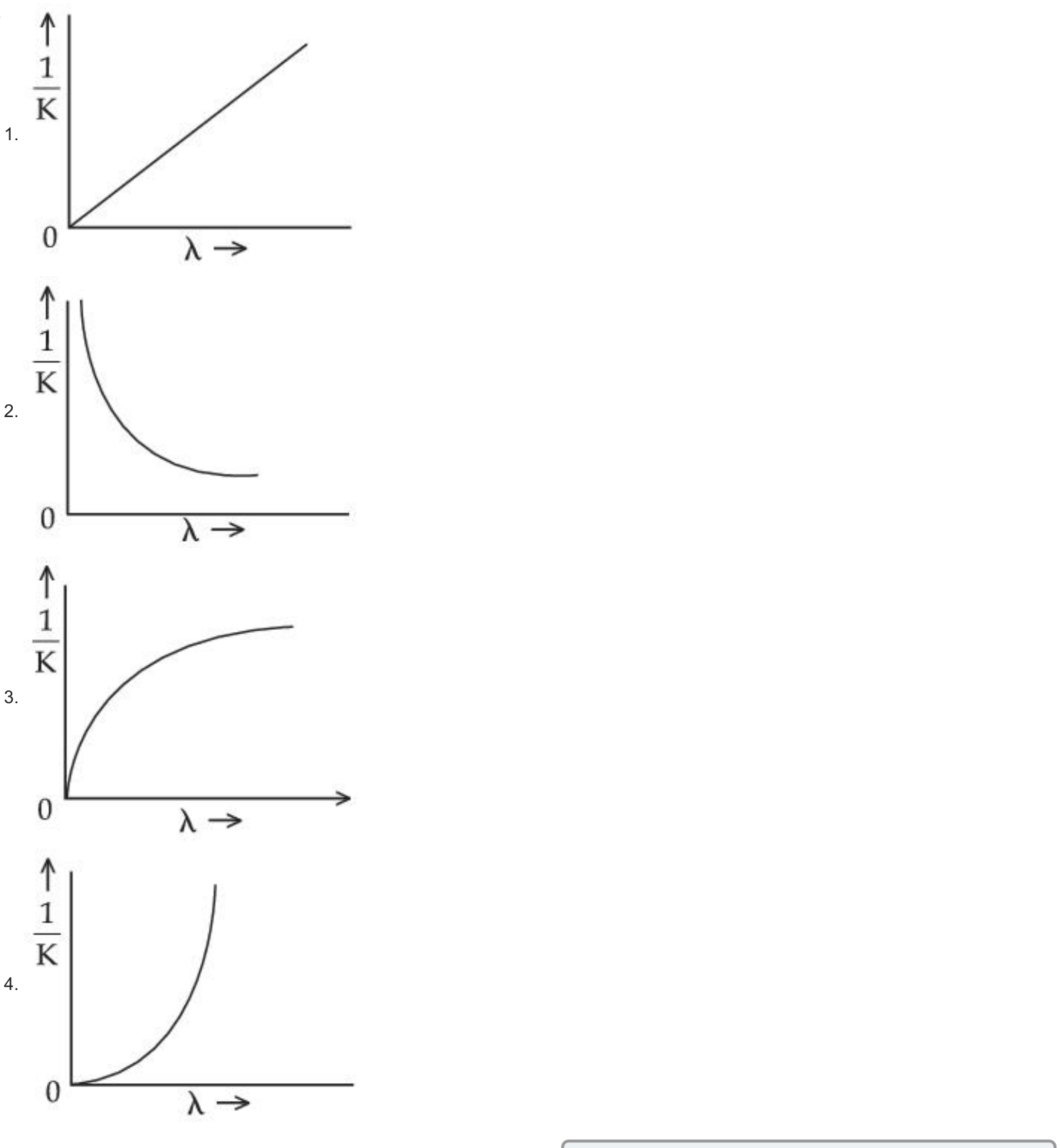
Choose an option first, then open the answer.
Question from the source paper. Answer from the official final answer key (the key rows carrying this paper's Question IDs), version of 2025-02-12. Published documents are listed by the exam body at its document index.
Question 42
From JEE (Main) 2025 Session 1, 29 January 2025, Shift 1 — Paper 1 (B.E / B.Tech) Physics — 1 question withheld: source figures unavailable
Given below are two statements : one is labelled as Assertion (A) and the other is labelled as Reason (R). Assertion (A) : Emission of electrons in photoelectric effect can be suppressed by applying a sufficiently negative electron potential to the photoemissive substance. Reason (R) : A negative electric potential, which stops the emission of electrons from the surface of a photoemissive substance, varies linearly with frequency of incident radiation. In the light of the above statements, choose the most appropriate answer from the options given below :
Choose an option first, then open the answer.
Question from the source paper. Answer from the official final answer key (the key rows carrying this paper's Question IDs), version of 2025-02-12. Published documents are listed by the exam body at its document index.
Question 33
From JEE (Main) 2025 Session 1, 29 January 2025, Shift 2 — Paper 1 (B.E / B.Tech) Physics — 1 question withheld: source figures unavailable
In an experiment with photoelectric effect, the stopping potential,
Choose an option first, then open the answer.
Question from the source paper. Answer from the official final answer key (the key rows carrying this paper's Question IDs), version of 2025-02-12. Published documents are listed by the exam body at its document index.
Question 35
From JEE (Main) 2025 Session 2, 2 April 2025, Shift 1 — Paper 1 (B.E / B.Tech) Physics
A monochromatic light is incident on a metallic plate having work function φ. An electron, emitted normally to the plate from a point A with maximum kinetic energy, enters a constant magnetic field, perpendicular to the initial velocity of electron. The electron passes through a curve and hits back the plate at a point B. The distance between A and B is : (Given : The magnitude of charge of an electron is e and mass is m, h is Planck’s constant and c is velocity of light. Take the magnetic field exists throughout the path of electron)
Choose an option first, then open the answer.
Question from the source paper. Answer from the official final answer key (the key rows carrying this paper's Question IDs), version of 2025-04-18. Published documents are listed by the exam body at its document index.
Question 30
From JEE (Main) 2025 Session 2, 2 April 2025, Shift 2 — Paper 1 (B.E / B.Tech) Physics
An electron with mass 'm' with an initial velocity (t = 0) v⃗ = v₀ î (v₀ > 0) enters a magnetic field B⃗ = B₀ ĵ . If the initial de-Broglie wavelength at t = 0 is λ₀ then its value after time 't' would be :
Choose an option first, then open the answer.
Question from the source paper. Answer from the official final answer key (the key rows carrying this paper's Question IDs), version of 2025-04-18. Published documents are listed by the exam body at its document index.
Questions the exam body withdrew, and questions that need unavailable source figures, are stored with their papers and withheld here. Each served question links to its source paper.
This is self-study practice. It does not issue assessment results, certificates or profile proof. Attempts on this page reset when you leave it.