
// JEE (Main) / 2025
JEE (Main) 2025 Session 2, 4 April 2025, Shift 1 — Paper 1 (B.E / B.Tech) Chemistry
Chemistry · B.E / B.Tech
Work through the questions
25 questions
Take a moment to try each question before opening the available answer or solution.
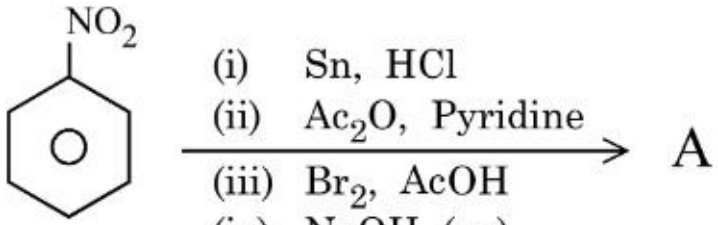
The major product (A) formed in the following reaction sequence is nitrobenzene ⟶[ (i) Sn, HCl, (ii) Ac₂O, Pyridine, (iii) Br₂, AcOH, (iv) NaOH (aq) ] A
- A2-bromo-4-bromoaniline (an –NH₂ group with Br at the ortho and para positions)
- B3-bromoaniline (an –NH₂ group with Br at the meta position)
- C4-bromoaniline (an –NH₂ group with Br at the para position)
- D2,4,6-tribromoaniline (an –NH₂ group with Br at both ortho positions and the para position)
View answer or solution
Answer
4-bromoaniline (an –NH₂ group with Br at the para position)
Which one of the following about an electron occupying the 1s orbital in a hydrogen atom is incorrect? (Bohr's radius is represented by a₀)
- AThe electron can be found at a distance 2a₀ from the nucleus
- BThe probability density of finding the electron is maximum at the nucleus
- CThe total energy of the electron is maximum when it is at a distance a₀ from the nucleus
- DThe 1s orbital is spherically symmetrical
View answer or solution
Answer
The total energy of the electron is maximum when it is at a distance a₀ from the nucleus
Purification and Characterisation of Organic Compounds
Identify the pair of reactants that upon reaction, with elimination of HCl will give rise to the dipeptide Gly-Ala .
- ANH₂–CH₂–COOH and NH₂–CH(CH₃)–COCl
- BNH₂–CH₂–COCl and ⁺NH₃–CH(CH₃)–COCl
- CNH₂–CH₂–COOH and NH₂–CH(CH₃)–COOH
- DNH₂–CH₂–COCl and NH₂–CH(CH₃)–COOH
View answer or solution
Answer
NH₂–CH₂–COCl and NH₂–CH(CH₃)–COOH
Purification and Characterisation of Organic Compounds
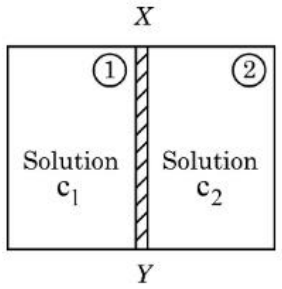
XY is the membrane/partition between two chambers 1 and 2 containing sugar solutions of concentration c₁ and c₂ (c₁ > c₂) mol L⁻¹. For the reverse osmosis to take place identify the correct condition. (Here p₁ and p₂ are pressures applied on chamber 1 and 2.) A. Membrane/Partition : Cellophane, p₁ > π B. Membrane/Partition : Porous, p₂ > π C. Membrane/Partition : Parchment paper, p₁ > π D. Membrane/Partition : Cellophane, p₂ > π Choose the correct answer from the option given below:
- AC Only
- BA and C Only
- CB and D Only
- DA and D Only
View answer or solution
Answer
A and C Only
Classification of Elements and Periodicity in Properties
Given below are the pairs of group 13 elements showing their relation in terms of atomic radius. (B < Al), (Al < Ga), (Ga < In) and (In < Tl) Identify the elements present in the incorrect pair and in that pair find out the element (X) that has higher ionic radius (M³⁺) than the other one. The atomic number of the element (X) is
- A81
- B49
- C13
- D31
View answer or solution
Answer
31
Benzene is treated with oleum to produce compound (X) which when further heated with molten sodium hydroxide followed by acidification produces compound (Y). The compound Y is treated with zinc metal to produce compound (Z). Identify the structure of compound (Z) from the following option.
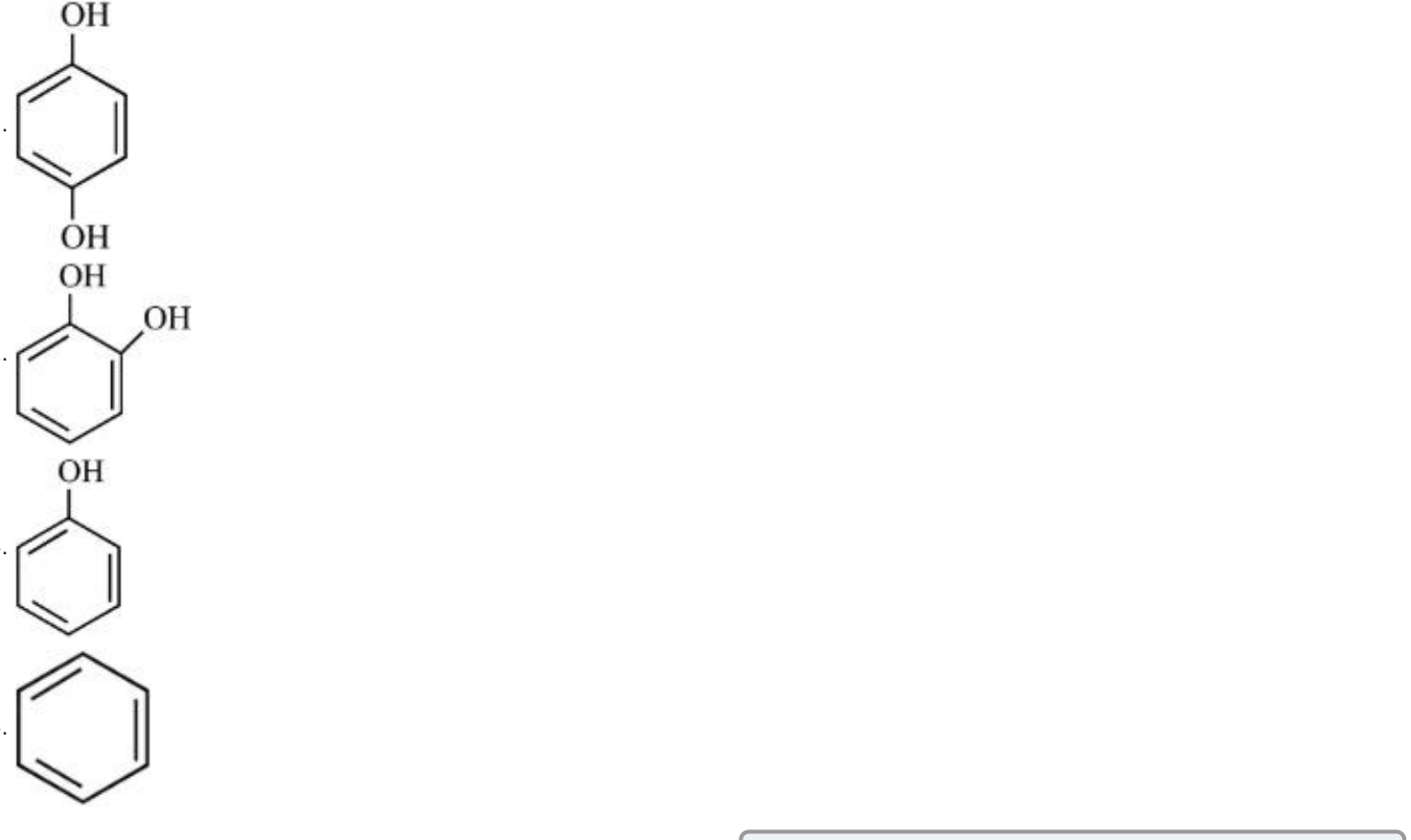
- ABenzene-1,4-diol (hydroquinone)
- BBenzene-1,2-diol (catechol)
- CPhenol
- DBenzene
View answer or solution
Answer
Benzene
Chemical Bonding and Molecular Structure
Given below are two statements. Statement I: The dipole moment of CH₃–CH=CH–CH=O (the carbons numbered 4, 3, 2, 1) is greater than CH₃–CH₂–CH₂–CH=O (the carbons numbered 4, 3, 2, 1). Statement II: C₁–C₂ bond length of CH₃–CH=CH–CH=O (the carbons numbered 4, 3, 2, 1) is greater than C₁–C₂ bond length of CH₃–CH₂–CH₂–CH=O (the carbons numbered 4, 3, 2, 1). In the light of the above statements, choose the correct answer from the options given below:
- ABoth Statement I and Statement II are true
- BStatement I is false but Statement II is true
- CBoth Statement I and Statement II are false
- DStatement I is true but Statement II is false
View answer or solution
Answer
Statement I is true but Statement II is false
Chemical Bonding and Molecular Structure
Pair of transition metal ions having the same number of unpaired electrons is
- ATi²⁺, Co²⁺
- BTi³⁺, Mn²⁺
- CV²⁺, Co²⁺
- DFe³⁺, Cr²⁺
View answer or solution
Answer
V²⁺, Co²⁺
Redox Reactions and Electrochemistry
Given below are two statements: Statement I: Nitrogen forms oxides with +1 to +5 oxidation states due to the formation of pπ - pπ bond with oxygen. Statement II: Nitrogen does not form halides with +5 oxidation state due to the absence of d-orbital in it. In the light of given statements, choose the correct answer from the options given below.
- ABoth Statement I and Statement II are False
- BStatement I is true but Statement II is false
- CStatement I is false but Statement II is true
- DBoth Statement I and Statement II are true
View answer or solution
Answer
Both Statement I and Statement II are true
Number of stereoisomers possible for the complexes, [CrCl₃(py)₃] and [CrCl₂(ox)₂]³⁻ are respectively (py = pyridine, ox = oxalate)
- A2 & 2
- B1 & 2
- C2 & 3
- D3 & 3
View answer or solution
Answer
2 & 3
Chemical Bonding and Molecular Structure
Which of the following molecule(s) show/s paramagnetic behavior? A. O₂ B. N₂ C. F₂ D. S₂ E. Cl₂ Choose the correct answer from the options given below:
- AA & E Only
- BA & C only
- CB Only
- DA & D Only
View answer or solution
Answer
A & D Only
One mole of an ideal gas expands isothermally and reversibly from 10 dm³ to 20 dm³ at 300 K. ΔU, q and work done in the process respectively are Given: R = 8.3 J K⁻¹ mol⁻¹ ln 10 = 2.3 log 2 = 0.30 log 3 = 0.48
- A0, 1.718 kJ, −1.718 kJ
- B0, −17.18 kJ, 1.718 J
- C0, 21.84 kJ, 21.84 kJ
- D0, 21.84 kJ, −1.726 J
View answer or solution
Answer
0, 1.718 kJ, −1.718 kJ
Let us consider a reversible reaction at temperature, T. In this reaction, both ΔH and ΔS were observed to have positive values. If the equilibrium temperature is Te, then the reaction becomes spontaneous at:
- AT = Te
- BTe = 5T
- CTe > T
- DT > Te
View answer or solution
Answer
T > Te
For A₂ + B₂ ⇌ 2AB Eₐ for forward and backward reaction are 180 and 200 kJ mol⁻¹ respectively If catalyst lowers Eₐ for both reaction by 100 kJ mol⁻¹. Which of the following statement is correct?
- AThe enthalpy change for the catalysed reaction is different from that of uncatalysed reaction.
- BThe enthalpy change for the reaction is +20 kJ mol⁻¹.
- CCatalyst does not alter the Gibbs energy change of a reaction.
- DCatalyst can cause non-spontaneous reactions to occur.
View answer or solution
Answer
Catalyst does not alter the Gibbs energy change of a reaction.
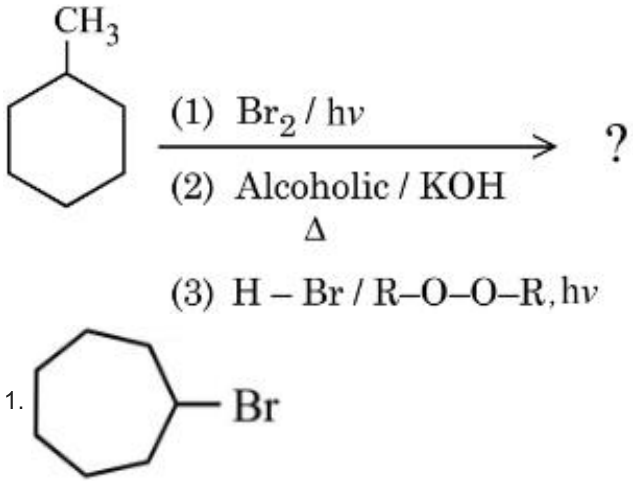
Predict the major product of the following reaction sequence:- methylcyclohexane ⟶[ (1) Br₂ / hν, (2) Alcoholic / KOH, Δ, (3) H – Br / R–O–O–R, hν ] ?
- ACyclooctane ring bearing a –Br group
- BA cyclohexane ring with a –CH₃ group and an adjacent –Br group
- CA cyclohexane ring bearing a –CH₂CH₂Br side chain
- DA cyclohexane ring with a –CH₃ group and a –Br group on the same carbon
View answer or solution
Answer
A cyclohexane ring with a –CH₃ group and an adjacent –Br group
Redox Reactions and Electrochemistry
On charging the lead storage battery, the oxidation state of lead changes from x₁ to y₁ at the anode and from x₂ to y₂ at the cathode. The values of x₁, y₁, x₂, y₂ are respectively :
- A0, +2, +4, +2
- B+4, +2, 0, +2
- C+2, 0, +2, +4
- D+2, 0, 0, +4
View answer or solution
Answer
+2, 0, +2, +4
Organic Compounds Containing Halogens
An organic compound (X) with molecular formula C₃H₆O is not readily oxidised. On reduction it gives C₃H₈O (Y) which reacts with HBr to give a bromide (Z) which is converted to Grignard reagent. This Grignard reagent on reaction with (X) followed by hydrolysis give 2, 3-dimethylbutan-2-ol. Compounds (X), (Y) and (Z) respectively are:
- ACH₃COCH₃, CH₃CH(OH)CH₃, CH₃CH(Br)CH₃
- BCH₃CH₂CHO, CH₃CH₂CH₂OH, CH₃CH₂CH₂Br
- CCH₃CH₂CHO, CH₃CH = CH₂, CH₃CH(Br)CH₃
- DCH₃COCH₃, CH₃CH₂CH₂OH, CH₃CH(Br)CH₃
View answer or solution
Answer
CH₃COCH₃, CH₃CH(OH)CH₃, CH₃CH(Br)CH₃
Organic Compounds Containing Oxygen
Aldol condensation is a popular and classical method to prepare α, β-unsaturated carbonyl compounds. This reaction can be both intermolecular and intramolecular. Predict which one of the following is not a product of intramolecular aldol condensation?
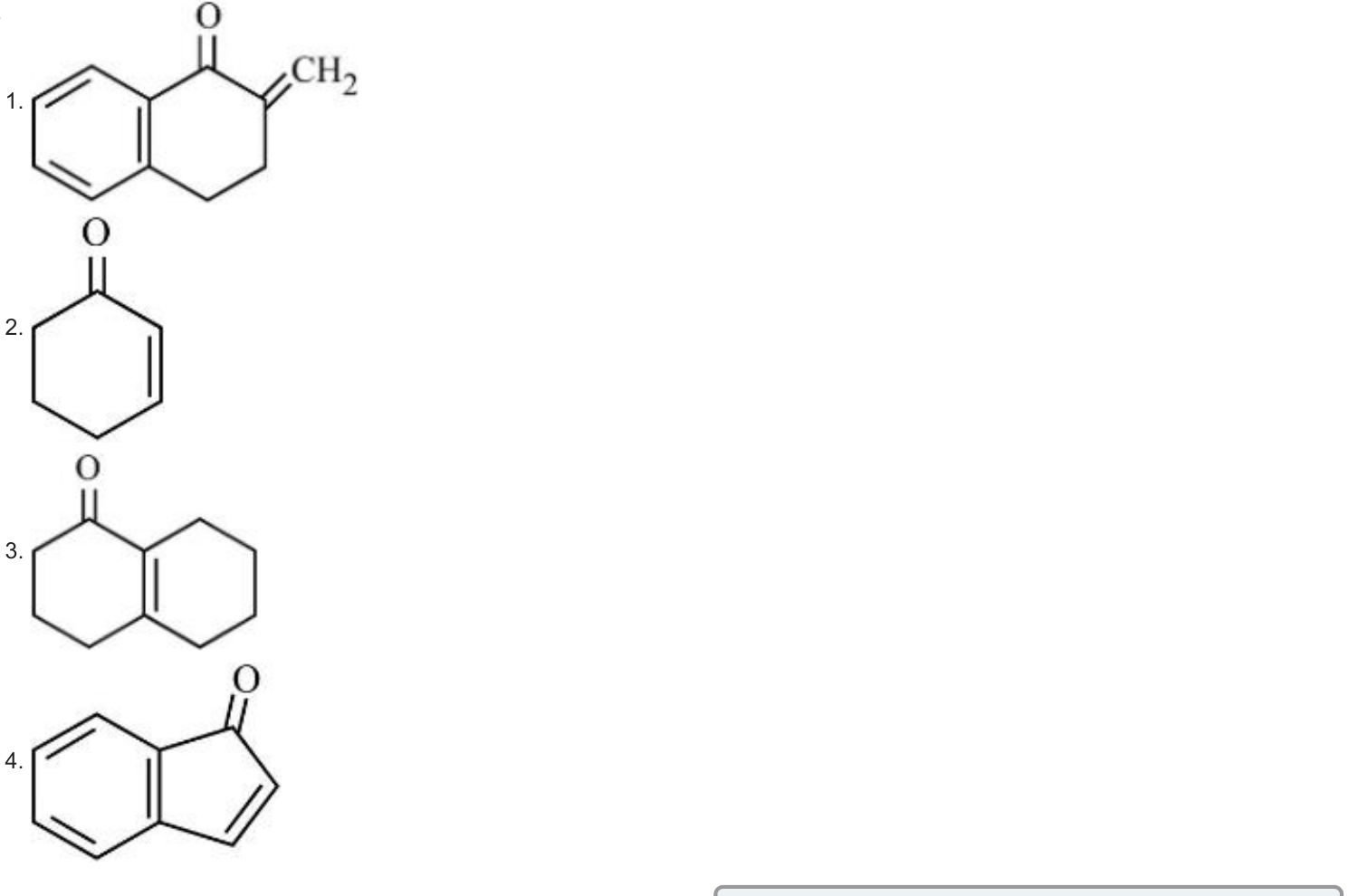
- AA benzocyclohexenone bearing an exocyclic =CH₂ group
- B2-cyclohexenone (a cyclohexenone ring)
- CA bicyclic ring bearing a ketone on the cyclohexane ring
- DA benzocyclopentenone (a benzene ring fused to a cyclopentenone ring)
View answer or solution
Answer
A benzocyclohexenone bearing an exocyclic =CH₂ group
Which one of the following complexes will have Δₒ = 0 and μ = 5.96 B.M?
- A[FeF₆]⁴⁻
- B[Fe(CN)₆]⁴⁻
- C[Mn(SCN)₆]⁴⁻
- D[Co(NH₃)₆]³⁺
View answer or solution
Answer
[Mn(SCN)₆]⁴⁻
Rate law for a reaction between A and B is given by r = k [A]ⁿ [B]ᵐ If concentration of A is doubled and concentration of B is halved from their initial value, the ratio of new rate of reaction to the initial rate of reaction (r₂/r₁) is
- A1/2^(m+n)
- B(n − m)
- C2^(n − m)
- D(m + n)
View answer or solution
Answer
2^(n − m)
Chemical Bonding and Molecular Structure
The total number of hydrogen bonds of a DNA-double Helix strand whose one strand has the following sequence of bases is ______ 5'- G - G-C-A-A-A-A-T-C-G-G-C-T-A-3'
View answer or solution
Answer
33
The pH of a 0.01 M weak acid HX (Kₐ = 4 × 10⁻¹⁰) is found to be 5. Now the acid solution is diluted with excess of water so that the pH of the solution changes to 6. The new concentration of the diluted weak acid is given as x × 10⁻⁴ M. The value of x is ________ (nearest integer)
View answer or solution
Answer
25
Some Basic Concepts in Chemistry
Fortification of food with iron is done using FeSO₄. 7H₂O. The mass in grams of the FeSO₄. 7H₂O required to achieve 12 ppm of iron in 150 kg of wheat is ________ (Nearest integer) [Given: Molar mass of Fe, S and O respectively are 56, 32 and 16 g mol⁻¹]
View answer or solution
Answer
9
Some Basic Concepts in Chemistry
In Dumas' method for estimation of nitrogen 1 g of an organic compound gave 150 mL of nitrogen collected at 300 K temperature and 900 mm Hg pressure. The percentage composition of nitrogen in the compound is __________ % (nearest integer) (Aqueous tension at 300 K = 15 mm Hg)
View answer or solution
Answer
20
Redox Reactions and Electrochemistry
KMnO₄ acts as an oxidising agent in acidic medium. ‘X’ is the difference between the oxidation states of Mn in reactant and product. ‘Y’ is the number of ‘d’ electrons present in the brown red precipitate formed at the end of the acetate ion test with neutral ferric chloride. The value of X + Y is ________
View answer or solution
Answer
10