
// QUESTION TOPIC
Properties of Solids and Liquids questions.
195 published questions across 90 papers, asked from 2022 to 2026. Each question links to the paper it was printed in, with the official answer wherever the exam body publishes one.
Showing 1–12 of 195 · sorted newest year first
Question 26
From JEE (Main) 2026 Session 1, 21 January 2026, Shift 1 — Paper 1 (B.E / B.Tech) Physics
An aluminium and steel rods having same lengths and cross-sections are joined to make total length of 120 cm at 30 °C. The coefficient of linear expansion of aluminium and steel are 24 × 10⁻⁶/°C and 1.2 × 10⁻⁵/°C, respectively. The length of this composite rod when its temperature is raised to 100 °C, is ______ cm.
Choose an option first, then open the answer.
Question from the source paper. Answer from the official final answer key (the key rows carrying this paper's Question IDs), version of 2026-02-16. Published documents are listed by the exam body at its document index.
Question 27
From JEE (Main) 2026 Session 1, 21 January 2026, Shift 1 — Paper 1 (B.E / B.Tech) Physics
A gas based geyser heats water flowing at the rate of 5.0 litres per minute from 27 °C to 87 °C. The rate of consumption of the gas is ______ g/s. (Take heat of combustion of gas = 5.0 × 10⁴ J/g) specific heat capacity of water = 4200 J/kg.°C
Choose an option first, then open the answer.
Question from the source paper. Answer from the official final answer key (the key rows carrying this paper's Question IDs), version of 2026-02-16. Published documents are listed by the exam body at its document index.
Question 30
From JEE (Main) 2026 Session 1, 21 January 2026, Shift 1 — Paper 1 (B.E / B.Tech) Physics
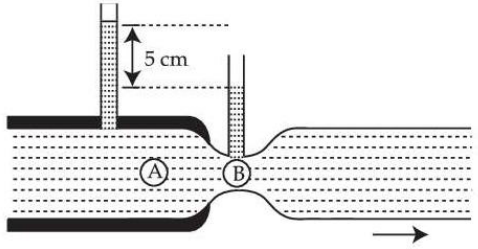
Water flows through a horizontal tube as shown in the figure. The difference in height between the water columns in vertical tubes is 5 cm and the area of cross-sections at A and B are 6 cm² and 3 cm² respectively. The rate of flow will be ______ cm³/s. (take g = 10 m/s²)
Choose an option first, then open the answer.
Question from the source paper. Answer from the official final answer key (the key rows carrying this paper's Question IDs), version of 2026-02-16. Published documents are listed by the exam body at its document index.
Question 31
From JEE (Main) 2026 Session 1, 21 January 2026, Shift 2 — Paper 1 (B.E / B.Tech) Physics
Surface tension of two liquids (having same densities), T₁ and T₂, are measured using capillary rise method utilizing two tubes with inner radii of r₁ and r₂ where r₁ > r₂. The measured liquid heights in these tubes are h₁ and h₂ respectively. [Ignore the weight of the liquid about the lowest point of miniscus]. The heights h₁ and h₂ and surfaces tensions T₁ and T₂ satisfy the relation :
Choose an option first, then open the answer.
Question from the source paper. Answer from the official final answer key (the key rows carrying this paper's Question IDs), version of 2026-02-16. Published documents are listed by the exam body at its document index.
Question 32
From JEE (Main) 2026 Session 1, 21 January 2026, Shift 2 — Paper 1 (B.E / B.Tech) Physics
A spherical body of radius r and density σ falls freely through a viscous liquid having density ρ and viscosity η and attains a terminal velocity v₀. Estimated maximum error in the quantity η is : (Ignore errors associated with σ, ρ and g, gravitational acceleration)
Choose an option first, then open the answer.
Question from the source paper. Answer from the official final answer key (the key rows carrying this paper's Question IDs), version of 2026-02-16. Published documents are listed by the exam body at its document index.
Question 47
From JEE (Main) 2026 Session 1, 21 January 2026, Shift 2 — Paper 1 (B.E / B.Tech) Physics
The terminal velocity of a metallic ball of radius 6 mm in a viscous fluid is 20 cm/s. The terminal velocity of another ball of same material and having radius 3 mm in the same fluid will be ______ cm/s.
This question was printed without answer options.
Open the answer when you are ready.
Question from the source paper. Answer from the official final answer key (the key rows carrying this paper's Question IDs), version of 2026-02-16. Published documents are listed by the exam body at its document index.
Question 30
From JEE (Main) 2026 Session 1, 22 January 2026, Shift 2 — Paper 1 (B.E / B.Tech) Physics — 2 questions withheld: source figures unavailable
When a part of a straight capillary tube is placed vertically in a liquid, the liquid raises upto certain height h. If the inner radius of the capillary tube, density of the liquid and surface tension of the liquid decrease by 1% each, then the height of the liquid in the tube will change by ______ %.
Choose an option first, then open the answer.
Question from the source paper. Answer from the official final answer key (the key rows carrying this paper's Question IDs), version of 2026-02-16. Published documents are listed by the exam body at its document index.
Question 34
From JEE (Main) 2026 Session 1, 23 January 2026, Shift 1 — Paper 1 (B.E / B.Tech) Physics — 1 question withheld: source figures unavailable
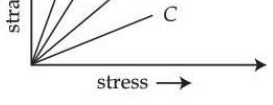
The strain-stress plot for materials A, B, C and D is shown in the figure. Which material has the largest Young's modulus ?
Choose an option first, then open the answer.
Question from the source paper. Answer from the official final answer key (the key rows carrying this paper's Question IDs), version of 2026-02-16. Published documents are listed by the exam body at its document index.
Question 27
From JEE (Main) 2026 Session 1, 23 January 2026, Shift 2 — Paper 1 (B.E / B.Tech) Physics — 3 questions withheld: source figures unavailable
An air bubble of volume 2.9 cm³ rises from the bottom of a swimming pool of 5 m deep. At the bottom of the pool water temperature is 17 °C. The volume of the bubble when it reaches the surface, where the water temperature is 27 °C, is ______ cm³. (g = 10 m/s², density of water = 10³ kg/m³, and 1 atm pressure is 10⁵ Pa)
Choose an option first, then open the answer.
Question from the source paper. Answer from the official final answer key (the key rows carrying this paper's Question IDs), version of 2026-02-16. Published documents are listed by the exam body at its document index.
Question 42
From JEE (Main) 2026 Session 1, 23 January 2026, Shift 2 — Paper 1 (B.E / B.Tech) Physics — 3 questions withheld: source figures unavailable
A small metallic sphere of diameter 2 mm and density 10.5 g/cm³ is dropped in glycerine having viscosity 10 Poise and density 1.5 g/cm³ respectively. The terminal velocity attained by the sphere is _____ cm/s. (π = 22/7 and g = 10 m/s²)
Choose an option first, then open the answer.
Question from the source paper. Answer from the official final answer key (the key rows carrying this paper's Question IDs), version of 2026-02-16. Published documents are listed by the exam body at its document index.
Question 48
From JEE (Main) 2026 Session 1, 23 January 2026, Shift 2 — Paper 1 (B.E / B.Tech) Physics — 3 questions withheld: source figures unavailable
A ball of radius r and density ρ dropped through a viscous liquid of density σ and viscosity η attains its terminal velocity at time t, given by t = A ρ^a r^b η^c σ^d, where A is a constant and a, b, c and d are integers. The value of (b+c)/(a+d) is ______.
This question was printed without answer options.
Open the answer when you are ready.
Question from the source paper. Answer from the official final answer key (the key rows carrying this paper's Question IDs), version of 2026-02-16. Published documents are listed by the exam body at its document index.
Question 30
From JEE (Main) 2026 Session 1, 24 January 2026, Shift 1 — Paper 1 (B.E / B.Tech) Physics
A brass wire of length 2 m and radius 1 mm at 27 °C is held taut between two rigid supports. Initially it was cooled to a temperature of −43 °C creating a tension T in the wire. The temperature to which the wire has to be cooled in order to increase the tension in it to 1.4T, is ______ °C.
Choose an option first, then open the answer.
Question from the source paper. Answer from the official final answer key (the key rows carrying this paper's Question IDs), version of 2026-02-16. Published documents are listed by the exam body at its document index.
How questions are grouped
This page groups Anna University questions by subject. Open a subject code’s syllabus to practise by unit where reviewed questions are available. Other exams may group questions by chapter.
Questions the exam body withdrew, and questions that need unavailable source figures, are withheld rather than served. Each served question links to its source.