
// JEE (Main) / 2023
JEE (Main) 2023 Session 2, 6 April 2023, Shift 2 — Paper 1 (B.E / B.Tech) Chemistry
Chemistry · B.E / B.Tech
Work through the questions
30 questions
Take a moment to try each question before opening the available answer or solution.
Organic Compounds Containing Oxygen
Element not present in Nessler’s reagent is
- AN
- BK
- CI
- DHg
View answer or solution
Answer
N
Purification and Characterisation of Organic Compounds
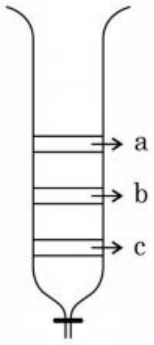
From the figure of column chromatography given below, identify incorrect statements. A. Compound ‘c’ is more polar than ‘a’ and ‘b’ B. Compound ‘a’ is least polar C. Compound ‘b’ comes out of the column before ‘c’ and after ‘a’ D. Compound ‘a’ spends more time in the column Choose the correct answer from the options given below:
- AA, B and D only
- BA, B and C only
- CB, C and D only
- DB and D only
View answer or solution
Answer
A, B and C only
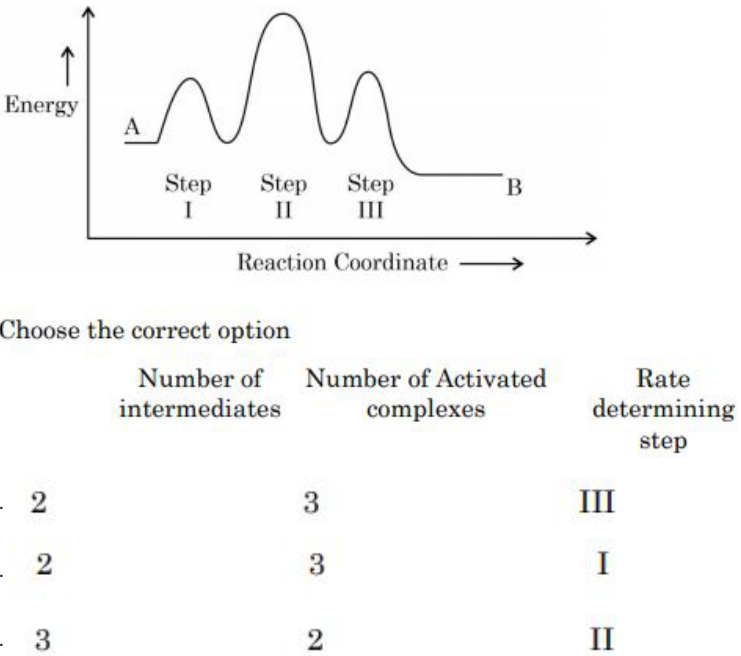
Consider the following reaction that goes from A to B in three steps as shown below: Choose the correct option Number of intermediates | Number of Activated complexes | Rate determining step
- A2 | 3 | III
- B2 | 3 | I
- C3 | 2 | II
- D2 | 3 | II
View answer or solution
Answer
2 | 3 | II
Organic Compounds Containing Halogens
The group of chemicals used as pesticide is
- ADDT, Aldrin
- BAldrin, Sodium chlorate, Sodium arsinite
- CDieldrin, Sodium arsinite, Tetrachloroethene
- DSodium chlorate, DDT, PAN
View answer or solution
Answer
DDT, Aldrin
Given below are two statements: Statement I: Morphine is a narcotic analgesic. It helps in relieving pain without producing sleep. Statement II: Morphine and its derivatives are obtained from opium poppy. In the light of the above statements, choose the correct answer from the options given below
- ABoth Statement I and Statement II are true
- BStatement I is true but Statement II is false
- CStatement I is false but Statement II is true
- DBoth Statement I and Statement II are false
View answer or solution
Answer
Statement I is false but Statement II is true
Find out the major product from the following reaction. [a six-membered ring with C=O at the top vertex, a double bond on the upper-right edge, and a methyl on the lower carbon of the double bond] —1) MeMgBr/CuI, 2) nPrI→
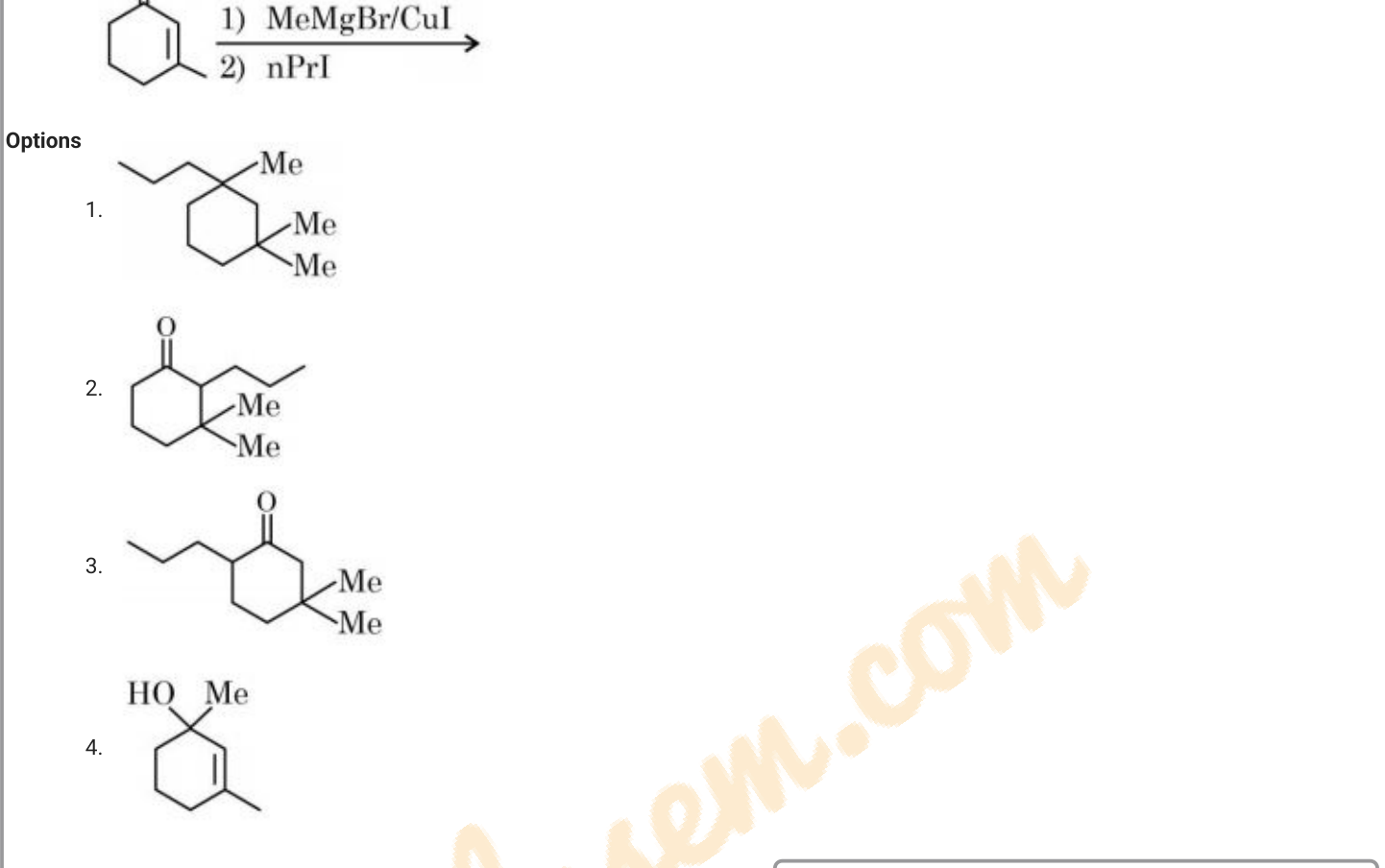
- Aa cyclohexane ring with a methyl group and an n-propyl chain on the top carbon and two methyl groups on the right-side carbon
- Ba cyclohexanone ring with C=O at the top, an n-propyl chain and a methyl group on the carbon to the right of the carbonyl, and two methyl groups on the next carbon
- Ca cyclohexanone ring with C=O at the top, an n-propyl chain on the carbon to the left of the carbonyl, and two methyl groups on the right-side carbon
- Da cyclohexene ring with a –C(OH)(CH₃)– group at the top carbon and a methyl group on the lower carbon of the double bond
View answer or solution
Answer
a cyclohexanone ring with C=O at the top, an n-propyl chain and a methyl group on the carbon to the right of the carbonyl, and two methyl groups on the next carbon
The IUPAC name of K₃[Co(C₂O₄)₃] is:-
- APotassium trioxalatocobalt(III)
- BPotassium trioxalatocobaltate(III)
- CPotassium tris(oxalato)cobalt(III)
- DPotassium tris(oxalato)cobaltate(III)
View answer or solution
Answer
Potassium trioxalatocobaltate(III)
Redox Reactions and Electrochemistry
The product, which is not obtained during the electrolysis of brine solution is
- AHCl
- BH₂
- CNaOH
- DCl₂
View answer or solution
Answer
HCl
Group-13 elements react with O₂ in amorphous form to form oxides of type M₂O₃ (M = element). Which among the following is the most basic oxide?
- AGa₂O₃
- BAl₂O₃
- CTl₂O₃
- DB₂O₃
View answer or solution
Answer
Tl₂O₃
If the radius of the first orbit of hydrogen atom is aₒ, then de Broglie's wavelength of electron in 3rd orbit is
- A3πaₒ
- Bπaₒ/6
- C6πaₒ
- Dπaₒ/3
View answer or solution
Answer
6πaₒ
The strongest acid from the following is
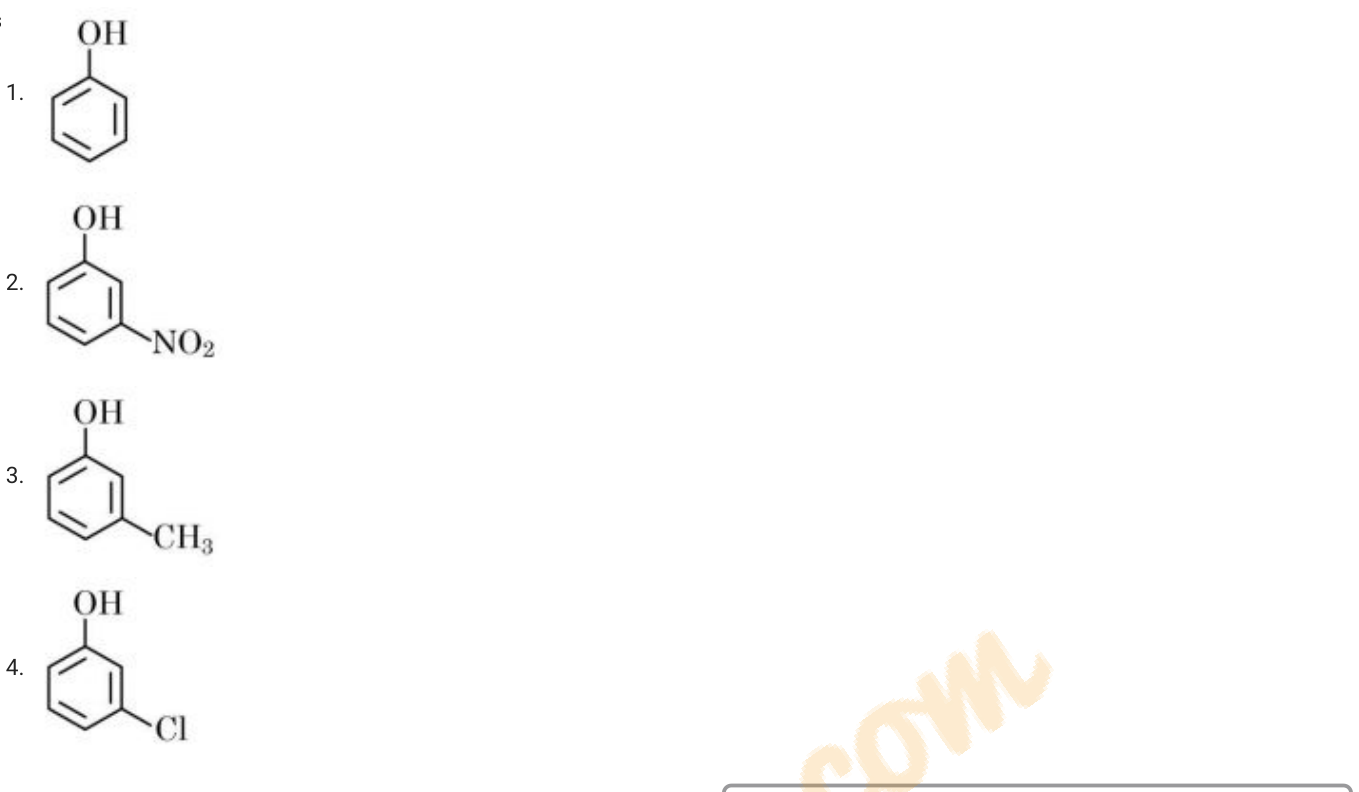
- ADrawn structure: phenol — a benzene ring (hexagon with three alternating double bonds) with an OH group on the top vertex and no other substituent.
- BDrawn structure: m-nitrophenol — a benzene ring (hexagon with three alternating double bonds) with an OH group on the top vertex and an NO₂ group on the meta (right-hand) vertex.
- CDrawn structure: m-cresol — a benzene ring (hexagon with three alternating double bonds) with an OH group on the top vertex and a CH₃ group on the meta (right-hand) vertex.
- DDrawn structure: m-chlorophenol — a benzene ring (hexagon with three alternating double bonds) with an OH group on the top vertex and a Cl atom on the meta (right-hand) vertex.
View answer or solution
Answer
Drawn structure: m-nitrophenol — a benzene ring (hexagon with three alternating double bonds) with an OH group on the top vertex and an NO₂ group on the meta (right-hand) vertex.
Redox Reactions and Electrochemistry
During the reaction of permanganate with thiosulphate, the change in oxidation of manganese occurs by value of 3. Identify which of the below medium will favour the reaction.
- Aboth aqueous acidic and neutral
- Baqueous acidic
- Caqueous neutral
- Dboth aqueous acidic and faintly alkaline
View answer or solution
Answer
aqueous neutral
Which one of the following elements will remain as liquid inside pure boiling water?
- AGa
- BBr
- CLi
- DCs
View answer or solution
Answer
Ga
Some Basic Concepts in Chemistry
The volume of 0.02 M aqueous HBr required to neutralize 10.0 mL of 0.01 M aqueous Ba(OH)₂ is (Assume complete neutralization)
- A2.5 mL
- B5.0 mL
- C10.0 mL
- D7.5 mL
View answer or solution
Answer
10.0 mL
Redox Reactions and Electrochemistry
Given below are two statements: one is labelled as "Assertion A" and the other is labelled as "Reason R" Assertion A: In the complex Ni(CO)₄ and Fe(CO)₅, the metals have zero oxidation state. Reason R: Low oxidation states are found when a complex has ligands capable of π-donor character in addition to the σ-bonding. In the light of the above statements, choose the most appropriate answer from the options given below
- ABoth A and R are correct but R is NOT the correct explanation of A
- BBoth A and R are correct and R is the correct explanation of A
- CA is correct but R is not correct
- DA is not correct but R is correct
View answer or solution
Answer
A is correct but R is not correct
Chemical Bonding and Molecular Structure
Structures of BeCl₂ in solid state, vapour phase and at very high temperature respectively are:
- APolymeric, Monomeric, Dimeric
- BPolymeric, Dimeric, Monomeric
- CMonomeric, Dimeric, Polymeric
- DDimeric, Polymeric, Monomeric
View answer or solution
Answer
Polymeric, Dimeric, Monomeric
Formation of which complex, among the following, is not a confirmatory test of Pb²⁺ ions
- Alead chromate
- Blead iodide
- Clead nitrate
- Dlead sulphate
View answer or solution
Answer
lead nitrate
In the following reaction, ‘B’ is
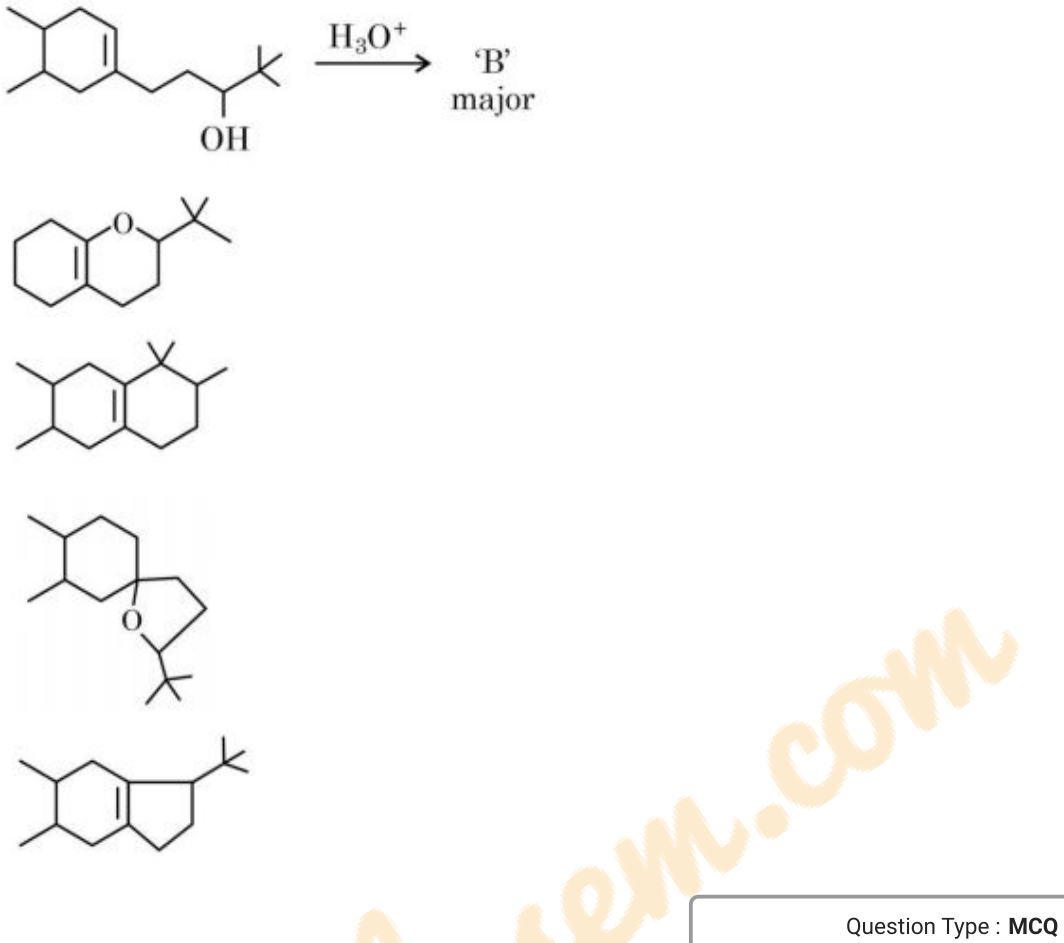
- ADrawn structure: a fused bicyclic system of two six-membered rings sharing a double bond; the left ring is a cyclohexane ring and the shared/adjacent bond is drawn as a double bond, the right ring contains an O at the top vertex and a tert-butyl group (a carbon with three short methyl lines) on the upper-right carbon.
- BDrawn structure: two fused six-membered rings sharing a double bond; the left ring carries two methyl groups (short lines) on its two left vertices, the right ring carries two methyl groups on its top vertex and one methyl group on its right vertex, with a double bond drawn between the two fusion carbons.
- CDrawn structure: a spiro compound in which a cyclohexane ring (with two methyl groups on its two left vertices) is joined at a single spiro carbon to a five-membered oxygen-containing ring; the five-membered ring carries an O at its lower-left vertex and a tert-butyl group (a carbon with three short methyl lines) below it.
- DDrawn structure: two fused rings — a six-membered ring (with two methyl groups on its two left vertices) fused to a five-membered ring sharing a double bond; the five-membered ring carries a tert-butyl group (a carbon with three short methyl lines) on its upper-right carbon.
View answer or solution
Answer
Drawn structure: two fused six-membered rings sharing a double bond; the left ring carries two methyl groups (short lines) on its two left vertices, the right ring carries two methyl groups on its top vertex and one methyl group on its right vertex, with a double bond drawn between the two fusion carbons.
Match List I with List II List I | List II Natural Amino acid | One Letter Code (A) Arginine | (I) D (B) Aspartic acid | (II) N (C) Asparagine | (III) A (D) Alanine | (IV) R Choose the correct answer from the options given below:
- A(A) – I, (B) – III, (C) – IV, (D) – II
- B(A) – IV, (B) – I, (C) – III, (D) – II
- C(A) – IV, (B) – I, (C) – II, (D) – III
- D(A) – III, (B) – I, (C) – II, (D) – IV
View answer or solution
Answer
(A) – IV, (B) – I, (C) – II, (D) – III
Ion having highest hydration enthalpy among the given alkaline earth metal ions is:
- ASr²⁺
- BBa²⁺
- CCa²⁺
- DBe²⁺
View answer or solution
Answer
Be²⁺
Number of isomeric aromatic amines with molecular formula C₈H₁₁N, which can be synthesized by Gabriel Phthalimide synthesis is ____________.
View answer or solution
Answer
6
The number of species having a square planar shape from the following is ____________. XeF₄, SF₄, SiF₄, BF₄⁻, BrF₄⁻, [Cu(NH₃)₄]²⁺, [FeCl₄]²⁻, [PtCl₄]²⁻
View answer or solution
Answer
4
Redox Reactions and Electrochemistry
The standard reduction potentials at 298 K for the following half cells are given below: NO₃⁻ + 4H⁺ + 3e⁻ → NO(g) + 2H₂O E° = 0.97 V V²⁺(aq) + 2e⁻ → V E° = −1.19 V Fe³⁺(aq) + 3e⁻ → Fe E° = −0.04 V Ag⁺(aq) + e⁻ → Ag(s) E° = 0.80 V Au³⁺(aq) + 3e⁻ → Au(s) E° = 1.40 V The number of metal(s) which will be oxidized by NO₃⁻ in aqueous solution is ___________.
View answer or solution
Answer
3
Some Basic Concepts in Chemistry
Consider the following data Heat of combustion of H₂(g) = −241.8 kJ mol⁻¹ Heat of combustion of C(s) = −393.5 kJ mol⁻¹ Heat of combustion of C₂H₅OH(l) = −1234.7 kJ mol⁻¹ The heat of formation of C₂H₅OH(l) is (−)______________ kJ mol⁻¹ (Nearest integer).
View answer or solution
Answer
278
Consider the following pairs of solution which will be isotonic at the same temperature. The number of pairs of solutions is / are ____________. A. 1 M aq. NaCl and 2 M aq. urea B. 1 M aq. CaCl₂ and 1.5 M aq. KCl C. 1.5 M aq. AlCl₃ and 2 M aq. Na₂SO₄ D. 2.5 M aq. KCl and 1 M aq. Al₂(SO₄)₃
View answer or solution
Answer
4
Organic Compounds Containing Halogens
Among the following, the number of compounds which will give positive iodoform reaction is ____________ (a) 1-Phenylbutan-2-one (b) 2-Methylbutan-2-ol (c) 3-Methylbutan-2-ol (d) 1-Phenylethanol (e) 3,3-dimethylbutan-2-one (f) 1-Phenylpropan-2-ol
View answer or solution
Answer
4
Chemical Bonding and Molecular Structure
In an ice crystal, each water molecule is hydrogen bonded to ____________ neighbouring molecules.
View answer or solution
Answer
4
Principles Related to Practical Chemistry
The number of colloidal systems from the following, which will have 'liquid' as the dispersion medium, is __________ Gem stones, paints, smoke, cheese, milk, hair cream, insecticide sprays, froth, soap lather
View answer or solution
Answer
5
The equilibrium composition for the reaction PCl₃ + Cl₂ ⇌ PCl₅ at 298 K is given below: [PCl₃]ₑq = 0.2 mol L⁻¹, [Cl₂]ₑq = 0.1 mol L⁻¹, [PCl₅]ₑq = 0.40 mol L⁻¹ If 0.2 mol of Cl₂ is added at the same temperature, the equilibrium concentrations of PCl₅ is __________ × 10⁻² mol L⁻¹ Given: K꜀ for the reaction at 298 K is 20
View answer or solution
Answer
49
Chemical Bonding and Molecular Structure
Number of crystal systems from the following where body centred unit cell can be found, is __________ Cubic, tetragonal, orthorhombic, hexagonal, rhombohedral, monoclinic, triclinic
View answer or solution
Answer
3