
// JEE (Main) / 2023
JEE (Main) 2023 Session 2, 6 April 2023, Shift 1 — Paper 1 (B.E / B.Tech) Chemistry
Chemistry · B.E / B.Tech
Work through the questions
30 questions
Take a moment to try each question before opening the available answer or solution.
Match List I with List II | LIST I | LIST II | | Element detected | Reagent used / Product formed | | A. Nitrogen | I. Na₂[Fe(CN)₅ NO] | | B. Sulphur | II. AgNO₃ | | C. Phosphorous | III. Fe₄[Fe(CN)₆]₃ | | D. Halogen | IV. (NH₄)₂MoO₄ | Choose the correct answer from the options given below:
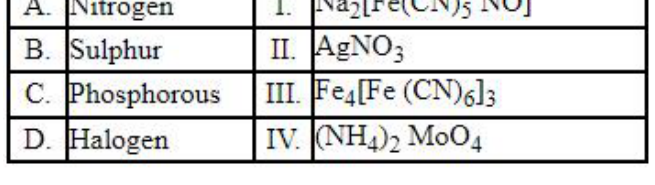
- AA-II, B-I, C-IV, D-III
- BA-IV, B-II, C-I, D-III
- CA-III, B-I, C-IV, D-II
- DA-II, B-IV, C-I, D-III
View answer or solution
Answer
A-III, B-I, C-IV, D-II
Classification of Elements and Periodicity in Properties
The difference between electron gain enthalpies will be maximum between:
- ANe and F
- BAr and Cl
- CNe and Cl
- DAr and F
View answer or solution
Answer
Ne and Cl
Redox Reactions and Electrochemistry
Which of the following options are correct for the reaction 2 [Au(CN)₂]⁻(aq) + Zn (s) → 2 Au (s) + [Zn(CN)₄]²⁻(aq) A. Redox reaction B. Displacement reaction C. Decomposition reaction D. Combination reaction Choose the correct answer from the options given below:
- AA only
- BC and D only
- CA and D only
- DA and B only
View answer or solution
Answer
A and B only
Chemical Bonding and Molecular Structure
A compound is formed by two elements X and Y. The element Y forms cubic close packed arrangement and those of element X occupy one third of the tetrahedral voids. What is the formula of the compound ?
- AXY₃
- BX₂Y₃
- CX₃Y
- DX₃Y₂
View answer or solution
Answer
X₂Y₃
Principles Related to Practical Chemistry
Polymer used in orlon is:
- APolyacrylonitrile
- BPolyamide
- CPolyethene
- DPolycarbonate
View answer or solution
Answer
Polyacrylonitrile
Organic Compounds Containing Oxygen
For the reaction RCH₂Br + I⁻ —Acetone→ RCH₂I + Br⁻ major The correct statement is
- AThe reaction can occur in acetic acid also.
- BBr⁻ can act as competing nucleophile.
- CThe transition state formed in the above reaction is less polar than the localised anion.
- DThe solvent used in the reaction solvates the ions formed in rate determining step.
View answer or solution
Answer
The transition state formed in the above reaction is less polar than the localised anion.
The major products A and B from the following reactions are: Drawn structure: a benzene ring (hexagon with a circle inside) bearing –NH–C(=O)–CH₃ on the right-hand vertex, with H above the N, O below the C in a double bond and CH₃ drawn to the right, reacted along a right-pointing arrow labelled Br₂ / AcOH above the arrow to A and along a left-pointing arrow labelled LiAlH₄ below the arrow to B.
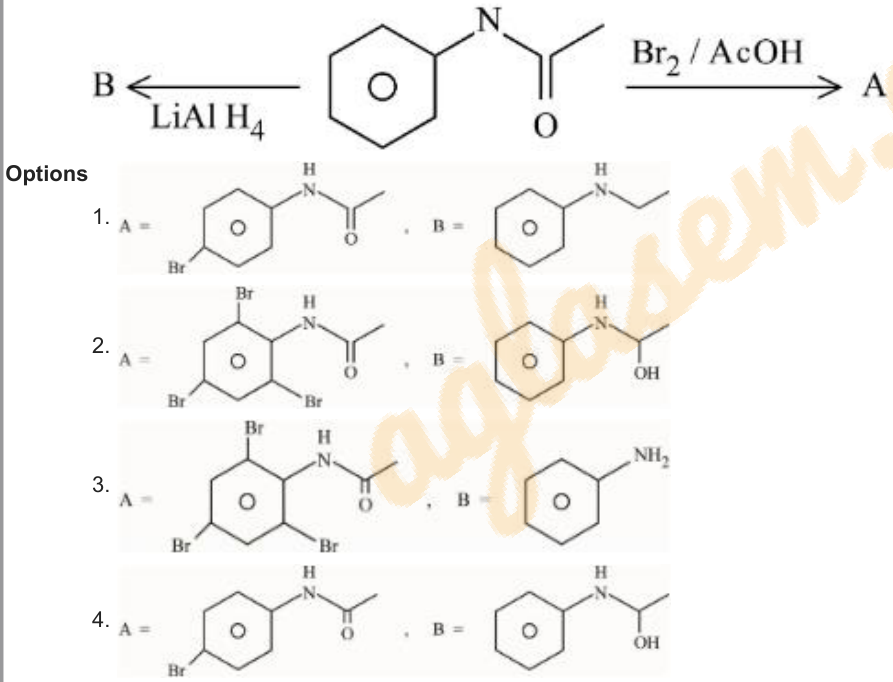
- ADrawn structure: A = a benzene ring (hexagon with a circle inside) bearing –NH–C(=O)–CH₃ on the right-hand vertex, with H above the N, O below the C in a double bond and CH₃ drawn to the right, and Br on the lower-left vertex; B = a benzene ring bearing –NH–CH₂CH₃ on the right-hand vertex, with H above the N and CH₂CH₃ (ethyl, drawn as a zigzag) drawn to the right.
- BDrawn structure: A = a benzene ring (hexagon with a circle inside) bearing –NH–C(=O)–CH₃ on the right-hand vertex, with H above the N, O below the C in a double bond and CH₃ drawn to the right, and Br on the top vertex, the lower-left vertex and the lower-right vertex; B = a benzene ring bearing –NH–CH(OH)–CH₃ on the right-hand vertex, with H above the N, OH printed below the CH and CH₃ drawn to the right.
- CDrawn structure: A = a benzene ring (hexagon with a circle inside) bearing –NH–C(=O)–CH₃ on the right-hand vertex, with H above the N, O below the C in a double bond and CH₃ drawn to the right, and Br on the top vertex, the lower-left vertex and the lower-right vertex; B = a benzene ring bearing –NH₂ on the right-hand vertex.
- DDrawn structure: A = a benzene ring (hexagon with a circle inside) bearing –NH–C(=O)–CH₃ on the right-hand vertex, with H above the N, O below the C in a double bond and CH₃ drawn to the right, and Br on the lower-left vertex; B = a benzene ring bearing –NH–CH(OH)–CH₃ on the right-hand vertex, with H above the N, OH printed below the CH and CH₃ drawn to the right.
View answer or solution
Answer
Drawn structure: A = a benzene ring (hexagon with a circle inside) bearing –NH–C(=O)–CH₃ on the right-hand vertex, with H above the N, O below the C in a double bond and CH₃ drawn to the right, and Br on the lower-left vertex; B = a benzene ring bearing –NH–CH₂CH₃ on the right-hand vertex, with H above the N and CH₂CH₃ (ethyl, drawn as a zigzag) drawn to the right.
The major product formed in the following reaction is Drawn structure: a benzene ring (hexagon with a circle inside) bearing at the upper-right vertex a –CH₂–CONH₂ side chain (CONH₂ label at the upper right) and at the lower-right vertex a –COOCH₃ group (COOCH₃ label at the lower right), reacted along a right-pointing arrow labelled Br₂ / NaOH above the arrow and Δ below the arrow.
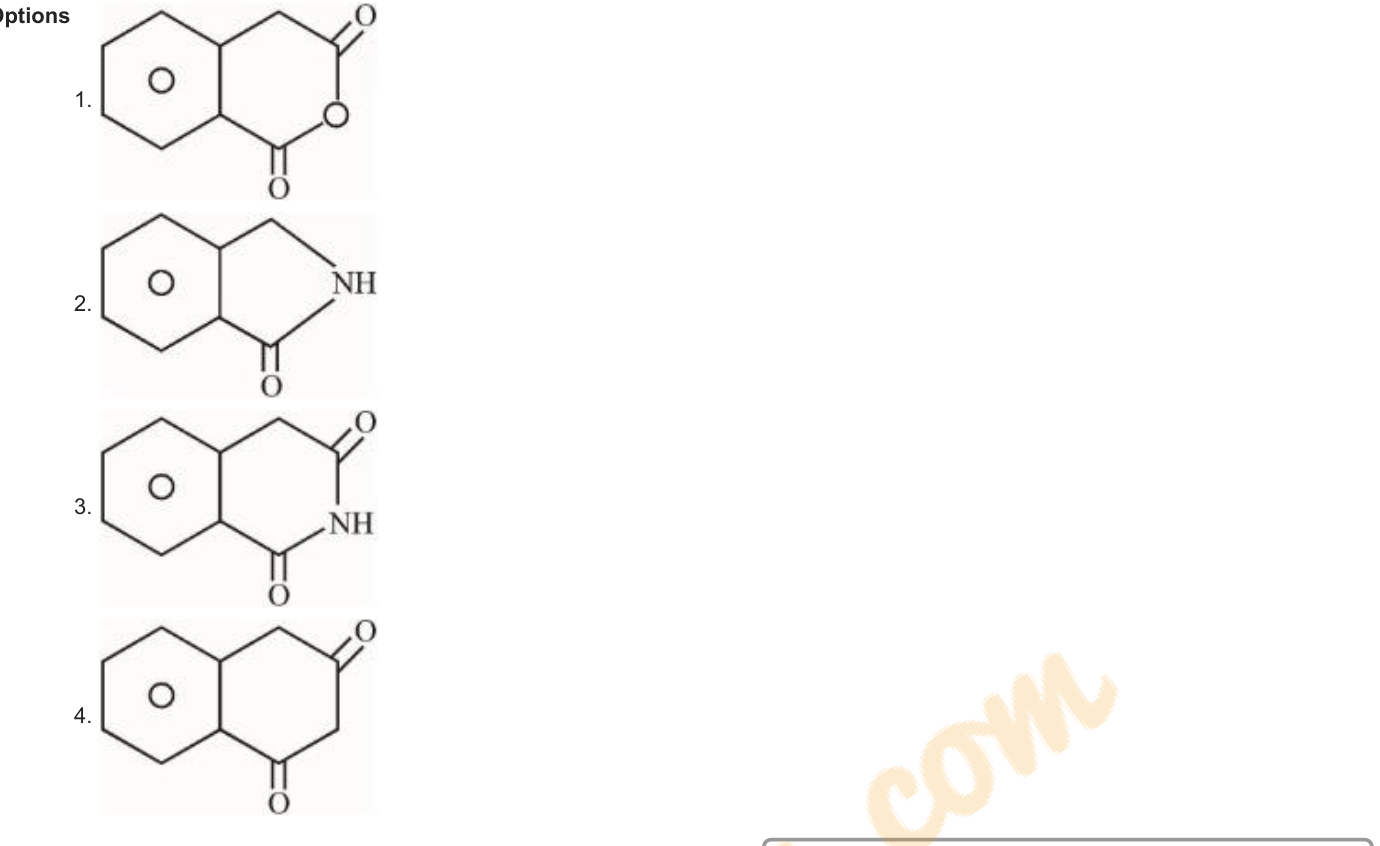
- ADrawn structure: two fused rings — a benzene ring (hexagon with a circle inside) on the left fused to a six-membered ring on its right; the right-hand ring carries CH₂ at the top, C=O at the upper-right vertex, O at the mid-right (between the two carbonyl carbons) and C=O at the bottom vertex attached to the fusion.
- BDrawn structure: two fused rings — a benzene ring (hexagon with a circle inside) on the left fused to a five-membered ring on its right; the right-hand ring carries CH₂ at the top, NH at the mid-right and C=O at the bottom vertex attached to the fusion.
- CDrawn structure: two fused rings — a benzene ring (hexagon with a circle inside) on the left fused to a six-membered ring on its right; the right-hand ring carries CH₂ at the top, C=O at the upper-right vertex, NH at the mid-right (between the two carbonyl carbons) and C=O at the bottom vertex attached to the fusion.
- DDrawn structure: two fused rings — a benzene ring (hexagon with a circle inside) on the left fused to a six-membered ring on its right; the right-hand ring carries CH₂ at the top, C=O at the upper-right vertex, CH₂ at the mid-right and C=O at the bottom vertex attached to the fusion.
View answer or solution
Answer
Drawn structure: two fused rings — a benzene ring (hexagon with a circle inside) on the left fused to a five-membered ring on its right; the right-hand ring carries CH₂ at the top, NH at the mid-right and C=O at the bottom vertex attached to the fusion.
Given below are two statements, one is labelled as Assertion A and the other is labelled as Reason R. Assertion A : Loss of electron from hydrogen atom results in nucleus of ~1.5 × 10⁻³ pm size. Reason R : Proton (H⁺) always exists in combined form. In the light of the above statements, choose the most appropriate answer from the options given below:
- AA is not correct but R is correct
- BBoth A and R are correct but R is NOT the correct explanation of A
- CA is correct but R is not correct
- DBoth A and R are correct and R is the correct explanation of A
View answer or solution
Answer
Both A and R are correct but R is NOT the correct explanation of A
Organic Compounds Containing Halogens
Match List I with List II LIST I Name of reaction | LIST II Reagent used A. Hell-Volhard-Zelinsky reaction | I. NaOH + I₂ B. Iodoform reaction | II. (i) CrO₂Cl₂, CS₂ (ii) H₂O C. Etard reaction | III. (i) Br₂ / red phosphorus (ii) H₂O D. Gatterman-Koch reaction | IV. CO, HCl, anhyd. AlCl₃ Choose the correct answer from the options given below:
- AA-I, B-II, C-III, D-IV
- BA-III, B-II, C-I, D-IV
- CA-III, B-I, C-II, D-IV
- DA-III, B-I, C-IV, D-II
View answer or solution
Answer
A-III, B-I, C-II, D-IV
For a concentrated solution of a weak electrolyte (K_eq = equilibrium constant) A₂B₃ of concentration ‘c’, the degree of dissociation ‘α’ is
- A(K_eq/(25c²))^(1/5)
- B(K_eq/(5c⁴))^(1/5)
- C(K_eq/(108c⁴))^(1/5)
- D(K_eq/(6c⁵))^(1/5)
View answer or solution
Answer
(K_eq/(108c⁴))^(1/5)
Match List I with List II LIST I - Enzymatic reaction | LIST II - Enzyme A. Sucrose → Glucose and Fructose | I. Zymase B. Glucose → ethyl alcohol and CO₂ | II. Pepsin C. Starch → Maltose | III. Invertase D. Proteins → Amino acids | IV. Diastase Choose the correct answer from the options given below:
- AA-I, B-IV, C-III, D-II
- BA-I, B-II, C-IV, D-III
- CA-III, B-I, C-IV, D-II
- DA-III, B-I, C-II, D-IV
View answer or solution
Answer
A-III, B-I, C-IV, D-II
Match List I with List II LIST I Vitamin | LIST II Deficiency disease A. Vitamin A | I. Beri-Beri B. Thiamine | II. Cheilosis C. Ascorbic acid | III. Xerophthalmia D. Riboflavin | IV. Scurvy Choose the correct answer from the options given below:
- AA-III, B-II, C-IV, D-I
- BA-IV, B-I, C-III, D-II
- CA-IV, B-II, C-III, D-I
- DA-III, B-I, C-IV, D-II
View answer or solution
Answer
A-III, B-I, C-IV, D-II
The possibility of photochemical smog formation is more at
- AHimalayan villages in winter
- BThe places with healthy vegetation
- CIndustrial areas
- DMarshy lands
View answer or solution
Answer
Industrial areas
Redox Reactions and Electrochemistry
The standard electrode potential of M⁺/ M in aqueous solution does not depend on
- AIonisation of a solid metal atom
- BSublimation of a solid metal
- CHydration of a gaseous metal ion
- DIonisation of a gaseous metal atom
View answer or solution
Answer
Ionisation of a solid metal atom
Chemical Bonding and Molecular Structure
Match List I with List II LIST I Oxide | LIST II Type of bond A. N₂O₄ | I. 1 N = O bond B. NO₂ | II. 1 N - O - N bond C. N₂O₅ | III. 1 N - N bond D. N₂O | IV. 1 N=N / N ≡ N bond Choose the correct answer from the options given below:
- AA-II, B-I, C-III, D-IV
- BA-III, B-I, C-IV, D-II
- CA-II, B-IV, C-III, D-I
- DA-III, B-I, C-II, D-IV
View answer or solution
Answer
A-III, B-I, C-II, D-IV
Some Basic Concepts in Chemistry
Compound P →(HCl, Δ) Filter → Residue Q / Filtrate →(NaOH) Oily Liquid R. (M.F. C₁₄H₁₃ON) M.F = MOLECULAR FORMULA Compound P is neutral, Q gives effervescence with NaHCO₃ while R reacts with Hinsbergs reagent to give solid soluble in NaOH. Compound P is
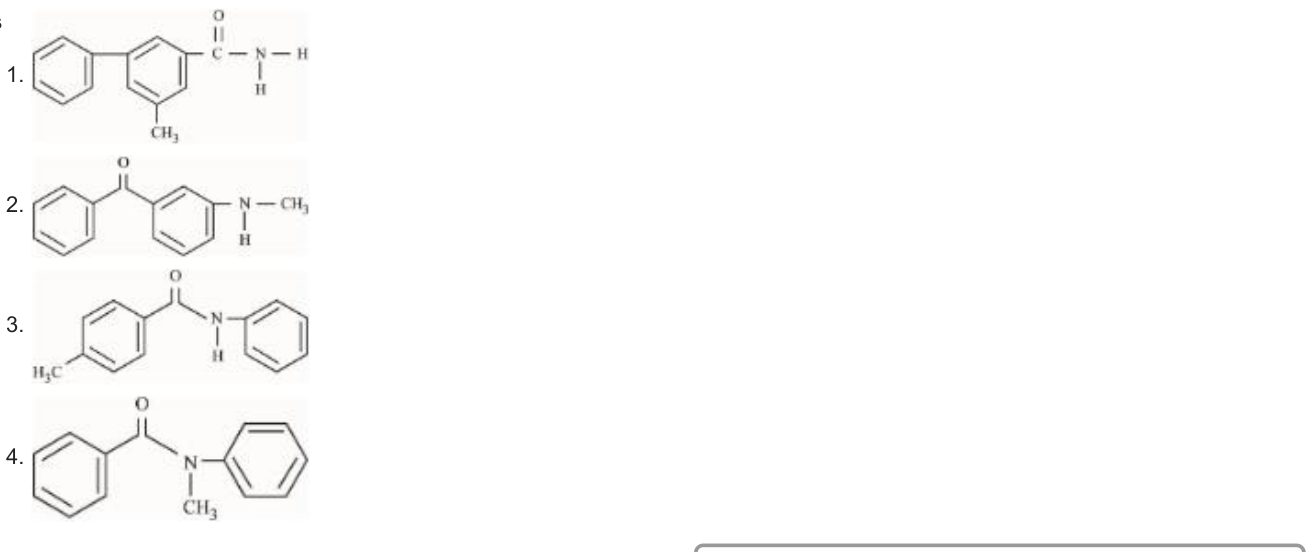
- Abiphenyl structure: phenyl ring joined to a second phenyl ring bearing CH₃ below and -C(=O)-NH₂ to the right (carbon with =O above, N with H to right and H below)
- Bbenzophenone structure: phenyl ring -C(=O)- phenyl ring bearing -NH-CH₃ (N attached to ring, H below, CH₃ to right), =O above the carbonyl carbon
- Cp-tolyl-benzoic amide structure: H₃C-phenyl -C(=O)-NH-phenyl (=O above carbonyl, N with H below, joining the two phenyl rings)
- Dbenzoic amide structure: phenyl ring -C(=O)-N(CH₃)-phenyl (=O above carbonyl, N with CH₃ below, joining the two phenyl rings)
View answer or solution
Answer
p-tolyl-benzoic amide structure: H₃C-phenyl -C(=O)-NH-phenyl (=O above carbonyl, N with H below, joining the two phenyl rings)
Given below are two statements, one is labelled as Assertion A and the other is labelled as Reason R. Assertion A: The spin only magnetic moment value for [Fe(CN)₆]³⁻ is 1.74 BM, whereas for [Fe(H₂O)₆]³⁺ is 5.92 BM. Reason R : In both complexes, Fe is present in +3 oxidation state. In the light of the above statements, choose the correct answer from the options given below:
- AA is false but R is true
- BBoth A and R are true and R is the correct explanation of A
- CA is true but R is false
- DBoth A and R are true but R is NOT the correct explanation of A
View answer or solution
Answer
Both A and R are true but R is NOT the correct explanation of A
Principles Related to Practical Chemistry
The setting time of Cement is increased by adding
- ASilica
- BLimestone
- CClay
- DGypsum
View answer or solution
Answer
Gypsum
Redox Reactions and Electrochemistry
Strong reducing and oxidizing agents among the following, respectively, are
- AEu²⁺ and Ce⁴⁺
- BCe⁴⁺ and Eu²⁺
- CCe⁴⁺ and Tb⁴⁺
- DCe³⁺ and Ce⁴⁺
View answer or solution
Answer
Eu²⁺ and Ce⁴⁺
Redox Reactions and Electrochemistry
In ammonium – phosphomolybdate, the oxidation state of Mo is + __________
View answer or solution
Answer
6
The value of log K for the reaction A ⇌ B at 298 K is __________. (Nearest integer) Given: ΔH° = −54.07 kJ mol⁻¹ ΔS° = 10 J K⁻¹ mol⁻¹ (Take 2.303 × 8.314 × 298 = 5705)
View answer or solution
Answer
10
Mass of Urea (NH₂CONH₂) required to be dissolved in 1000 g of water in order to reduce the vapour pressure of water by 25% is __________ g. (Nearest integer) Given: Molar mass of N, C, O and H are 14, 12, 16 and 1 g mol⁻¹ respectively.
View answer or solution
Answer
1111
Some Basic Concepts in Chemistry
If 5 moles of BaCl₂ is mixed with 2 moles of Na₃PO₄, the maximum number of moles of Ba₃(PO₄)₂ formed is __________ (Nearest integer)
View answer or solution
Answer
1
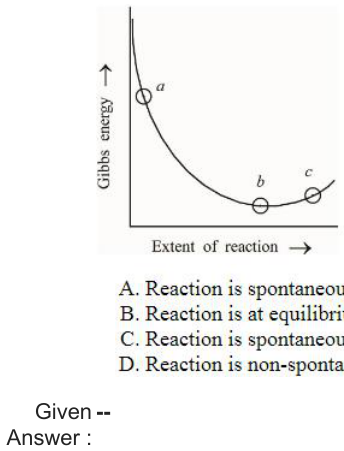
Consider the graph of Gibbs free energy G vs Extent of reaction. The number of statement/s from the following which are true with respect to points (a), (b) and (c) is __________ A. Reaction is spontaneous at (a) and (b) B. Reaction is at equilibrium at point (b) and non-spontaneous at point (c) C. Reaction is spontaneous at (a) and non-spontaneous at (c) D. Reaction is non-spontaneous at (a) and (b)
View answer or solution
Answer
2
Number of ambidentate ligands in a representative metal complex [M(en)(SCN)₄] is __________. [en = ethylenediamine]
View answer or solution
Answer
4
Number of bromo derivatives obtained on treating ethane with excess of Br₂ in diffused sunlight is __________
View answer or solution
Answer
9
Chemical Bonding and Molecular Structure
The number of species from the following which have square pyramidal structure is __________ PF₅, BrF₄⁻, IF₅, BrF₅, XeOF₄, ICl₄⁻
View answer or solution
Answer
3
For the adsorption of hydrogen on platinum, the activation energy is 30 k J mol⁻¹ and for the adsorption of hydrogen on nickel, the activation energy is 41.4 k J mol⁻¹. The logarithm of the ratio of the rates of chemisorption on equal areas of the metals at 300 K is __________ (Nearest integer) Given: ln 10 = 2.3 R = 8.3 J K⁻¹ mol⁻¹
View answer or solution
Answer
2
Some Basic Concepts in Chemistry
The wavelength of an electron of kinetic energy 4.50 × 10⁻²⁹ J is __________ × 10⁻⁵ m. (Nearest integer) Given : mass of electron is 9 × 10⁻³¹ kg, h = 6.6 × 10⁻³⁴ J s
View answer or solution
Answer
7