
// JEE (Main) / 2022
JEE (Main) 2022 Session 2, 29 July 2022, Shift 1 — Paper 1 (B.E / B.Tech) Chemistry
Chemistry · B.E / B.Tech
Work through the questions
30 questions
Take a moment to try each question before opening the available answer or solution.
Chemical Bonding and Molecular Structure
Which of the following pair of molecules contain odd electron molecule and an expanded octet molecule ?
- ABCl₃ and SF₆
- BNO and H₂SO₄
- CSF₆ and H₂SO₄
- DBCl₃ and NO
View answer or solution
Answer
NO and H₂SO₄
Some Basic Concepts in Chemistry
N₂(g) + 3H₂(g) ⇌ 2NH₃(g) 20 g 5 g Consider the above reaction, the limiting reagent of the reaction and number of moles of NH₃ formed respectivly are :
- AH₂, 1.42 moles
- BH₂, 0.71 moles
- CN₂, 1.42 moles
- DN₂, 0.71 moles
View answer or solution
Answer
N₂, 1.42 moles
100 mL of 5% (w/v) solution of NaCl in water was prepared in 250 mL beaker. Albumin from the egg was poured into NaCl solution and stirred well. This resulted in a/an :
- ALyophilic sol
- BLyophobic sol
- CEmulsion
- DPrecipitate
View answer or solution
Answer
Lyophilic sol
Classification of Elements and Periodicity in Properties
The first ionization enthalpy of Na, Mg and Si, respectively, are : 496, 737 and 786 kJ mol⁻¹. The first ionization enthalpy (kJ mol⁻¹) of Al is :
- A487
- B768
- C577
- D856
View answer or solution
Answer
577
In metallurgy the term "gangue" is used for :
- AContamination of undesired earthy materials.
- BContamination of metals, other than desired metal.
- CMinerals which are naturally occuring in pure form
- DMagnetic impurities in an ore.
View answer or solution
Answer
Contamination of undesired earthy materials.
The reaction of zinc with excess of aqueous alkali, evolves hydrogen gas and gives :
- AZn(OH)₂
- BZnO
- C[Zn(OH)₄]²⁻
- D[ZnO₂]²⁻
View answer or solution
Answer
[ZnO₂]²⁻
Lithium nitrate and sodium nitrate, when heated separately, respectively, give :
- ALiNO₂ and NaNO₂
- BLi₂O and Na₂O
- CLi₂O and NaNO₂
- DLiNO₂ and Na₂O
View answer or solution
Answer
Li₂O and NaNO₂
Chemical Bonding and Molecular Structure
Number of lone pairs of electrons in the central atom of SCl₂, O₃, ClF₃ and SF₆, respectively, are :
- A0, 1, 2 and 2
- B2, 1, 2 and 0
- C1, 2, 2 and 0
- D2, 1, 0 and 2
View answer or solution
Answer
2, 1, 2 and 0
In following pairs, the one in which both transition metal ions are colourless is :
- ASc³⁺, Zn²⁺
- BTi⁴⁺, Cu²⁺
- CV²⁺, Ti³⁺
- DZn²⁺, Mn²⁺
View answer or solution
Answer
Sc³⁺, Zn²⁺
Redox Reactions and Electrochemistry
In neutral or faintly alkaline medium, KMnO₄ being a powerful oxidant can oxidize, thiosulphate almost quantitatively, to sulphate. In this reaction overall change in oxidation state of manganese will be :
- A5
- B1
- C0
- D3
View answer or solution
Answer
3
Some Basic Concepts in Chemistry
Which among the following pairs has only herbicides ?
- AAldrin and Dieldrin
- BSodium chlorate and Aldrin
- CSodium arsinate and Dieldrin
- DSodium chlorate and sodium arsinite.
View answer or solution
Answer
Sodium chlorate and sodium arsinite.
Which among the following is the strongest Bronsted base ?
- AA: triethylamine, N bonded to three CH₂CH₃ groups with a lone pair on N
- BB: diethylamine, N bonded to two CH₂CH₃ groups and one H with a lone pair on N
- CC: N-methylpyrrole, a five-membered ring with two C=C bonds and N–CH₃ carrying the lone pair
- DD: quinuclidine, a bicyclic [2.2.2] amine with the lone pair on the bridgehead N
View answer or solution
Answer
D: quinuclidine, a bicyclic [2.2.2] amine with the lone pair on the bridgehead N
Which among the following pairs of the structures will give different products on ozonolysis ? (Consider the double bonds in the structures are rigid and not delocalized.)
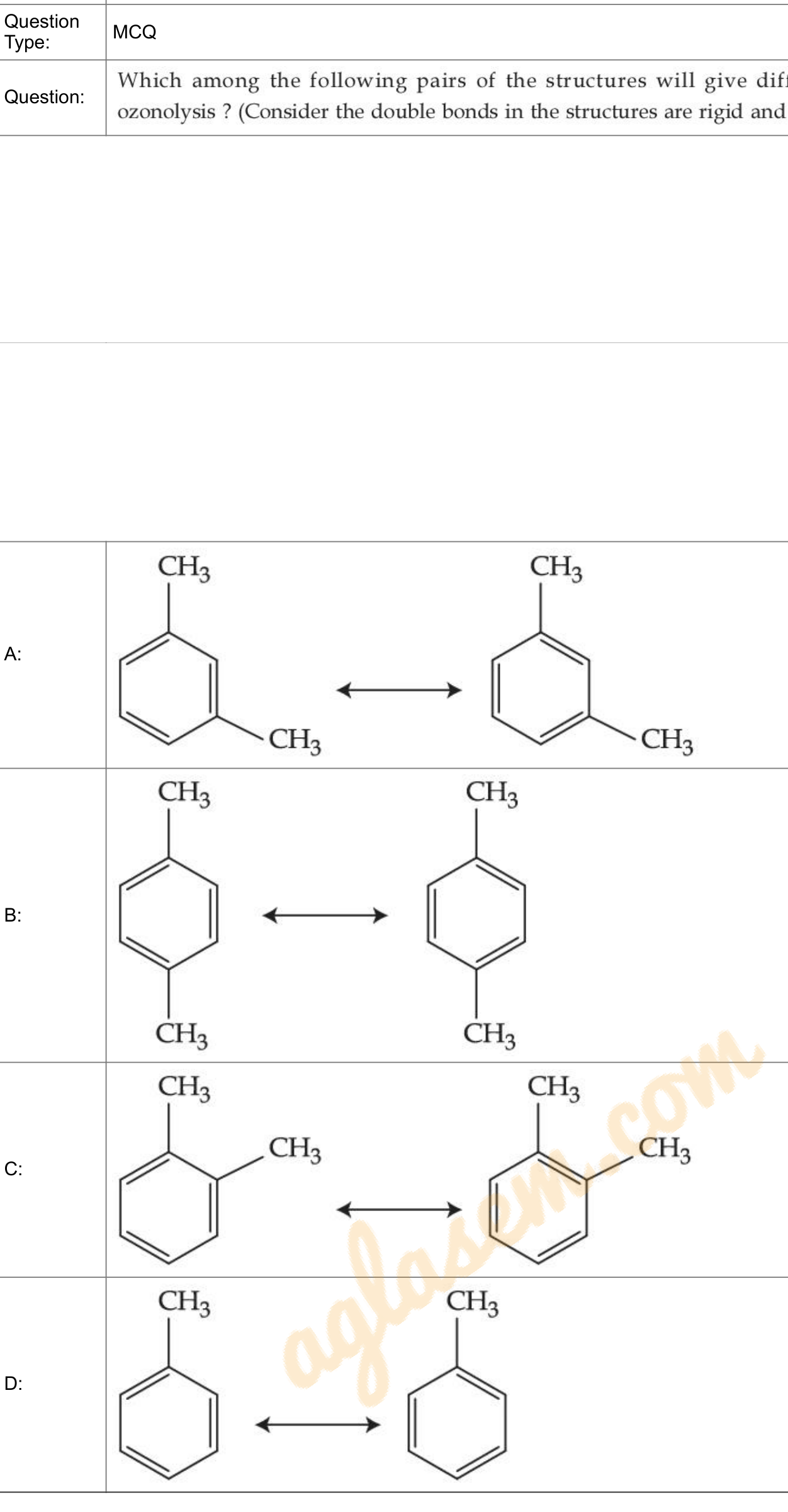
- AA: two meta-xylene structures (CH₃ at positions 1 and 3) differing only in the placement of the three ring double bonds
- BB: two para-xylene structures (CH₃ at positions 1 and 4) differing only in the placement of the three ring double bonds
- CC: two ortho-xylene structures (CH₃ at positions 1 and 2) differing only in the placement of the three ring double bonds
- DD: two toluene structures (one CH₃) differing only in the placement of the three ring double bonds
View answer or solution
Answer
C: two ortho-xylene structures (CH₃ at positions 1 and 2) differing only in the placement of the three ring double bonds
['A' (Major Product)] ←(AgCN / C₂H₅OH−H₂O)— [CH₃CH₂–Cl] —(NaCN / C₂H₅OH−H₂O)→ ['B' (Major Product)] Considering the above reactions, the compound 'A' and compound 'B' respectively are :
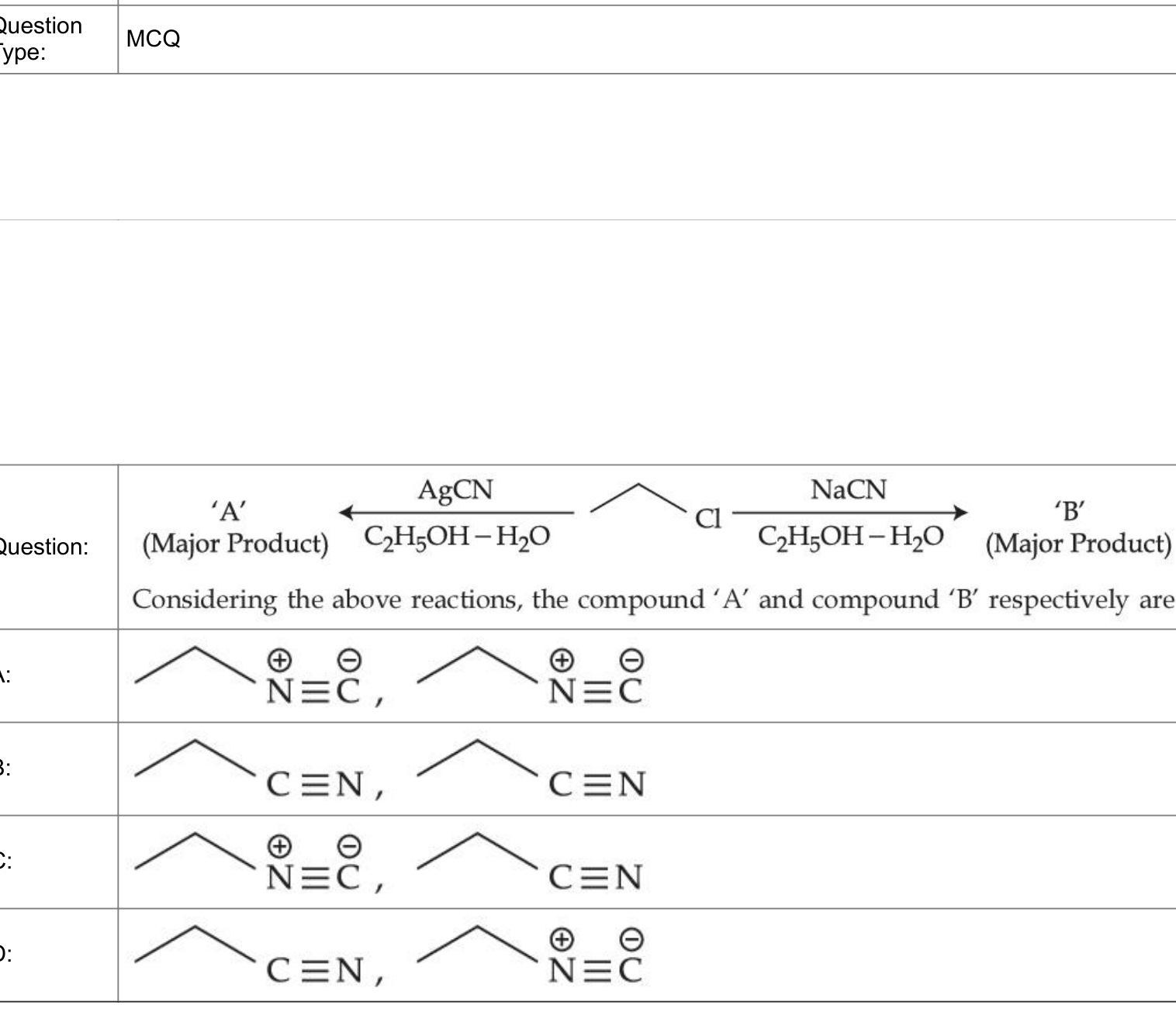
- AA: CH₃CH₂–N⁺≡C⁻ , B: CH₃CH₂–N⁺≡C⁻
- BA: CH₃CH₂–C≡N , B: CH₃CH₂–C≡N
- CA: CH₃CH₂–N⁺≡C⁻ , B: CH₃CH₂–C≡N
- DA: CH₃CH₂–C≡N , B: CH₃CH₂–N⁺≡C⁻
View answer or solution
Answer
A: CH₃CH₂–N⁺≡C⁻ , B: CH₃CH₂–C≡N
Consider the above reaction sequence, the Product 'C' is :
- AA: 3,5-dibromobenzonitrile (benzene ring with –Br at both positions ortho to the –CN substituted carbon, no –OH)
- BB: 3,5-dibromo-4-hydroxybenzaldehyde (benzene ring with –OH, two –Br ortho to it, and –CHO para to the –OH)
- CC: 3,5-dibromobenzaldehyde (benzene ring with –CHO and two –Br ortho to the –CHO substituted carbon, no –OH)
- DD: 3,5-dibromo-4-hydroxybenzonitrile (benzene ring with –OH, two –Br ortho to it, and –CN para to the –OH)
View answer or solution
Answer
D: 3,5-dibromo-4-hydroxybenzonitrile (benzene ring with –OH, two –Br ortho to it, and –CN para to the –OH)
Consider the above reaction, the compound 'A' is :
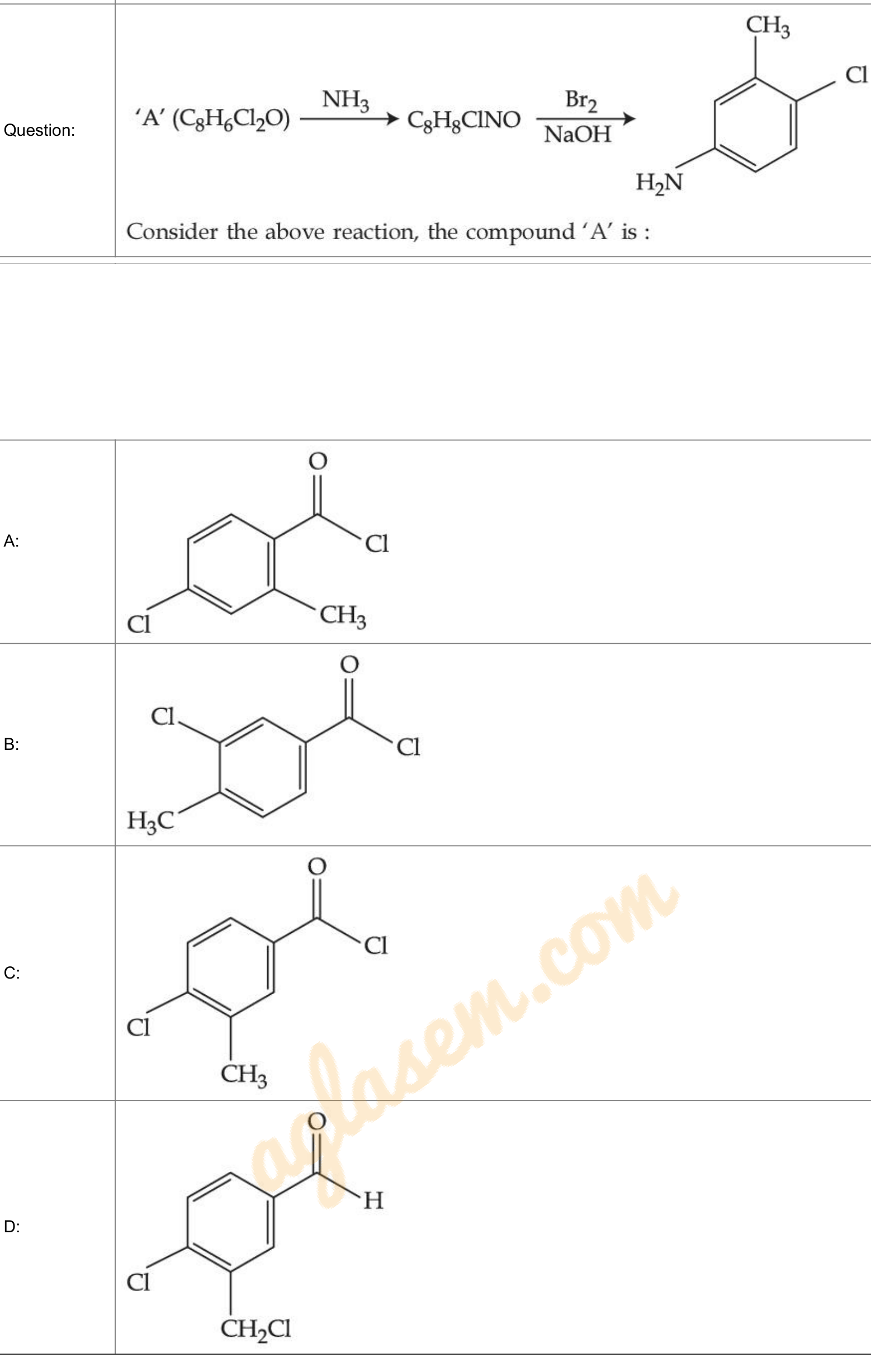
- AA: 4-chloro-2-methylbenzoyl chloride (benzene ring with –COCl, –CH₃ ortho to it, and –Cl para to the –COCl)
- BB: 3-chloro-4-methylbenzoyl chloride (benzene ring with –COCl, –CH₃ para to it, and –Cl meta to the –COCl and ortho to the –CH₃)
- CC: 4-chloro-3-methylbenzoyl chloride (benzene ring with –COCl, –Cl para to it, and –CH₃ meta to the –COCl and ortho to the –Cl)
- DD: 4-chloro-3-(chloromethyl)benzoyl chloride (benzene ring with –COCl, –Cl para to it, and –CH₂Cl meta to the –COCl and ortho to the –Cl)
View answer or solution
Answer
C: 4-chloro-3-methylbenzoyl chloride (benzene ring with –COCl, –Cl para to it, and –CH₃ meta to the –COCl and ortho to the –Cl)
[Benzenediazonium chloride, drawn as a benzene ring bearing –N⁺≡N Cl⁻] + 'A' —(NaOH)→ Product (Orange-red dye) Which among the following represent reagent 'A' ?
- AA: 2-naphthol (naphthalene with –OH at the β-carbon of one ring)
- BB: 1-naphthol (naphthalene with –OH at the α-carbon, adjacent to the ring junction)
- CC: aniline (benzene ring with –NH₂)
- DD: 1-naphthylamine (naphthalene with –NH₂ at the α-carbon, adjacent to the ring junction)
View answer or solution
Answer
A: 2-naphthol (naphthalene with –OH at the β-carbon of one ring)
Consider the following reaction sequence : [4-aminobenzonitrile, drawn as a benzene ring with –NH₂ at the top and –CN at the bottom] —(i) AlH (i-Bu)₂; (ii) H₂O)→ 'A' —(CH₃CHO / dil NaOH, Δ)→ B (Major Product) The product 'B' is :
- AA: OHC–C₆H₄–N=CH–CH₃
- BB: H₂N–C₆H₄–CH=CH–CHO
- CC: H₂N–C₆H₄–CH₂–N=CH–CH₃
- DD: H₂N–C₆H₄–C(=O)–N=CH–CHO
View answer or solution
Answer
B: H₂N–C₆H₄–CH=CH–CHO
Which of the following compounds is an example of hypnotic drug ?
- ASeldane
- BAmytal
- CAspartame
- DProntosil
View answer or solution
Answer
Amytal
Organic Compounds Containing Oxygen
A compound 'X' is acidic and it is soluble in NaOH solution, but insoluble in NaHCO₃ solution. Compound 'X' also gives violet colour with neutral FeCl₃ solution. The compound 'X' is :
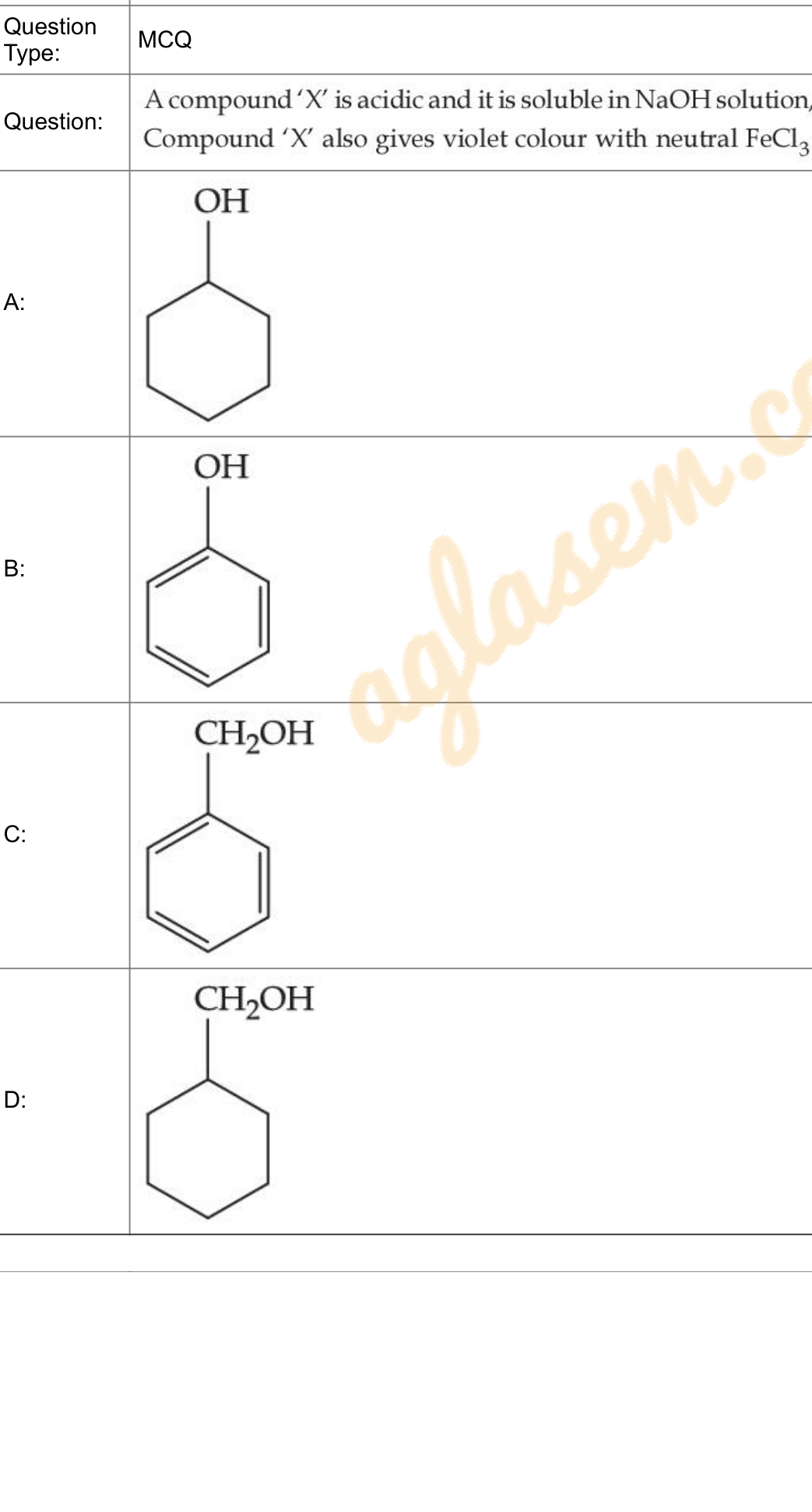
- AA: cyclohexanol (cyclohexane ring with –OH)
- BB: phenol (benzene ring with –OH)
- CC: benzyl alcohol (benzene ring with –CH₂OH)
- DD: cyclohexylmethanol (cyclohexane ring with –CH₂OH)
View answer or solution
Answer
B: phenol (benzene ring with –OH)
Redox Reactions and Electrochemistry
Resistance of a conductivity cell (cell constant 129 m⁻¹) filled with 74.5 ppm solution of KCl is 100 Ω (labelled as solution 1). When the same cell is filled with KCl solution of 149 ppm, the resistance is 50 Ω (labelled as solution 2). The ratio of molar conductivity of solution 1 and solution 2 is i.e. Λ₁/Λ₂ = x×10⁻³. The value of x is __________. (Nearest integer) Given, molar mass of KCl is 74.5 g mol⁻¹.
View answer or solution
Answer
1000
Classification of Elements and Periodicity in Properties
Ionic radii of cation A⁺ and anion B⁻ are 102 and 181 pm respectively. These ions are allowed to crystallize into an ionic solid. This crystal has cubic close packing for B⁻. A⁺ is present in all octahedral voids. The edge length of the unit cell of the crystal AB is __________pm. (Nearest Integer)
View answer or solution
Answer
512
Some Basic Concepts in Chemistry
The minimum uncertainty in the speed of an electron in an one dimensional region of length 2a₀ (Where a₀ = Bohr radius 52.9 pm) is __________ km s⁻¹. (Given : Mass of electron = 9.1×10⁻³¹ kg, Planck's constant h = 6.63×10⁻³⁴ Js)
View answer or solution
Answer
548
When 600 mL of 0.2 M HNO₃ is mixed with 400 mL of 0.1 M NaOH solution in a flask, the rise in temperature of the flask is __________ ×10⁻² °C. (Enthalpy of neutralisation = 57 kJ mol⁻¹ and Specific heat of water = 4.2 JK⁻¹g⁻¹) (Neglect heat capacity of flask)
View answer or solution
Answer
54
If O₂ gas is bubbled through water at 303 K, the number of millimoles of O₂ gas that dissolve in 1 litre of water is __________. (Nearest Integer) (Given : Henry's Law constant for O₂ at 303 K is 46.82 k bar and partial pressure of O₂ = 0.920 bar) (Assume solubility of O₂ in water is too small, nearly negligible)
View answer or solution
Answer
1
If the solubility product of PbS is 8 × 10⁻²⁸, then the solubility of PbS in pure water at 298 K is x × 10⁻¹⁶ mol L⁻¹. The value of x is __________. (Nearest Integer) [Given : √2 = 1.41]
View answer or solution
Answer
282
The reaction between X and Y is first order with respect to X and zero order with respect to Y. Experiment [X] / mol L⁻¹ [Y] / mol L⁻¹ Initial rate / mol L⁻¹ min⁻¹ I 0.1 0.1 2×10⁻³ II L 0.2 4×10⁻³ III 0.4 0.4 M×10⁻³ IV 0.1 0.2 2×10⁻³ Examine the data of table and calculate ratio of numerical values of M and L. (Nearest Integer)
View answer or solution
Answer
40
In a linear tetrapeptide (Constituted with different amino acids), (number of amino acids) − (number of peptide bonds) is __________.
View answer or solution
Answer
1
Some Basic Concepts in Chemistry
In bromination of Propyne, with Bromine 1, 1, 2, 2-tetrabromopropane is obtained in 27% yield. The amount of 1, 1, 2, 2-tetrabromopropane obtained from 1 g of Bromine in this reaction is __________ ×10⁻¹ g. (Nearest integer) (Molar Mass : Bromine = 80 g/mol )
View answer or solution
Answer
3
[Fe(CN)₆]³⁻ should be an inner orbital complex. Ignoring the pairing energy, the value of crystal field stabilization energy for this complex is (−) __________ Δ₀. (Nearest integer)
View answer or solution
Answer
2