
// JEE (Main) / 2022
JEE (Main) 2022 Session 2, 28 July 2022, Shift 2 — Paper 1 (B.E / B.Tech) Chemistry
Chemistry · B.E / B.Tech
Work through the questions
30 questions
Take a moment to try each question before opening the available answer or solution.
Given below are two statements : One is labelled as Assertion A and the other is labelled as Reason R\n\nAssertion A : Zero orbital overlap is an out of phase overlap.\n\nReason R : It results due to different orientation / direction of approach of orbitals.\n\nIn the light of the above statements, choose the correct answer from the options given below
- ABoth A and R are true and R is the correct explanation of A
- BBoth A and R are true but R is NOT the correct explanation of A
- CA is true but R is false
- DA is false but R is true
View answer or solution
Answer
Both A and R are true and R is the correct explanation of A
Classification of Elements and Periodicity in Properties
The correct decreasing order for metallic character is
- ANa > Mg > Be > Si > P
- BP > Si > Be > Mg > Na
- CSi > P > Be > Na > Mg
- DBe > Na > Mg > Si > P
View answer or solution
Answer
Na > Mg > Be > Si > P
Given below are two statements : One is labelled as Assertion A and the other is labelled as Reason R\n\nAssertion A : The reduction of a metal oxide is easier if the metal formed is in liquid state than solid state.\n\nReason R : The value of ΔG⊖ becomes more on negative side as entropy is higher in liquid state than solid state.\n\nIn the light of the above statements, choose the most appropriate answer from the options given below
- ABoth A and R are correct and R is the correct explanation of A
- BBoth A and R are correct but R is NOT the correct explanation of A
- CA is correct but R is not correct
- DA is not correct but R is correct
View answer or solution
Answer
Both A and R are correct and R is the correct explanation of A
Some Basic Concepts in Chemistry
The products obtained during treatment of hard water using Clark's method are :
- ACaCO₃ and MgCO₃
- BCa(OH)₂ and Mg(OH)₂
- CCaCO₃ and Mg(OH)₂
- DCa(OH)₂ and MgCO₃
View answer or solution
Answer
CaCO₃ and Mg(OH)₂
Statement I : An alloy of lithium and magnesium is used to make aircraft plates.\n\nStatement II : The magnesium ions are important for cell-membrane integrity.\n\nIn the light the above statements, choose the correct answer from the options given below
- ABoth Statement I and Statement II are true
- BBoth Statement I and Statement II are false
- CStatement I is true but Statement II is false
- DStatement I is false but Statement II is true
View answer or solution
Answer
Both Statement I and Statement II are false
White phosphorus reacts with thionyl chloride to give
- APCl₅, SO₂ and S₂Cl₂
- BPCl₃, SO₂ and S₂Cl₂
- CPCl₃, SO₂ and Cl₂
- DPCl₅, SO₂ and Cl₂
View answer or solution
Answer
PCl₃, SO₂ and S₂Cl₂
Concentrated HNO₃ reacts with Iodine to give
- AHI, NO₂ and H₂O
- BHIO₂, N₂O and H₂O
- CHIO₃, NO₂ and H₂O
- DHIO₄, N₂O and H₂O
View answer or solution
Answer
HIO₃, NO₂ and H₂O
Which of the following pair is not isoelectronic species?\n\n(At. no. Sm, 62; Er, 68; Yb, 70; Lu, 71; Eu, 63; Tb, 65; Tm, 69)
- ASm²⁺ and Er³⁺
- BYb²⁺ and Lu³⁺
- CEu²⁺ and Tb⁴⁺
- DTb²⁺ and Tm⁴⁺
View answer or solution
Answer
Sm²⁺ and Er³⁺
Given below are two statements : One is labelled as Assertion A and the other is labelled as Reason R\n\nAssertion A : Permanganate titrations are not performed in presence of hydrochloric acid.\n\nReason R : Chlorine is formed as a consequence of oxidation of hydrochloric acid.\n\nIn the light of the above statements, choose the correct answer from the options given below
- ABoth A and R are true and R is the correct explanation of A
- BBoth A and R are true but R is NOT the correct explanation of A
- CA is true but R is false
- DA is false but R is true
View answer or solution
Answer
Both A and R are true and R is the correct explanation of A
Chemical Bonding and Molecular Structure
Match List I with List II\n\nList I (Complex) : A. Ni(CO)₄; B. [Ni(CN)₄]²⁻; C. [Co(CN)₆]³⁻; D. [CoF₆]³⁻\n\nList II (Hybridization) : I. sp³; II. sp³d²; III. d²sp³; IV. dsp²\n\nChoose the correct answer from the options given below :
- AA-IV, B-I, C-III, D-II
- BA-I, B-IV, C-III, D-II
- CA-I, B-IV, C-II, D-III
- DA-IV, B-I, C-II, D-III
View answer or solution
Answer
A-I, B-IV, C-III, D-II
Dinitrogen and dioxygen, the main constituents of air do not react with each other in atmosphere to form oxides of nitrogen because
- AN₂ is unreactive in the condition of atmosphere.
- BOxides of nitrogen are unstable.
- CReaction between them can occur in the presence of a catalyst.
- DThe reaction is endothermic and require very high temperature.
View answer or solution
Answer
The reaction is endothermic and require very high temperature.
The major product in the given reaction is\n\n[An alkene chain drawn with (CH₃)₂C= at the left end, a zig-zag chain and C(OH)(CH₃)₂ at the right end] —(1) H⁺, heat (2) HBr→
- A(CH₃)₂C=CH–CH₂–CH₂–CH₂–C(CH₃)₂ with a label B₂ at the right end (the starting chain with the terminal carbon labelled B₂)
- Ba cyclopentane ring bearing two adjacent C(CH₃)₂ groups, one of them labelled B₂
- Ca cyclopentane ring bearing a Br–C(CH₃)₃? (a tert-butyl bromide drawn as Br above a t-butyl) at one carbon and C(CH₃)₂ at the adjacent carbon (brominated cyclic product)
- Dan open-chain bromide drawn as an isopropyl group (CH₃)₂CH– then Br on the next carbon, a zig-zag chain and an isopropyl end (open-chain bromo product)
View answer or solution
Answer
a cyclopentane ring bearing a Br–C(CH₃)₃? (a tert-butyl bromide drawn as Br above a t-butyl) at one carbon and C(CH₃)₂ at the adjacent carbon (brominated cyclic product)
Arrange the following in increasing order of reactivity towards nitration\n\nA. p-xylene\n\nB. bromobenzene\n\nC. mesitylene\n\nD. nitrobenzene\n\nE. benzene\n\nChoose the correct answer from the options given below
- AC < D < E < A < B
- BD < B < E < A < C
- CD < C < E < A < B
- DC < D < E < B < A
View answer or solution
Answer
D < B < E < A < C
Compound I is heated with Conc. HI to give a hydroxy compound A which is further heated with Zn dust to give compound B. Identify A and B.\n\n[a benzene ring bearing an isopropyl (CH(CH₃)₂) through O, labelled I] —(Conc. HI / Δ)→ A —(Zn, Δ)→ B
- AA = isopropanol (a two-carbon chain with OH on the central carbon) , B = propane (a three-carbon zig-zag)
- BA = phenol (a benzene ring bearing OH); B = p-benzoquinone (a ring with =O at the top and =O at the bottom, double bonds on the sides)
- CA = o-isopropylphenol (a benzene ring with OH at the top and an isopropyl group at the right); B = isopropylbenzene (a benzene ring bearing an isopropyl group)
- DA = phenol (OH at the top of the ring drawn with the bond to the left); B = benzene (the bare benzene ring)
View answer or solution
Answer
A = phenol (OH at the top of the ring drawn with the bond to the left); B = benzene (the bare benzene ring)
Given below are two statements : one is labelled as Assertion A and the other is labelled as Reason R\n\nAssertion A : Aniline on nitration yields ortho, meta & para nitro derivatives of aniline.\n\nReason R : Nitrating mixture is a strong acidic mixture.\n\nIn the light of the above statements, choose the correct answer from the options given below
- ABoth A and R are true and R is the correct explanation of A
- BBoth A and R are true but R is NOT the correct explanation of A
- CA is true but R is false
- DA is false but R is true
View answer or solution
Answer
Both A and R are true and R is the correct explanation of A
Organic Compounds Containing Oxygen
Match List I with List II\n\nList I (Polymer) : A. [–CH₂–C(Cl)=CH–CH₂–]ₙ (neoprene repeat); B. [–NH–(CH₂)₆–NH–C(=O)–(CH₂)₄–C(=O)–]ₙ (nylon repeat); C. [–CH₂–CH(Cl)–]ₙ (PVC repeat); D. [two phenol rings joined by CH₂ groups]ₙ (bakelite repeat)\n\nList II (Nature) : I. Thermosetting polymer; II. Fibers; III. Elastomer; IV. Thermoplastic polymer\n\nChoose the correct answer from the options given below :
- AA-II, B-III, C-IV, D-I
- BA-III, B-II, C-IV, D-I
- CA-III, B-I, C-IV, D-II
- DA-I, B-III, C-IV, D-II
View answer or solution
Answer
A-III, B-II, C-IV, D-I
Two statements in respect of drug-enzyme interaction are given below\n\nStatement I : Action of an enzyme can be blocked only when an inhibitor blocks the active site of the enzyme.\n\nStatement II : An inhibitor can form a strong covalent bond with the enzyme.\n\nIn the light of the above statements, choose the correct answer from the options given below
- ABoth Statement I and Statement II are true
- BBoth Statement I and Statement II are false
- CStatement I is true but Statement II is false
- DStatement I is false but Statement II is true
View answer or solution
Answer
Statement I is false but Statement II is true
Purification and Characterisation of Organic Compounds
Given below are two statements : One is labelled as Assertion A and the other is labelled as Reason R\n\nAssertion A : Thin layer chromatography is an adsorption chromatography.\n\nReason R : A thin layer of silica gel is spread over a glass plate of suitable size in thin layer chromatography which acts as an adsorbent.\n\nIn the light of the above statements, choose the correct answer from the options given below
- ABoth A and R are true and R is the correct explanation of A
- BBoth A and R are true but R is NOT the correct explanation of A
- CA is true but R is false
- DA is false but R is true
View answer or solution
Answer
Both A and R are true and R is the correct explanation of A
The formulas of A and B for the following reaction sequence\n\nFructose —(HCN / H₃O⁺)→ A\n\nFructose —(i) NaBH₄ (ii) HI/P→ B\n\nare
- AA = C₇H₁₄O₈, B = C₆H₁₄
- BA = C₇H₁₃O₇, B = C₇H₁₄O
- CA = C₇H₁₂O₈, B = C₆H₁₄
- DA = C₇H₁₄O₈, B = C₆H₁₄O₆
View answer or solution
Answer
A = C₇H₁₄O₈, B = C₆H₁₄
Find out the major product for the above reaction.\n\n[a cyclohexene ring drawn with a –CH₂–COOH chain at the upper-right carbon] —(1) I₂/NaHCO₃ (2) Pyridine, Δ→
- AA = a fused bicyclic drawn as a cyclohexane ring fused to a γ-lactone ring, the fusion double bond in the six-membered ring and the lactone carbonyl at the right vertex (dihydrofuran-2-one fused system)
- BB = the starting cyclohexene acid drawn with I above the right alkene carbon, I below-left at the lower alkene carbon, and CO₂H at the end of the –CH₂– chain (diiodo acid)
- CC = the fused bicyclic lactone but with the ring double bond inside the five-membered lactone ring (carbonyl at the right vertex, double bond up-left of it)
- DD = the fused bicyclic lactone but with the ring double bond in the six-membered ring on the upper-left side (carbonyl at the right vertex)
View answer or solution
Answer
C = the fused bicyclic lactone but with the ring double bond inside the five-membered lactone ring (carbonyl at the right vertex, double bond up-left of it)
Some Basic Concepts in Chemistry
2L of 0.2M H₂SO₄ is reacted with 2L of 0.1M NaOH solution, the molarity of the resulting product Na₂SO₄ in the solution is _______ millimolar. (Nearest integer)
View answer or solution
Answer
25
Some Basic Concepts in Chemistry
Metal M crystallizes into a fcc lattice with the edge length of 4.0 × 10⁻⁸ cm. The atomic mass of the metal is _______ g/mol. (Nearest integer)\n\n(Use : N_A = 6.02 × 10²³ mol⁻¹, density of metal, M = 9.03g cm⁻³)
View answer or solution
Answer
87
If the wavelength for an electron emitted from H-atom is 3.3 × 10⁻¹⁰ m, then energy absorbed by the electron in its ground state compared to minimum energy required for its escape from the atom, is ______ times. (Nearest integer)\n\n[Given : h = 6.626 × 10⁻³⁴ J s]\n\nMass of electron = 9.1 × 10⁻³¹ kg
View answer or solution
Answer
2
A gaseous mixture of two substances A and B, under a total pressure of 0.8 atm is in equilibrium with an ideal liquid solution. The mole fraction of substance A is 0.5 in the vapour phase and 0.2 in the liquid phase. The vapour pressure of pure liquid A is ________ atm. (Nearest integer)
View answer or solution
Answer
2
At 600K, 2 mol of NO are mixed with 1 mol of O₂.\n\n2NO₍g₎ + O₂(g) ⇌ 2NO₂(g)\n\nThe reaction occurring as above comes to equilibrium under a total pressure of 1 atm. Analysis of the system shows that 0.6 mol of oxygen are present at equilibrium. The equilibrium constant for the reaction is __________. (Nearest integer)
View answer or solution
Answer
2
A sample of 0.125g of an organic compound when analyzed by Duma's method yields 22.78 mL of nitrogen gas collected over KOH solution at 280 K and 759 mm Hg. The percentage of nitrogen in the given organic compound is ________. (Nearest integer)\n\nGiven :\n\n(a) The vapour pressure of water of 280 K is 14.2 mm Hg.\n\n(b) R = 0.082 L atm K⁻¹ mol⁻¹
View answer or solution
Answer
22
Redox Reactions and Electrochemistry
On reaction with stronger oxidizing agent like KIO₄, hydrogen peroxide oxidizes with the evolution of O₂. The oxidation number of I in KIO₄ changes to ______________.
View answer or solution
Answer
5
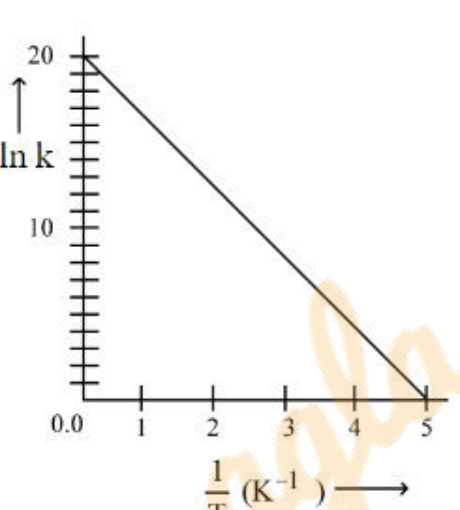
For a reaction, given below is the graph of ln k vs 1/T. The activation energy for the reaction is equal to ________ cal mol⁻¹. (nearest integer)\n\n(Given : R = 2 cal K⁻¹ mol⁻¹)
View answer or solution
Answer
8
Some Basic Concepts in Chemistry
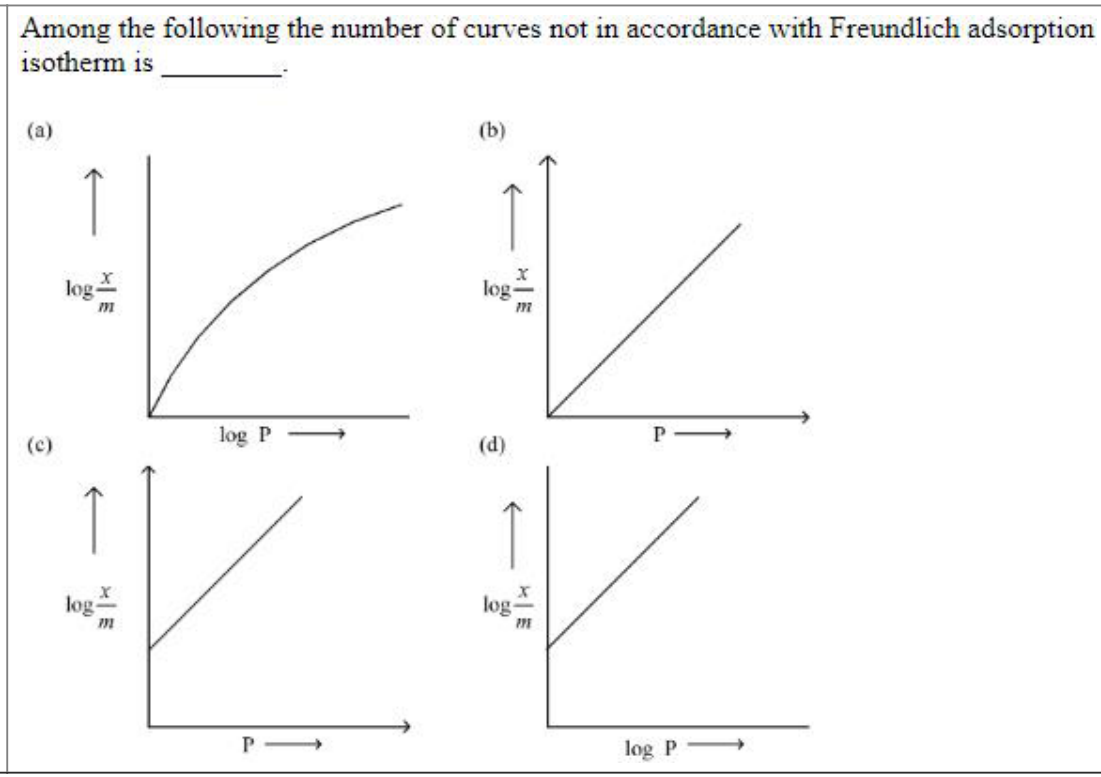
Among the following the number of curves not in accordance with Freundlich adsorption isotherm is _____________
View answer or solution
Answer
3
Among the following the number of state variables is ___________.\n\nInternal energy (U)\n\nVolume (V)\n\nHeat (q)\n\nEnthalpy (H)
View answer or solution
Answer
3