
// JEE (Main) / 2022
JEE (Main) 2022 Session 2, 27 July 2022, Shift 2 — Paper 1 (B.E / B.Tech) Chemistry
Chemistry · B.E / B.Tech
Work through the questions
30 questions
Take a moment to try each question before opening the available answer or solution.
The correct decreasing order of energy for the orbitals having, following set of quantum numbers :\n\n(A) n = 3, l = 0, m = 0\n\n(B) n = 4, l = 0, m = 0\n\n(C) n = 3, l = 1, m = 0\n\n(D) n = 3, l = 2, m = 1\n\nis :
- A(D) > (B) > (C) > (A)
- B(B) > (D) > (C) > (A)
- C(C) > (B) > (D) > (A)
- D(B) > (C) > (D) > (A)
View answer or solution
Answer
(D) > (B) > (C) > (A)
Chemical Bonding and Molecular Structure
Match List - I with List - II.\n\nList - I\n\n(A) ψ_MO = ψ_A − ψ_B\n\n(B) μ = Q × r\n\n(C) (N_b − N_a)/2\n\n(D) ψ_MO = ψ_A + ψ_B\n\nList - II\n\n(I) Dipole moment\n\n(II) Bonding molecular orbital\n\n(III) Anti-bonding molecular orbital\n\n(IV) Bond order\n\nChoose the correct answer from the options given below :
- A(A) - (II), (B) - (I), (C) - (IV), (D) - (III)
- B(A) - (III), (B) - (IV), (C) - (I), (D) - (II)
- C(A) - (III), (B) - (I), (C) - (IV), (D) - (II)
- D(A) - (III), (B) - (IV), (C) - (II), (D) - (I)
View answer or solution
Answer
(A) - (III), (B) - (I), (C) - (IV), (D) - (II)
The plot of pH-metric titration of weak base NH₄OH vs strong acid HCl looks like :
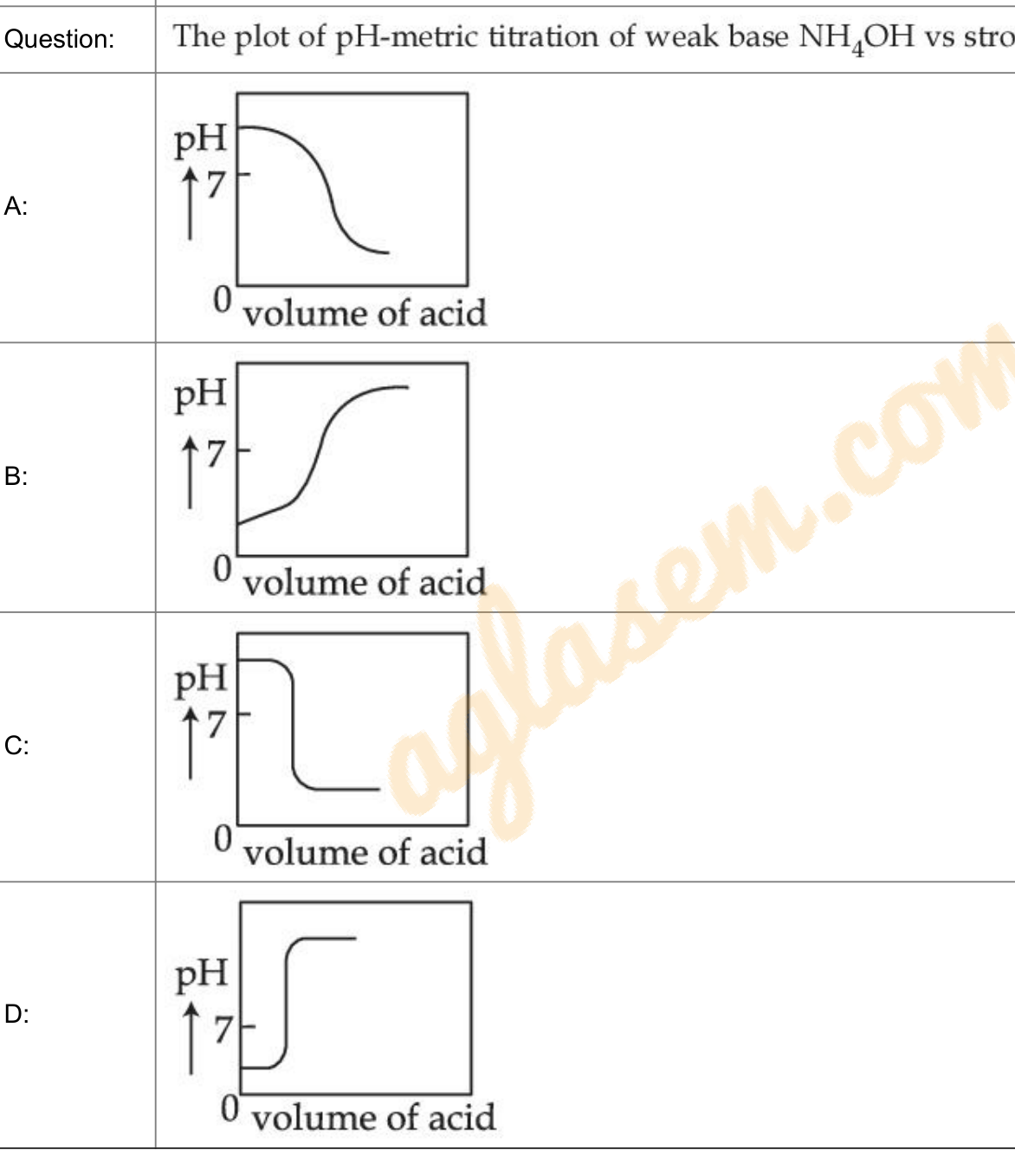
- ApH vs volume of acid: a curve starting high (above 7), falling smoothly through a steep S-shape and flattening at a low pH below 7
- BpH vs volume of acid: a curve starting low (below 7), rising smoothly through a steep S-shape and flattening at a high pH above 7
- CpH vs volume of acid: a curve starting high, dropping sharply in a near-vertical step and flattening at a low pH below 7
- DpH vs volume of acid: a curve starting low, jumping sharply in a near-vertical step and flattening at a high pH above 7
View answer or solution
Answer
pH vs volume of acid: a curve starting high (above 7), falling smoothly through a steep S-shape and flattening at a low pH below 7
Redox Reactions and Electrochemistry
Given below are two statements :\n\nStatement I : For KI, molar conductivity increases steeply with dilution\n\nStatement II : For carbonic acid, molar conductivity increases slowly with dilution\n\nIn the light of the above statements, choose the correct answer from the options given below :
- ABoth Statement I and Statement II are true
- BBoth Statement I and Statement II are false
- CStatement I is true but Statement II is false
- DStatement I is false but Statement II is true
View answer or solution
Answer
Both Statement I and Statement II are false
Some Basic Concepts in Chemistry
Given below are two statements : one is labelled as Assertion (A) and the other is labelled as Reason (R).\n\nAssertion (A) : Dissolved substances can be removed from a colloidal solution by diffusion through a parchment paper.\n\nReason (R) : Particles in a true solution cannot pass through parchment paper but the colloidal particles can pass through the parchment paper.\n\nIn the light of the above statements, choose the correct answer from the options given below :
- ABoth (A) and (R) are correct and (R) is the correct explanation of (A)
- BBoth (A) and (R) are correct but (R) is not the correct explanation of (A)
- C(A) is correct but (R) is not correct
- D(A) is not correct but (R) is correct
View answer or solution
Answer
(A) is correct but (R) is not correct
Classification of Elements and Periodicity in Properties
Outermost electronic configurations of four elements A, B, C, D are given below :\n\n(A) 3s²\n\n(B) 3s²3p¹\n\n(C) 3s²3p³\n\n(D) 3s²3p⁴\n\nThe correct order of first ionization enthalpy for them is :
- A(A) < (B) < (C) < (D)
- B(B) < (A) < (D) < (C)
- C(B) < (D) < (A) < (C)
- D(B) < (A) < (C) < (D)
View answer or solution
Answer
(B) < (A) < (D) < (C)
An element A of group 1 shows similarity to an element B belonging to group 2. If A has maximum hydration enthalpy in group 1 then B is :
- AMg
- BBe
- CCa
- DSr
View answer or solution
Answer
Mg
Given below are two statements : one is labelled as Assertion (A) and the other is labelled as Reason (R).\n\nAssertion (A) : Boron is unable to form BF₆³⁻.\n\nReason (R) : Size of B is very small.\n\nIn the light of the above statements, choose the correct answer from the options given below :
- ABoth (A) and (R) are true and (R) is the correct explanation of (A)
- BBoth (A) and (R) are true but (R) is not the correct explanation of (A)
- C(A) is true but (R) is false
- D(A) is false but (R) is true
View answer or solution
Answer
Both (A) and (R) are true but (R) is not the correct explanation of (A)
Redox Reactions and Electrochemistry
In neutral or alkaline solution, MnO₄⁻ oxidises thiosulphate to :
- AS₂O₇²⁻
- BS₂O₈²⁻
- CSO₃²⁻
- DSO₄²⁻
View answer or solution
Answer
SO₄²⁻
Redox Reactions and Electrochemistry
Low oxidation state of metals in their complexes are common when ligands :
- Ahave good π-accepting character
- Bhave good σ-donor character
- Care having good π-donating ability
- Dare having poor σ-donating ability
View answer or solution
Answer
have good π-accepting character
Some Basic Concepts in Chemistry
Given below are two statements :\n\nStatement I : The non bio-degradable fly ash and slag from steel industry can be used by cement industry.\n\nStatement II : The fuel obtained from plastic waste is lead free.\n\nIn the light of the above statements, choose the most appropriate answer from the options given below :
- ABoth Statement I and Statement II are correct
- BBoth Statement I and Statement II are incorrect
- CStatement I is correct but Statement II is incorrect
- DStatement I is incorrect but Statement II is correct
View answer or solution
Answer
Both Statement I and Statement II are correct
Organic Compounds Containing Oxygen
The structure of A in the given reaction is :\n\n[an acyl group R–C(=O)–CH₃] + NaOH + [CH₃CH₂Br] → A major product
- AR — C(OH)(CH₃) — CH(CH₃)Br (a carbon bearing OH above, R to the left and CH₃ to the right, joined below to a carbon bearing CH₃ to the lower-left and Br to the lower-right)
- BR — C(OH)(CH₃) — CH₂CH₃ (a carbon bearing OH above, R to the left and CH₃ to the right, joined below to CH₂CH₃)
- CR — C(=O) — CH₂ — CH₂ — CH₃ (a ketone: R joined to a carbonyl carbon, then a chain of three carbons ending in CH₃)
- DR — C(=O) — CH₂ — CH₂ — CH₂ — CH₂ — OH (a ketone: R joined to a carbonyl carbon, then a chain of four carbons ending in OH)
View answer or solution
Answer
R — C(=O) — CH₂ — CH₂ — CH₃ (a ketone: R joined to a carbonyl carbon, then a chain of three carbons ending in CH₃)
Organic Compounds Containing Halogens
Major product ‘B’ of the following reaction sequence is :\n\nCH₃ – C(CH₃) = CH – CH₃ —(Br₂/CH₃OH)→ A —(HI)→ B (major product)
- ACH₃ – C(OH)(CH₃) — CH(Br) — CH₃ (HO above the second carbon, Br above the third)
- BCH₃ – C(I)(CH₃) — CH(Br) — CH₃ (I above the second carbon, Br above the third)
- CCH₃ – C(Br)(CH₃) — CH(OH) — CH₃ (Br above the second carbon, OH above the third)
- DCH₃ – C(Br)(CH₃) — CH(I) — CH₃ (Br above the second carbon, I above the third)
View answer or solution
Answer
CH₃ – C(I)(CH₃) — CH(Br) — CH₃ (I above the second carbon, Br above the third)
Match List - I with List - II.\n\nList - I\n\n(A) [a benzene ring bearing COCl] —(H₂/Pd-BaSO₄)→ [a benzene ring bearing CHO]\n\n(B) CH₃ – CN —(SnCl₂/HCl, H₃O⁺)→ CH₃ – CHO\n\n(C) [a benzene ring bearing CH₃] —(CrO₂Cl₂, H₃O⁺)→ [a benzene ring bearing CHO]\n\n(D) [a benzene ring] —(CO, HCl, AlCl₃ (anhyd))→ [a benzene ring bearing CHO]\n\nList - II\n\n(I) Gatterman Koch reaction\n\n(II) Etard reaction\n\n(III) Stephen reaction\n\n(IV) Rosenmund reaction\n\nChoose the correct answer from the options given below :
- A(A) - (IV), (B) - (III), (C) - (II), (D) - (I)
- B(A) - (I), (B) - (II), (C) - (III), (D) - (IV)
- C(A) - (II), (B) - (III), (C) - (IV), (D) - (I)
- D(A) - (III), (B) - (II), (C) - (I), (D) - (IV)
View answer or solution
Answer
(A) - (IV), (B) - (III), (C) - (II), (D) - (I)
Match List - I with List - II.\n\nList - I (Polymer) : (A) Neoprene; (B) Teflon; (C) Acrilan; (D) Natural rubber\n\nList - II (Monomer) : (I) Acrylonitrile; (II) Chloroprene; (III) Tetrafluoroethene; (IV) Isoprene\n\nChoose the correct answer from the options given below :
- A(A) - (II), (B) - (III), (C) - (I), (D) - (IV)
- B(A) - (II), (B) - (I), (C) - (III), (D) - (IV)
- C(A) - (II), (B) - (I), (C) - (IV), (D) - (III)
- D(A) - (I), (B) - (II), (C) - (III), (D) - (IV)
View answer or solution
Answer
(A) - (II), (B) - (III), (C) - (I), (D) - (IV)
An organic compound ‘A’ contains nitrogen and chlorine. It dissolves readily in water to give a solution that turns litmus red. Titration of compound ‘A’ with standard base indicates that the molecular weight of ‘A’ is 131 ± 2. When a sample of ‘A’ is treated with aq. NaOH, a liquid separates which contains N but not Cl. Treatment of the obtained liquid with nitrous acid followed by phenol gives orange precipitate. The compound ‘A’ is :
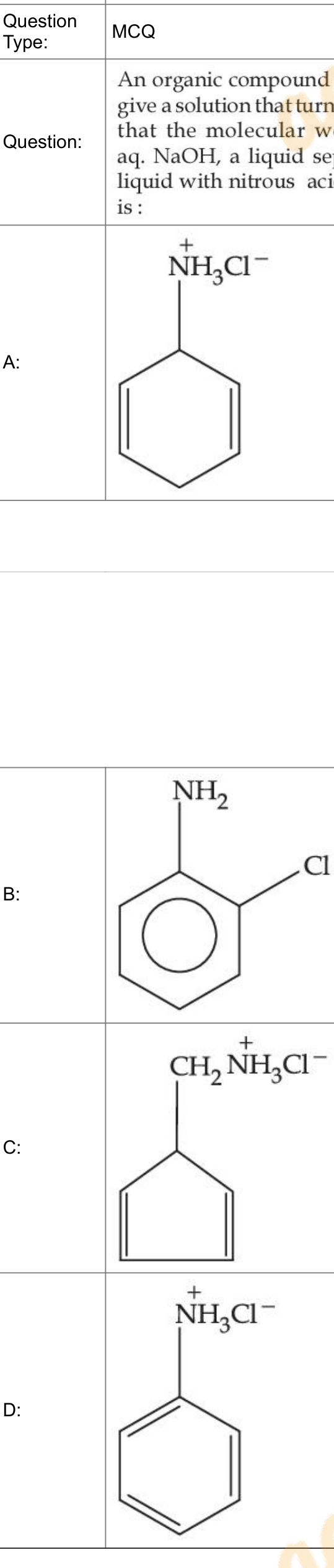
- Aa benzene ring bearing NH₃⁺Cl⁻ (anilinium chloride) at the top
- Ba benzene ring with NH₂ at the top and Cl on the adjacent (ortho) vertex
- Ca five-membered ring with two double bonds bearing CH₂NH₃⁺Cl⁻ at the top
- Da seven-membered ring with three double bonds bearing NH₃⁺Cl⁻ at the top
View answer or solution
Answer
a seven-membered ring with three double bonds bearing NH₃⁺Cl⁻ at the top
Match List - I with List - II.\n\nList - I\n\n(A) Glucose + HI\n\n(B) Glucose + Br₂ water\n\n(C) Glucose + acetic anhydride\n\n(D) Glucose + HNO₃\n\nList - II\n\n(I) Gluconic acid\n\n(II) Glucose pentacetate\n\n(III) Saccharic acid\n\n(IV) Hexane\n\nChoose the correct answer from the options given below :
- A(A) - (IV), (B) - (I), (C) - (II), (D) - (III)
- B(A) - (IV), (B) - (III), (C) - (II), (D) - (I)
- C(A) - (III), (B) - (I), (C) - (IV), (D) - (II)
- D(A) - (I), (B) - (III), (C) - (IV), (D) - (II)
View answer or solution
Answer
(A) - (IV), (B) - (I), (C) - (II), (D) - (III)
Organic Compounds Containing Oxygen
Which of the following enhances the lathering property of soap ?
- ASodium stearate
- BSodium carbonate
- CSodium rosinate
- DTrisodium phosphate
View answer or solution
Answer
Sodium rosinate
Purification and Characterisation of Organic Compounds
Match List - I with List - II.\n\nList - I (Mixture) : (A) Chloroform & Aniline; (B) Benzoic acid & Naphthalene; (C) Water & Aniline; (D) Naphthalene & Sodium chloride\n\nList - II (Purification Process) : (I) Steam distillation; (II) Sublimation; (III) Distillation; (IV) Crystallisation\n\nChoose the correct answer from the options given below :
- A(A) - (IV), (B) - (III), (C) - (I), (D) - (II)
- B(A) - (III), (B) - (I), (C) - (IV), (D) - (II)
- C(A) - (III), (B) - (IV), (C) - (II), (D) - (I)
- D(A) - (III), (B) - (IV), (C) - (I), (D) - (II)
View answer or solution
Answer
(A) - (III), (B) - (IV), (C) - (I), (D) - (II)
Principles Related to Practical Chemistry
Fe³⁺ cation gives a prussian blue precipitate on addition of potassium ferrocyanide solution due to the formation of :
- A[Fe(H₂O)₆]₂[Fe(CN)₆]
- BFe₂[Fe(CN)₆]₂
- CFe₃[Fe(OH)₂(CN)₄]₂
- DFe₄[Fe(CN)₆]₃
View answer or solution
Answer
Fe₄[Fe(CN)₆]₃
Some Basic Concepts in Chemistry
The normality of H₂SO₄ in the solution obtained on mixing 100 mL of 0.1 M H₂SO₄ with 50 mL of 0.1 M NaOH is __________ × 10⁻¹ N. (Nearest Integer)
View answer or solution
Answer
1
For a real gas at 25°C temperature and high pressure (99 bar) the value of compressibility factor is 2, so the value of Vander Waal’s constant ‘b’ should be __________ × 10⁻² L mol⁻¹ (Nearest integer) (Given R = 0.083 L bar K⁻¹mol⁻¹)
View answer or solution
Answer
25
A gas (Molar mass=280 g mol⁻¹) was burnt in excess O₂ in a constant volume calorimeter and during combustion the temperature of calorimeter increased from 298.0 K to 298.45 K. If the heat capacity of calorimeter is 2.5 kJ K⁻¹ and enthalpy of combustion of gas is 9 kJ mol⁻¹ then amount of gas burnt is __________ g. (Nearest Integer)
View answer or solution
Answer
35
When a certain amount of solid A is dissolved in 100 g of water at 25°C to make a dilute solution, the vapour pressure of the solution is reduced to one-half of that of pure water. The vapour pressure of pure water is 23.76 mmHg. The number of moles of solute A added is __________. (Nearest Integer)
View answer or solution
Answer
3
[A] → [B]\nReactant | Product\n\nIf formation of compound [B] follows the first order of kinetics and after 70 minutes the concentration of [A] was found to be half of its initial concentration. Then the rate constant of the reaction is x × 10⁻⁶ s⁻¹. The value of x is __________. (Nearest Integer)
View answer or solution
Answer
165
Among the following ores Bauxite, Siderite, Cuprite, Calamine, Haemtite, Kaolinite, Malachite, Magnetite, Sphalerite, Limonite, Cryolite, the number of principal ores if iron is __________.
View answer or solution
Answer
4
Redox Reactions and Electrochemistry
The oxidation state of manganese in the product obtained in a reaction of potassium permanganate and hydrogen peroxide in basic medium is __________.
View answer or solution
Answer
4
The number of molecule(s) or ion(s) from the following having non-planar structure is __________.\n\nNO₃⁻, H₂O₂, BF₃, PCl₃, XeF₄, SF₄, XeO₃, PH₄⁺, SO₃, [Al(OH)₄]⁻
View answer or solution
Answer
6
The spin only magnetic moment of the complex present in Fehling’s reagent is __________ B.M. (Nearest integer).
View answer or solution
Answer
2
Organic Compounds Containing Oxygen
In the above reaction, 5 g of toluene is converted into benzaldehyde with 92% yield. The amount of benzaldehyde produced is __________ × 10⁻² g. (Nearest integer)

View answer or solution
Answer
530