
// JEE (Main) / 2022
JEE (Main) 2022 Session 1, 30 June 2022, Shift 1 — Paper 1 (B.E / B.Tech) Chemistry
Chemistry · B.E / B.Tech
Work through the questions
30 questions
Take a moment to try each question before opening the available answer or solution.
Some Basic Concepts in Chemistry
An element X has a body centred cubic (bcc) structure with a cell edge of 200 pm. The density of the element is 5 g cm⁻³. The number of atoms present in 300 g of the element X is ________. Given : Avogadro constant, N_A = 6.0 × 10²³ mol⁻¹.
- A5 N_A
- B6 N_A
- C15 N_A
- D25 N_A
View answer or solution
Answer
25 N_A
The number of radial nodes and total number of nodes in 4p orbital respectively are :
- A2 and 3
- B2 and 2
- C3 and 4
- D4 and 4
View answer or solution
Answer
2 and 3
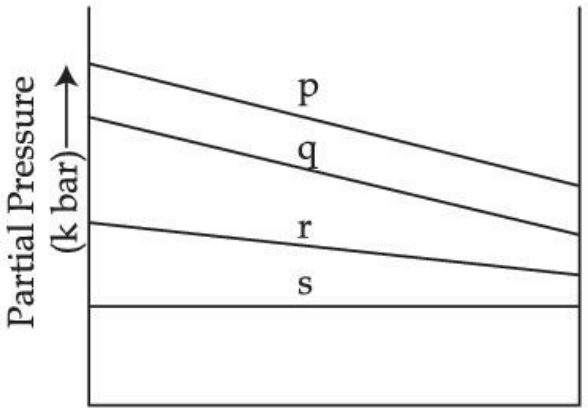
For a solution of the gases A, B, C and D in water at 298 K, the values of Henry's law constant (K_H) are 30.40, 2.34, 1.56 × 10⁻⁵ and 0.513 k bar respectively. In the given graph, the lines marked as 'p' and 's' correspond respectively to :
- AA and C
- BB and A
- CD and A
- DC and D
View answer or solution
Answer
A and C
The equilibrium constant for the reversible reaction 2A(g) ⇌ 2B(g) + C(g) is K₁ and for the reaction (3/2)A(g) ⇌ (3/2)B(g) + (3/4)C(g) is K₂. K₁ and K₂ are related as :
- AK₁ = √K₂
- BK₂ = √K₁
- CK₂ = K₁^(3/4)
- DK₁ = K₂^(3/4)
View answer or solution
Answer
K₂ = K₁^(3/4)
In which of the following half cells, electrochemical reaction is pH dependent ?
- APt | Fe³⁺, Fe²⁺
- BMnO₄⁻ | Mn²⁺
- CAg | AgCl | Cl⁻
- D(1/2)F₂ | F⁻
View answer or solution
Answer
MnO₄⁻ | Mn²⁺
Classification of Elements and Periodicity in Properties
The correct order of electron gain enthalpy (− ve value) is :
- AO > S > Se > Te
- BO < S < Se < Te
- CO < S > Se > Te
- DO < S > Se < Te
View answer or solution
Answer
O < S > Se > Te
ΔG° vs T plot for the formation of MgO, involving reaction 2Mg + O₂ → 2MgO, will look like :
- Aa line rising gently then more steeply with T
- Ba straight line rising steadily with T
- Ca line rising with T and then becoming horizontal
- Da line rising to a peak and then falling with T
View answer or solution
Answer
a line rising gently then more steeply with T
Some Basic Concepts in Chemistry
Match List - I with List - II : List - I (a) Sodium hydride (b) Silane (c) Vanadium hydride (d) Aluminium hydride List - II (i) Lewis acid (ii) Saline hydride (iii) Molecular hydride (iv) Non-stoichiometric hydride Correct answer is :
- A(a)-(ii), (b)-(iii), (c)-(iv), (d)-(i)
- B(a)-(ii), (b)-(iv), (c)-(iii), (d)-(i)
- C(a)-(iii), (b)-(ii), (c)-(i), (d)-(iv)
- D(a)-(i), (b)-(iii), (c)-(iv), (d)-(ii)
View answer or solution
Answer
(a)-(ii), (b)-(iii), (c)-(iv), (d)-(i)
Correct statement about alkali metal oxides is
- Aperoxides are colored.
- Bsuperoxides are paramagnetic.
- Coxides are paramagnetic.
- Dperoxides are both colored and paramagnetic.
View answer or solution
Answer
superoxides are paramagnetic.
A →(573 K) Red phosphorus →(heat ; 803 K under pressure) B Red phosphorus is obtained by heating "A" at 573 K, and can be converted to "B" by heating at 803 K under pressure. A and B, respectively, are
- Aβ-black phosphorus and white phosphorus.
- Bwhite phosphorus and β-black phosphorus.
- Cα-black phosphorus and white phosphorus.
- Dwhite phosphorus and α-black phosphorus.
View answer or solution
Answer
white phosphorus and α-black phosphorus.
Correct formula of the compound which gives a white precipitate with BaCl₂ solution, but not with AgNO₃ solution, is
- A[Co(NH₃)₅Br]SO₄.
- B[Co(NH₃)₅SO₄]Br.
- C[Pt(NH₃)₄Cl₂]Br₂
- D[Pt(NH₃)₄Br₂]Cl₂.
View answer or solution
Answer
[Co(NH₃)₅Br]SO₄.
Organic Compounds Containing Oxygen
Which one of the following chemicals has not been used for the dry cleaning of clothes ?
- ATetrachloroethene
- BLiquid CO₂
- CEthanol
- DH₂O₂
View answer or solution
Answer
Ethanol
Purification and Characterisation of Organic Compounds
TLC analysis of a mixture having 3 components (A, B, C) using silica gel as the stationary phase gave following R_f values; for A = 0.72, B = 0.48, C = 0.20. Regarding the above observations, which one of the following statements is not correct for column chromatography of the mixture ?
- AA is the most non-polar component
- BC is the most soluble component in mobile phase
- CA will be eluted first
- DC is the most strongly absorbed component
View answer or solution
Answer
C is the most soluble component in mobile phase
Consider the given chemical reaction cyclohexanecarboxylic acid --(i) Red P, Cl₂ / (ii) H₂O--> P (Major Product) Identify the product P.
- A1-chloro-1-cyclohexanecarboxylic acid (a cyclohexane ring with Cl and –COOH on the same carbon)
- Bcyclohexanecarbonyl chloride (a cyclohexane ring bearing –C(=O)Cl)
- C3-chlorocyclohexane-1-carboxylic acid (a cyclohexane ring with –COOH and Cl on the carbon meta to it)
- D4-chlorocyclohexane-1-carboxylic acid (a cyclohexane ring with –COOH and Cl on the carbon para to it)
View answer or solution
Answer
1-chloro-1-cyclohexanecarboxylic acid (a cyclohexane ring with Cl and –COOH on the same carbon)
Choose the reaction which is not possible :
- Ahalobenzene + 2Na --Ether--> biphenyl
- B1-chloro-4-nitrobenzene + NaOH --(i) Δ, (ii) HCl--> 4-nitrophenol
- Cphenylacetaldehyde + [Ag(NH₃)₂]⁺ + OH⁻ --Δ--> phenylacetate ion (C₆H₅–CH₂COO⁻)
- Dbenzaldehyde + Cu²⁺ + OH⁻ --> benzoate ion (C₆H₅–COO⁻)
View answer or solution
Answer
benzaldehyde + Cu²⁺ + OH⁻ --> benzoate ion (C₆H₅–COO⁻)
Organic Compounds Containing Oxygen
Which among the following will be the major product of the given reaction ? CH₃–C(=O)–CH₂–CH₂–C(=O)–CH₂–CH₂–CO₂H --(i) 10% KOH / (ii) H₃O⁺-->
- Aa cyclopent-2-en-1-one ring carrying a –CH₂–CH₂–CO₂H chain on the double-bonded ring carbon away from the carbonyl
- Ba cyclopent-2-en-1-one ring carrying a –CH₂–CO₂H chain and a methyl group on the double-bonded ring carbons
- Ca cyclohex-2-en-1-one ring carrying a –CO₂H group and a methyl group on the double-bonded ring carbons
- Da spiro bicyclic lactone (a cyclopentanone ring spiro-fused to a five-membered lactone ring)
View answer or solution
Answer
a cyclopent-2-en-1-one ring carrying a –CH₂–CO₂H chain and a methyl group on the double-bonded ring carbons
A + CH₃CH₂OH → benzene --(i) H₂SO₄ (oleum), Δ (ii) NaOH (iii) HCl--> B Consider the above reaction sequence. Identify the component A and component B :
- AA = C₆H₅NH₂, B = chlorobenzene
- BA = C₆H₅N₂⁺Cl⁻, B = phenol
- CA = chlorobenzene, B = C₆H₅NH₂
- DA = phenol, B = C₆H₅N₂⁺Cl⁻
View answer or solution
Answer
A = C₆H₅N₂⁺Cl⁻, B = phenol
Match List - I with List - II. List - I (Polymer) (a) Acrilan (b) Neoprene (c) Polystyrene (d) Buna-N List - II (Repeat Unit) (i) –[CH₂–C(Cl)=CH–CH₂]–ₙ (ii) –[CH₂–CH(C₆H₅)]–ₙ (iii) –[CH₂–CH(CN)]–ₙ (iv) –[CH₂–CH=CH–CH₂–CH₂–CH(CN)]–ₙ Choose the correct match from the options given below :
- A(a)-(iii), (b)-(iv), (c)-(ii), (d)-(i)
- B(a)-(iii), (b)-(ii), (c)-(i), (d)-(iv)
- C(a)-(iii), (b)-(i), (c)-(ii), (d)-(iv)
- D(a)-(ii), (b)-(iii), (c)-(i), (d)-(iv)
View answer or solution
Answer
(a)-(iii), (b)-(i), (c)-(ii), (d)-(iv)
The sugar produced after complete hydrolysis of DNA is
- Aa pentose sugar.
- Ba hexose sugar.
- Ca polysaccharide.
- Da disaccharide.
View answer or solution
Answer
a pentose sugar.
Organic Compounds Containing Oxygen
The reagent neutral ferric chloride is used to detect the presence of ________
- Asulphide ion and alcoholic –OH group
- Bacetate ion and phenolic –OH group.
- Csulphide ion and phenolic –OH group.
- Dacetate ion and alcoholic –OH group.
View answer or solution
Answer
acetate ion and phenolic –OH group.
Some Basic Concepts in Chemistry
Blister copper is produced by reaction of copper oxide with copper sulphide. 2Cu₂O + Cu₂S → 6Cu + SO₂ When 2.86 × 10³ g of Cu₂O and 4.77 × 10³ g of Cu₂S are used for reaction, the mass of copper produced is ________ g. (nearest integer) (Atomic mass of Cu = 63.5 a.m. u S = 32.0 a.m. u O = 16.0 a.m. u)
View answer or solution
Answer
3810
Chemical Bonding and Molecular Structure
Amongst the following, the number of molecule/(s) having net resultant dipole moment is ________. NF₃, BF₃, BeF₂, CHCl₃, H₂S, SiF₄, CCl₄, PF₅
View answer or solution
Answer
3
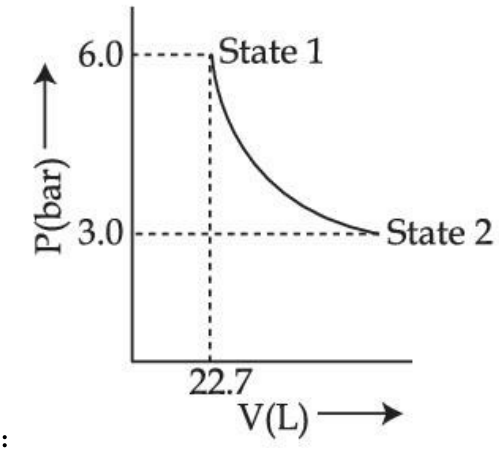
1.0 mol of monoatomic ideal gas is expanded from state 1 to state 2 as shown in the figure. The magnitude of the work done for the expansion of gas from state 1 to state 2 at 300 K is ________ J. (Nearest integer) (Given : R=8.3 J K⁻¹ mol⁻¹, ln10=2.3, log2=0.30)
View answer or solution
Answer
1718
For the reaction P → B, the values of frequency factor A and activation energy E_A are 4 × 10¹³ s⁻¹ and 8.3 kJ mol⁻¹ respectively. If the reaction is of first order, the temperature at which the rate constant is 2 × 10⁻⁶ s⁻¹ is ________ × 10⁻¹ K (Given : ln 10 = 2.3, R = 8.3 J K⁻¹ mol⁻¹, log2 = 0.30)
View answer or solution
Answer
225
Some Basic Concepts in Chemistry
100 mL of 0.3 M acetic acid is shaken with 0.8 g of wood charcoal. The final concentration of acetic acid in the solution after adsorption is 0.125 M. The mass of acetic acid adsorbed per gram of carbon is ________ × 10⁻⁴ g. (Given : Molar mass of acetic acid = 60 g mol⁻¹)
View answer or solution
Answer
13125
Redox Reactions and Electrochemistry
In the following brown complex, the oxidation state of iron is + ________. [Fe(H₂O)₆]²⁺ + NO → [Fe(H₂O)₅(NO)]²⁺ + H₂O
View answer or solution
Answer
2
Spin only magnetic moment (μ_s) of K₃[Fe(CN)₆] is ________ B.M. (Nearest integer).
View answer or solution
Answer
2
Purification and Characterisation of Organic Compounds
An organic compound with 51.6% sulfur is heated in a Carius tube. The amount of this compound which will form 0.752 g of barium sulphate is ________ × 10⁻¹ g. (Given molar mass of barium sulphate 233 g mol⁻¹) (Nearest integer).
View answer or solution
Answer
2
A hydrocarbon ‘X’ is found to have molar mass of 80. A 10.0 mg of compound ‘X’ on hydrogenation consumed 8.40 mL of H₂ gas (measured at STP). Ozonolysis of compound ‘X’ yields only formaldehyde and dialdehyde. The total number of fragments/molecules produced from the ozonolysis of compound ‘X’ is ________.
View answer or solution
Answer
4
How many of the following drugs belong to the tranquilizer class ________ ? Veronal, Luminal, Propanal, Seconal
View answer or solution
Answer
3