
// JEE (Main) / 2026
JEE (Main) 2026 Session 2, 5 April 2026, Shift 2 — Paper 1 (B.E / B.Tech) Physics
Physics · B.E / B.Tech
Work through the questions
25 questions
Take a moment to try each question before opening the available answer or solution.
Dual Nature of Matter and Radiation
Match List – I with List – II. List - I: A. Meter (L) ; B. Second (S) ; C. Kilogram (M) ; D. Kelvin (K) List - II: I. √(hc/G) ; II. √(Gh/c⁵) ; III. √(K²L²c³/(Gh)) ; IV. √(Gh/c³) where h (Planck's constant), G (gravitational constant) and c (speed of light in vacuum) as fundamental units. Choose the correct answer from the options given below :
- AA-II, B-IV, C-I, D-III
- BA-IV, B-II, C-I, D-III
- CA-IV, B-I, C-II, D-III
- DA-III, B-I, C-II, D-IV
View answer or solution
Answer
A-IV, B-II, C-I, D-III
In an experiment to determine the resistance of a given wire using Ohm's law, the voltmeter and ammeter readings are noted as 10 V and 5 A, respectively. The least counts of voltmeter and ammeter are 500 mV and 200 mA, respectively. The estimated error in the resistance measurement is _________ Ω
- A0.25
- B2
- C2.5
- D0.18
View answer or solution
Answer
0.18
A mass of 1 kg is kept on a inclined plane with 30° inclination with respect to horizontal plane and it is at rest initially. Then the whole assembly is moved up with constant velocity of 4 m/s. The work done by the frictional force in time 2 s is _________ J. (Take g = 10 m/s²)
- A20
- B25
- C30
- D10
View answer or solution
Answer
20
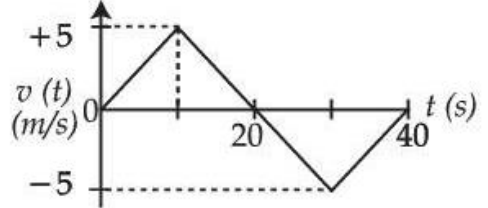
The velocity (v) versus time (t) plot of a particle is shown in the figure, for a time interval of 40 s. The total distance travelled by the particle and the average velocity during this period are, respectively _________. [Figure: graph of v(t) in m/s versus t in s. v starts at 0 at t = 0, rises linearly to +5 m/s at t = 10 s, falls linearly to 0 at t = 20 s, falls linearly to −5 m/s at t = 30 s and returns linearly to 0 at t = 40 s. The v-axis is marked +5 and −5; the t-axis is marked 20 and 40.]
- A25 m and zero
- B50 m and zero
- C100 m and zero
- D100 m and 2.5 m/s
View answer or solution
Answer
100 m and zero
A wheel initially at rest is subjected to a uniform angular acceleration about its axis. In the first 2 s it rotates through an angle θ₁ and in the next 2 s it rotates through an angle θ₂. The ratio θ₂/θ₁ is _________.
- A6
- B3
- C4
- D1/3
View answer or solution
Answer
3
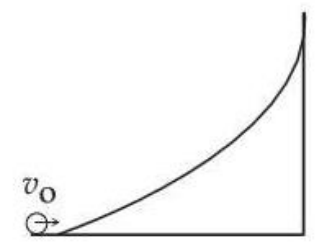
An object of uniform density rolls up the curved path with the initial velocity v₀ as shown in the figure. If the maximum height attained by an object is (7v₀²)/(10 g) (g = acceleration due to gravity), the object is a _________. [Figure: a curved path rising from a horizontal base at the left up to a vertical wall at the right; at the left end of the path a small circle with an arrow is labelled v₀.]
- Asolid cylinder
- Bring
- Cdisc
- Dsolid sphere
View answer or solution
Answer
solid sphere
A body of mass m is taken from the surface of earth to a height equal to twice the radius of earth (Rₑ). The increase in potential energy will be _________. (g is acceleration due to gravity at the surface of earth)
- A(1/2) mgRₑ
- B(3/4) mgRₑ
- C(1/4) mgRₑ
- D(2/3) mgRₑ
View answer or solution
Answer
(2/3) mgRₑ
Properties of Solids and Liquids
Eight mercury drops, each of radius r, coalesce to form a bigger drop. The surface energy released in this process is _________. (S is the surface tension of mercury).
- A8πr²S
- B16πr²S
- C64πr²S
- D4πr²S
View answer or solution
Answer
16πr²S
An ideal gas at pressure P and temperature T is expanding such that PT³ = constant. The coefficient of volume expansion of the gas is _________.
- A2/T
- B1/T
- C4/T
- D3/T
View answer or solution
Answer
4/T
Match List – I with List – II. List - I: A. sin²ωt ; B. sin³(2ωt) ; C. sin(ωt) + cos(πωt) ; D. cos ωt + cos 2ωt List - II: I. Periodic with time period T = π/ω but not simple harmonic motion (SHM) ; II. Periodic with time period T = 2π/ω but Not SHM ; III. Periodic with time period T = π/ω and SHM ; IV. Non-periodic Choose the correct answer from the options given below :
- AA-III, B-I, C-IV, D-II
- BA-II, B-I, C-III, D-IV
- CA-III, B-II, C-IV, D-I
- DA-II, B-I, C-IV, D-III
View answer or solution
Answer
A-III, B-I, C-IV, D-II
A metal rod of length L rotates about one end at origin with a uniform angular velocity ω. The magnetic field radially falls off as B(r) = B₀ e^(−λr), λ being a positive constant. The emf induced (neglecting the centripetal force on electrons in the rod) is :
- AB₀ω[1/λ² − e^(−λL)(1/λ² + L/λ)]
- BB₀ω[1/λ² + e^(−λL)(1/λ² + L/λ)]
- CB₀ω[4/λ² − e^(−2λL)(1/λ² + 2L/λ)]
- DB₀ω[3/λ² − e^(−3λL)(3/λ² + L/λ)]
View answer or solution
Answer
B₀ω[1/λ² − e^(−λL)(1/λ² + L/λ)]
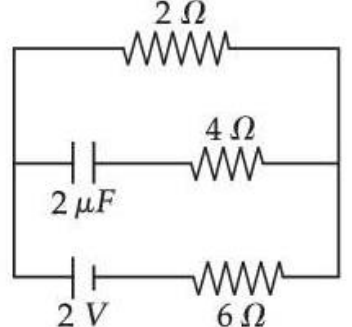
Under steady state condition the potential difference across the capacitor in the circuit is _______ V. [Figure: a rectangular circuit with three parallel branches between the left node and the right node — top branch: 2 Ω resistor; middle branch: 2 μF capacitor in series with a 4 Ω resistor; bottom branch: 2 V cell in series with a 6 Ω resistor.]
- A0.5
- B1.5
- C0
- D2
View answer or solution
Answer
0.5
A particle of charge q and mass m is projected from origin with an initial velocity v⃗ = (v₀/√2 x̂ + v₀/√2 ŷ). There exists a uniform magnetic field B⃗ = B₀ ẑ and a space varying electric field E⃗ = E₀ e^(−λx) x̂ within the region 0 ≤ x ≤ L. After travelling a distance such that x-coordinate has changed from x = 0 to x = L, the change in the kinetic energy is _________.
- A(qE₀/λ)[1 − e^(−λL)]
- B(v₀qB₀/(2λ))[2 − e^(−2λL)]
- C(qE₀/λ)[1 + e^(−λL)]
- Dq((E₀ + v₀B₀)/λ)[1 − e^(−λL/2)]
View answer or solution
Answer
(qE₀/λ)[1 − e^(−λL)]
Given below are two statements : one is labelled as Assertion (A) and the other is labelled as Reason (R). Assertion (A) : The electromagnetic wave exerts pressure on the surface on which they are allowed to fall. Reason (R) : There is no mass associated with the electromagnetic waves. In the light of the above statements, choose the correct answer from the options given below :
- ABoth (A) and (R) are true and (R) is the correct explanation of (A)
- BBoth (A) and (R) are true but (R) is not the correct explanation of (A)
- C(A) is true but (R) is false
- D(A) is false but (R) is true
View answer or solution
Answer
Both (A) and (R) are true but (R) is not the correct explanation of (A)
A thin convex lens and a thin concave lens are kept in contact and are co-axial. Which of the following statements is correct for this combination of two lenses ?
- Abehaves as concave lens if |f_convex| > |f_concave|
- Bbehaves as concave lens if |f_convex| < |f_concave|
- Cbehaves as convex lens if |f_convex| > |f_concave|
- DFocal length of the lens system will change if the positions of two lenses are interchanged
View answer or solution
Answer
behaves as concave lens if |f_convex| > |f_concave|
An object AB is placed 15 cm on the left of a convex lens P of focal length 10 cm. Another convex lens Q is now placed 15 cm right of lens P. If the focal length of lens Q is 15 cm, the final image is _________.
- Avirtual, formed at 7.5 cm right of lens Q, with a size bigger than that of AB
- Breal, formed at 7.5 cm right of lens Q, with a size same as that of AB
- Cformed at infinity.
- Dreal, formed at 7 cm right of lens Q, with a size smaller than that of AB
View answer or solution
Answer
real, formed at 7.5 cm right of lens Q, with a size same as that of AB
The maximum intensity in a Young's double slit experiment is I₀. Distance between the slits (d) is 5λ, where λ is the wavelength of light used. The intensity of the fringe, exactly opposite to one of the slits on the screen, placed at D = 10d is _________.
- AI₀/4
- BI₀/2
- CI₀
- D3I₀/4
View answer or solution
Answer
I₀/2
Dual Nature of Matter and Radiation
An electron is travelling with a velocity v in free space and when it enters a medium, its velocity is reduced by 20%. The de Broglie wavelength of electron in the medium is αλ₀, where λ₀ is its de Broglie wavelength in free space. The value of α is _________.
- A1.20
- B1.0
- C1.25
- D0.75
View answer or solution
Answer
1.25
Assuming the experimental mass of (12/6)C as 12 u, the mass defect of (12/6)C atom is _________ MeV/c². (Mass of proton = 1.00727 u. mass of neutron = 1.00866 u, 1 u = 931.5 MeV/c² and c is the speed of the light in vacuum).
- A127.5
- B89.03
- C272.0
- D92.0
View answer or solution
Answer
89.03
In a semiconductor p-n diode, the doping concentrations on p-side and n-side are 10^15 atoms/cm³ and 10^18 atoms/cm³, respectively. Which one of the following statements is true ?
- AWidths of depletion region on either side of the interface are equal
- BThe depletion region width is more on p-side compared to that in n-side
- CThe depletion region width is more on n-side compared to that in p-side
- DNo depletion region forms because of unequal doping concentrations on p and n-sides
View answer or solution
Answer
The depletion region width is more on p-side compared to that in n-side
A copper wire of length 3 m is stretched by 3 mm by applying an external force. The volume of the wire is 600 × 10⁻⁶ m³. The elastic potential energy stored in the wire in stretched condition would be _________ J. (Given Young modulus of copper = 1.1 × 10¹¹ N/m²)
View answer or solution
Answer
33
Properties of Solids and Liquids
The heat extracted out of x gram of water initially at 50 °C to cool it down to 0 °C is sufficient to evaporate (1000 − x) gram of water also initially at 50 °C. The value of x (closest integer) is _________. (Take latent heat of water 2256 kJ/kg. K, specific heat capacity of water 4200 J/kg. K)
View answer or solution
Answer
922
A series LCR circuit with R = 20 Ω, L = 1.6 H and C = 40 μF is connected to a variable frequency a.c. source. The inductive reactance at resonant frequency is _________ Ω.
View answer or solution
Answer
200
When an external resistance of 5 Ω is connected across terminals of a cell, a current of 0.25 A flows through it. When the 5 Ω resistor is replaced by a 2 Ω resistor, a current of 0.5 A flows through it. The internal resistance of the cell is _________ Ω.
View answer or solution
Answer
1
A circular loop of radius 20 cm and resistance 2 Ω is placed in a time varying magnetic field B⃗ = (2t² + 2t + 3) T. At t = 0, for the plane of the loop being perpendicular to the magnetic field and, the induced current in the loop at t = 3 s is α/50 A. The value of α is _________. (Take π = 22/7)
View answer or solution
Answer
44