
// JEE (Main) / 2025
JEE (Main) 2025 Session 2, 4 April 2025, Shift 2 — Paper 1 (B.E / B.Tech) Physics
Physics · B.E / B.Tech
Work through the questions
25 questions
Take a moment to try each question before opening the available answer or solution.
Two polarisers P₁ and P₂ are placed in such a way that the intensity of the transmitted light will be zero. A third polariser P₃ is inserted in between P₁ and P₂, at particular angle between P₂ and P₃. The transmitted intensity of the light passing the through all three polarisers is maximum. The angle between the polarisers P₂ and P₃ is :
- Aπ/8
- Bπ/6
- Cπ/4
- Dπ/3
View answer or solution
Answer
π/4
A radioactive material P first decays into Q and then Q decays to non-radioactive material R. Which of the following figure represents time dependent mass of P, Q and R ?
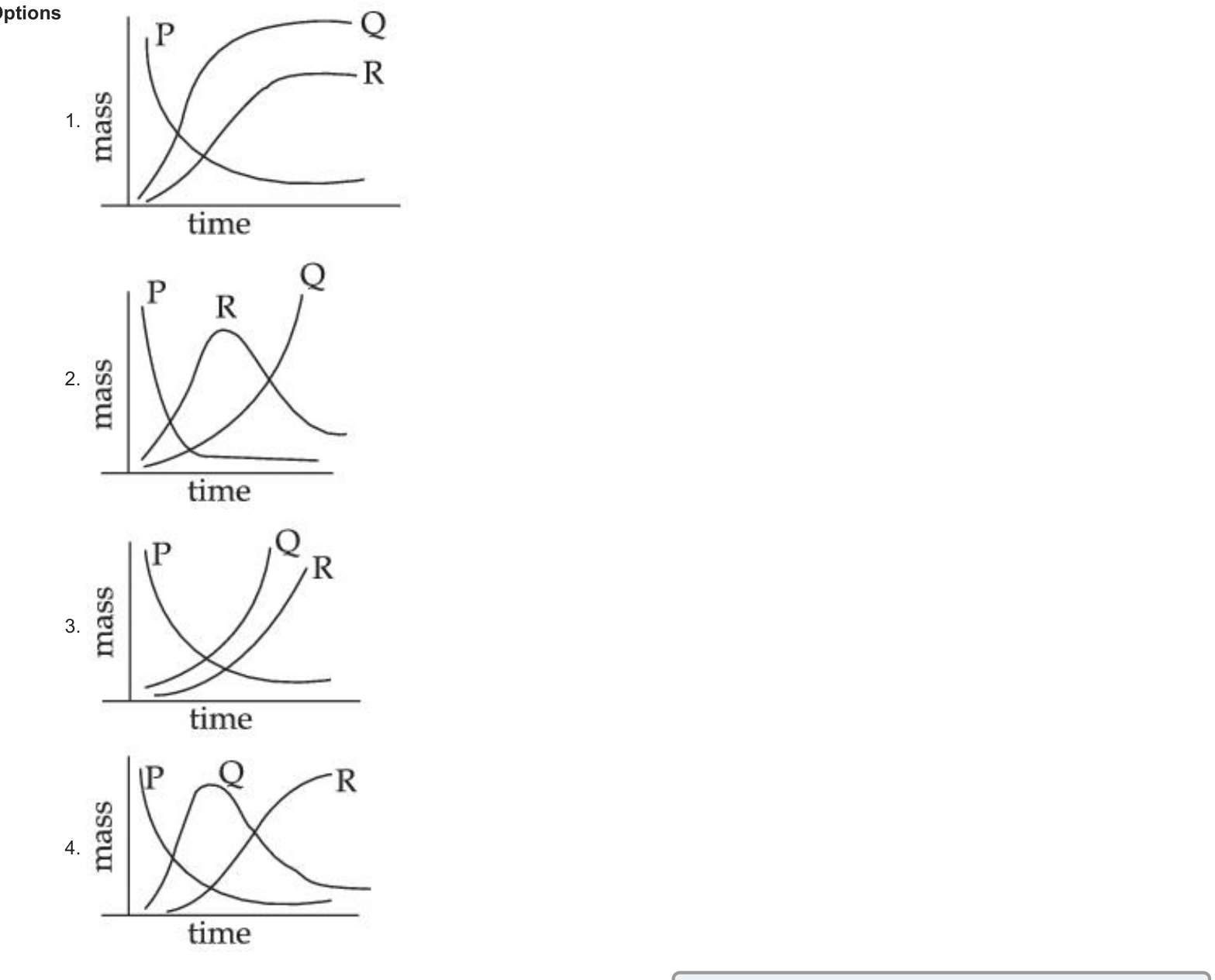
- AGraph: mass on the vertical axis against time on the horizontal axis; the curve labelled P falls monotonically from a high value to a low plateau, the curve labelled Q rises monotonically and levels off at the highest plateau, and the curve labelled R rises monotonically and levels off at a lower plateau.
- BGraph: mass on the vertical axis against time on the horizontal axis; the curve labelled P falls monotonically to a low value, the curve labelled R rises to a rounded peak and then falls back to a low value, and the curve labelled Q rises monotonically with increasing slope.
- CGraph: mass on the vertical axis against time on the horizontal axis; the curve labelled P falls monotonically to a low plateau, and the curves labelled Q and R both rise monotonically, with Q rising more steeply and ending above R.
- DGraph: mass on the vertical axis against time on the horizontal axis; the curve labelled P falls monotonically to a low plateau, the curve labelled Q rises to a rounded peak and then falls back to a low value, and the curve labelled R rises monotonically to the highest plateau.
View answer or solution
Answer
Graph: mass on the vertical axis against time on the horizontal axis; the curve labelled P falls monotonically to a low plateau, the curve labelled Q rises to a rounded peak and then falls back to a low value, and the curve labelled R rises monotonically to the highest plateau.
Given below are two statements : Statement (I) : The dimensions of Planck's constant and angular momentum are same. Statement (II) : In Bohr's model electron revolve around the nucleus only in those orbits for which angular momentum is integral multiple of Planck's constant. In the light of the above statements, choose the most appropriate answer from the options given below :
- AStatement I is correct but Statement II is incorrect
- BBoth Statement I and Statement II are incorrect
- CBoth Statement I and Statement II are correct
- DStatement I is incorrect but Statement II is correct
View answer or solution
Answer
Statement I is correct but Statement II is incorrect
There are 'n' number of identical electric bulbs, each is designed to draw a power p independently from the mains supply. They are now joined in series across the mains supply. The total power drawn by the combination is :
- Ap/n²
- Bnp
- Cp
- Dp/n
View answer or solution
Answer
p/n
Consider a n-type semiconductor in which nₑ and nₕ are number of electrons and holes, respectively. (A) Holes are minority carriers (B) The dopant is a pentavalent atom (C) nₑnₕ ≠ nᵢ² (where nᵢ is number of electrons or holes in semiconductor when it is intrinsic form) (D) nₑnₕ ≥ nᵢ² (E) The holes are not generated due to the donors Choose the correct answer from the options given below :
- A(A), (B), (E) only
- B(A), (C), (D) only
- C(A), (C), (E) only
- D(A), (B), (C) only
View answer or solution
Answer
(A), (B), (E) only
Properties of Solids and Liquids
Consider a rectangular sheet of solid material of length l = 9 cm and width d = 4 cm. The coefficient of linear expansion is α = 3.1 × 10⁻⁵ K⁻¹ at room temperature and one atmospheric pressure. The mass of sheet m = 0.1 kg and the specific heat capacity C_V = 900 J kg⁻¹K⁻¹. If the amount of heat supplied to the material is 8.1 × 10² J then change in area of the rectangular sheet is :
- A3.0 × 10⁻⁷ m²
- B4.0 × 10⁻⁷ m²
- C6.0 × 10⁻⁷ m²
- D2.0 × 10⁻⁶ m²
View answer or solution
Answer
2.0 × 10⁻⁶ m²
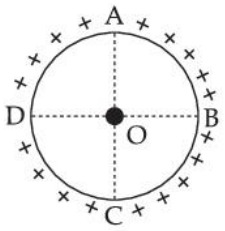
A metallic ring is uniformly charged as shown in figure. AC and BD are two mutually perpendicular diameters. Electric field due to arc AB at 'O' is 'E' in magnitude. What would be the magnitude of electric field at 'O' due to arc ABC ?
- A√2 E
- BZero
- CE/2
- D2E
View answer or solution
Answer
√2 E
There are two vessels filled with an ideal gas where volume of one is double the volume of other. The large vessel contains the gas at 8 kPa at 1000 K while the smaller vessel contains the gas at 7 kPa at 500 K. If the vessels are connected to each other by a thin tube allowing the gas to flow and the temperature of both vessels is maintained at 600 K, at steady state the pressure in the vessels will be (in kPa).
- A6
- B24
- C18
- D4.4
View answer or solution
Answer
6
Properties of Solids and Liquids
A cylindrical rod of length 1 m and radius 4 cm is mounted vertically. It is subjected to a shear force of 10⁵ N at the top. Considering infinitesimally small displacement in the upper edge, the angular displacement θ of the rod axis from its original position would be : (shear moduli, G = 10¹⁰ N/m²)
- A1/4π
- B1/160π
- C1/40π
- D1/2π
View answer or solution
Answer
1/160π
A wheel is rolling on a plane surface. The speed of a particle on the highest point of the rim is 8 m/s. The speed of the particle on the rim of the wheel at the same level as the centre of wheel, will be :
- A8√2 m/s
- B8 m/s
- C4 m/s
- D4√2 m/s
View answer or solution
Answer
4√2 m/s
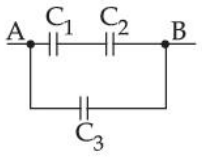
Three parallel plate capacitors C₁, C₂ and C₃ each of capacitance 5 μF are connected as shown in figure. The effective capacitance between points A and B, when the space between the parallel plates of C₁ capacitor is filled with a dielectric medium having dielectric constant of 4, is :
- A30 μF
- B9 μF
- C7.5 μF
- D22.5 μF
View answer or solution
Answer
9 μF
Displacement of a wave is expressed as x(t) = 5cos(628t + π/2) m. The wavelength of the wave when its velocity is 300 m/s is : (π = 3.14)
- A0.5 m
- B5 m
- C0.33 m
- D3 m
View answer or solution
Answer
3 m
A block of mass 25 kg is pulled along a horizontal surface by a force at an angle 45° with the horizontal. The friction coefficient between the block and the surface is 0.25. The block travels at a uniform velocity. The workdone by the applied force during a displacement of 5 m of the block is :
- A735 J
- B970 J
- C245 J
- D490 J
View answer or solution
Answer
245 J
In an electromagnetic system, a quantity defined as the ratio of electric dipole moment and magnetic dipole moment has dimension of [M^P L^Q T^R A^S]. The value of P and Q are :
- A−1, 0
- B1, −1
- C−1, 1
- D0, −1
View answer or solution
Answer
0, −1
Match List - I with List - II. List - I (A) Isobaric (B) Isochoric (C) Adiabatic (D) Isothermal List - II (I) ΔQ = ΔW (II) ΔQ = ΔU (III) ΔQ = zero (IV) ΔQ = ΔU + PΔV ΔQ = Heat supplied ΔW = Work done by the system ΔU = Change in internal energy P = Pressure of the system ΔV = Change in volume of the system Choose the correct answer from the options given below :
- A(A)-(II), (B)-(IV), (C)-(III), (D)-(I)
- B(A)-(IV), (B)-(II), (C)-(III), (D)-(I)
- C(A)-(IV), (B)-(I), (C)-(III), (D)-(II)
- D(A)-(IV), (B)-(III), (C)-(II), (D)-(I)
View answer or solution
Answer
(A)-(IV), (B)-(II), (C)-(III), (D)-(I)
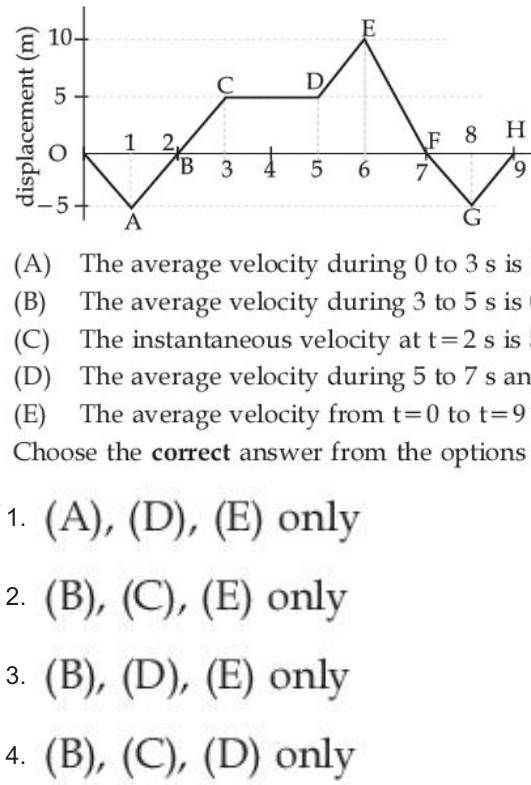
The displacement x versus time graph is shown below. (A) The average velocity during 0 to 3 s is 10 m/s (B) The average velocity during 3 to 5 s is 0 m/s (C) The instantaneous velocity at t = 2 s is 5 m/s (D) The average velocity during 5 to 7 s and instantaneous velocity at t = 6.5 s are equal (E) The average velocity from t = 0 to t = 9 s is zero Choose the correct answer from the options given below :
- A(A), (D), (E) only
- B(B), (C), (E) only
- C(B), (D), (E) only
- D(B), (C), (D) only
View answer or solution
Answer
(B), (C), (E) only
From the combination of resistors with resistances values R₁ = R₂ = R₃ = 5 Ω and R₄ = 10 Ω, which of the following combination is the best circuit to get an equivalent resistance of 6Ω ?
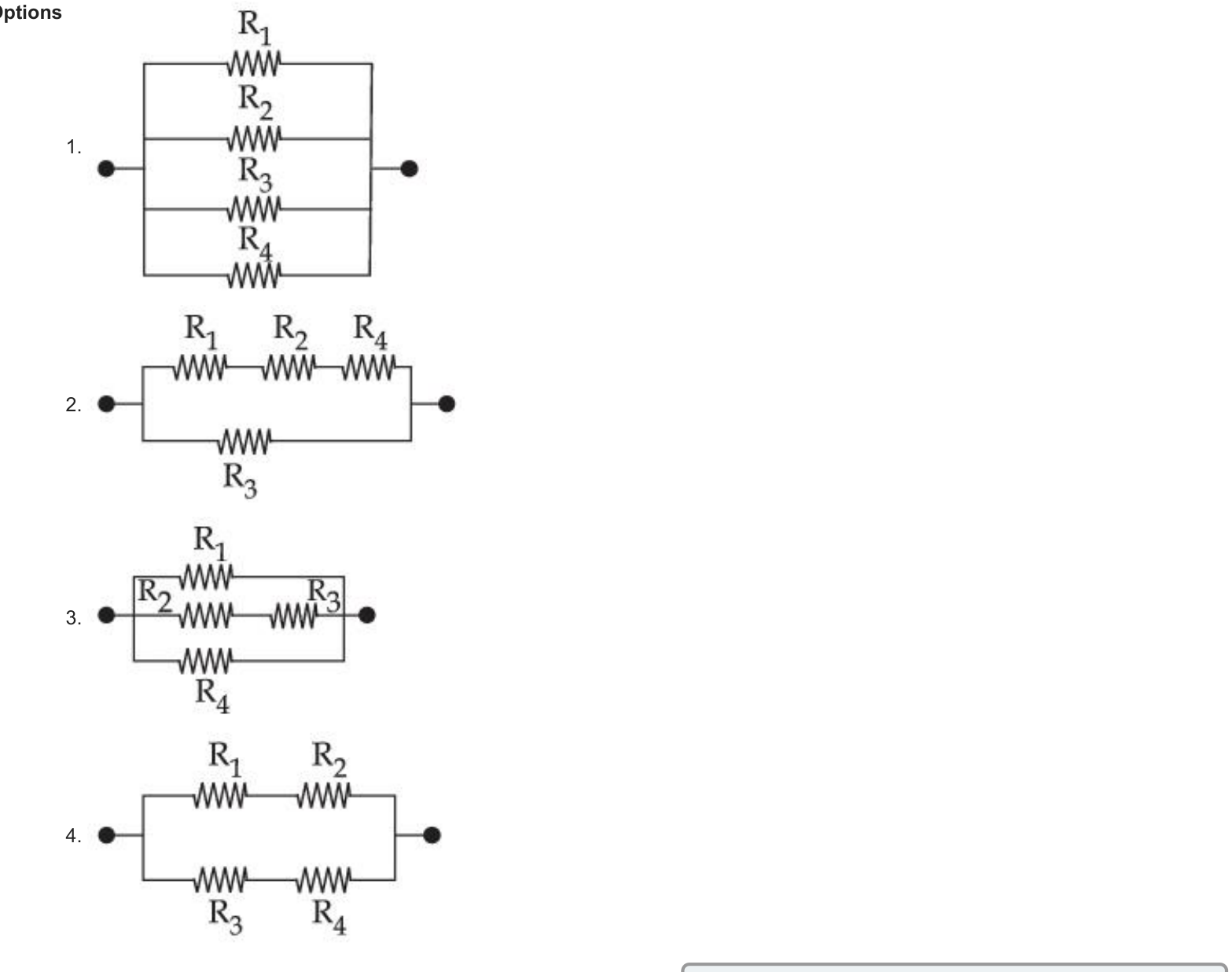
- ACircuit diagram: R₁, R₂, R₃ and R₄ all in parallel - each resistor is a separate horizontal branch spanning the same left and right vertical wires between the two terminals.
- BCircuit diagram: the upper branch has R₁, R₂ and R₄ in series and the lower branch has R₃ alone, the two branches in parallel between the two terminals.
- CCircuit diagram: three branches in parallel between the two terminals - the top branch has R₁ alone, the middle branch has R₂ in series with R₃, and the bottom branch has R₄ alone.
- DCircuit diagram: the upper branch has R₁ in series with R₂ and the lower branch has R₃ in series with R₄, the two branches in parallel between the two terminals.
View answer or solution
Answer
Circuit diagram: the upper branch has R₁ in series with R₂ and the lower branch has R₃ in series with R₄, the two branches in parallel between the two terminals.
A finite size object is placed normal to the principal axis at a distance of 30 cm from a convex mirror of focal length 30 cm. A plane mirror is now placed in such a way that the image produced by both the mirrors coincide with each other. The distance between the two mirrors is :
- A45 cm
- B22.5 cm
- C7.5 cm
- D15 cm
View answer or solution
Answer
7.5 cm
For the determination of refractive index of glass slab, a travelling microscope is used whose main scale contains 300 equal divisions equals to 15 cm. The vernier scale attached to the microscope has 25 divisions equals to 24 divisions of main scale. The least count (LC) of the travelling microscope is (in cm) :
- A0.002
- B0.001
- C0.0025
- D0.0005
View answer or solution
Answer
0.002
An object is kept at rest at a distance of 3R above the earth's surface where R is earth's radius. The minimum speed with which it must be projected so that it does not return to earth is : (Assume M = mass of earth, G = Universal gravitational constant)
- A√(3GM/R)
- B√(2GM/R)
- C√(GM/2R)
- D√(GM/R)
View answer or solution
Answer
√(GM/2R)
If an optical medium possesses a relative permeability of 10/π and relative permittivity of 1/0.0885, then the velocity of light is greater in vacuum than that in this medium by ________ times. (μ₀ = 4π × 10⁻⁷ H/m, ϵ₀ = 8.85 × 10⁻¹² F/m, c = 3 × 10⁸ m/s)
View answer or solution
Answer
6
A solid sphere with uniform density and radius R is rotating initially with constant angular velocity (ω₁) about its diameter. After some time during the rotation its starts loosing mass at a uniform rate, with no change in its shape. The angular velocity of the sphere when its radius become R/2 is xω₁. The value of x is ________.
View answer or solution
Answer
32
An inductor of self inductance 1 H is connected in series with a resistor of 100 π ohm and an ac supply of 100 π volt, 50 Hz. Maximum current flowing in the circuit is ________ A.
View answer or solution
Answer
1
Magnetic Effects of Current and Magnetism
A particle of charge 1.6 μC and mass 16 μg is present in a strong magnetic field of 6.28 T. The particle is then fired perpendicular to magnetic field. The time required for the particle to return to original location for the first time is ________ s. (π = 3.14)
View answer or solution
Answer
0
In a Young's double slit experiment, two slits are located 1.5 mm apart. The distance of screen from slits is 2 m and the wavelength of the source is 400 nm. If the 20 maxima of the double slit pattern are contained within the central maximum of the single slit diffraction pattern, then the width of each slit is x × 10⁻³ cm, where x-value is ________.
View answer or solution
Answer
15