
// Dr. A.P.J. Abdul Kalam Technical University, Uttar Pradesh / 2022
AKTU B.Tech — Basic Electrical Engineering (KEE201T), Semester 2, 2022
Basic Electrical Engineering · KEE201T · B.Tech Computer Science and Engineering · Semester 2
Questions
29
- 1(j)
- 2(a)
- 1(a)
- 1(e)
- 2(c)
- 1(c)
- 1(h)
- 1(f)
- 1(g)
- 2(b)
- 2(d)
- 2(e)
- 1(i)
- 3(a)
- 1(b)
- 1(d)
- 2(i)
- 5(i)
- 5(b)
- 4(a)
- 6(a)
- 7(a)
- 6(b)
- 4(b)
- 5(a)
- 4(i)
- 6(i)
- 3(b)
- 7(b)
Has an official figure
Work through the questions
29 questions
No verified answers are available for this paper.
Basic Electrical and Electronics Engineering
Write any two battery characteristics. Also, define any one.
No verified answer or solution is available for this question.
Basic Electrical and Electronics Engineering
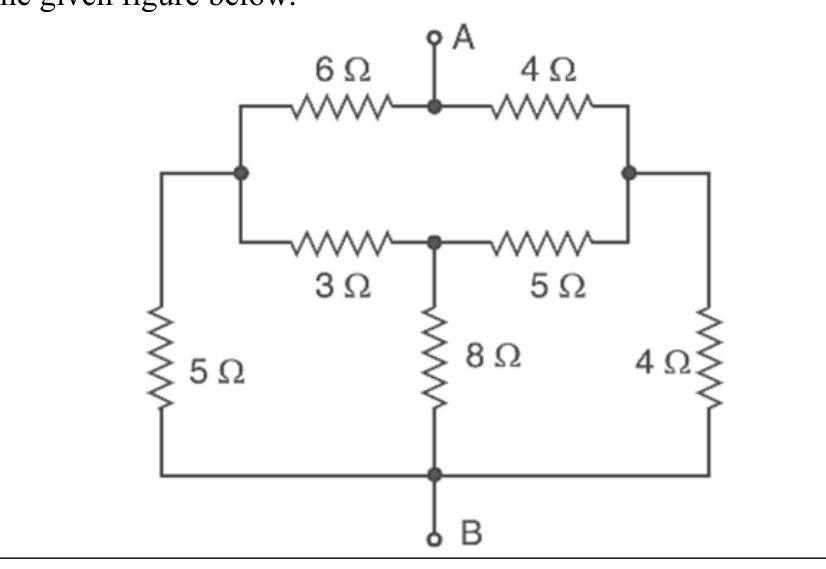
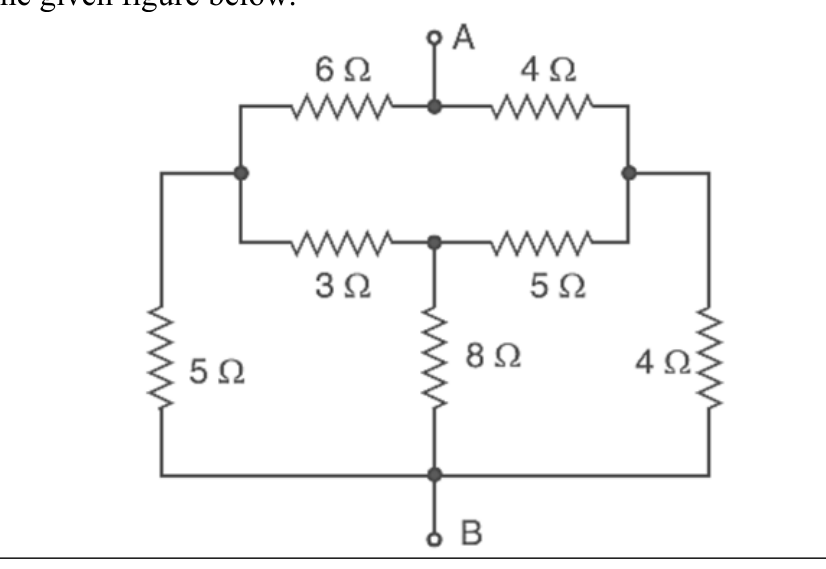
Calculate equivalent resistance across terminals A and B using star-delta or delta-star conversion for the given figure below.
No verified answer or solution is available for this question.
Basic Electrical and Electronics Engineering
Draw the V-I characteristics for ideal voltage source and ideal current source.
No verified answer or solution is available for this question.
Basic Electrical and Electronics Engineering
What is the nature of load for negative voltage regulation in the transformer?
No verified answer or solution is available for this question.
Basic Electrical and Electronics Engineering
Calculate the voltage across the circuit at resonance.
No verified answer or solution is available for this question.
Basic Electrical and Electronics Engineering
Why do we represent A.C. by sinusoidal waveform?
No verified answer or solution is available for this question.
Basic Electrical and Electronics Engineering
Why synchronous motor is doubly excited?
No verified answer or solution is available for this question.
Basic Electrical and Electronics Engineering
Draw the phasor diagram for an ideal transformer on no load.
No verified answer or solution is available for this question.
Basic Electrical and Electronics Engineering
What is the generated EMF in D.C. generator?
No verified answer or solution is available for this question.
Basic Electrical and Electronics Engineering
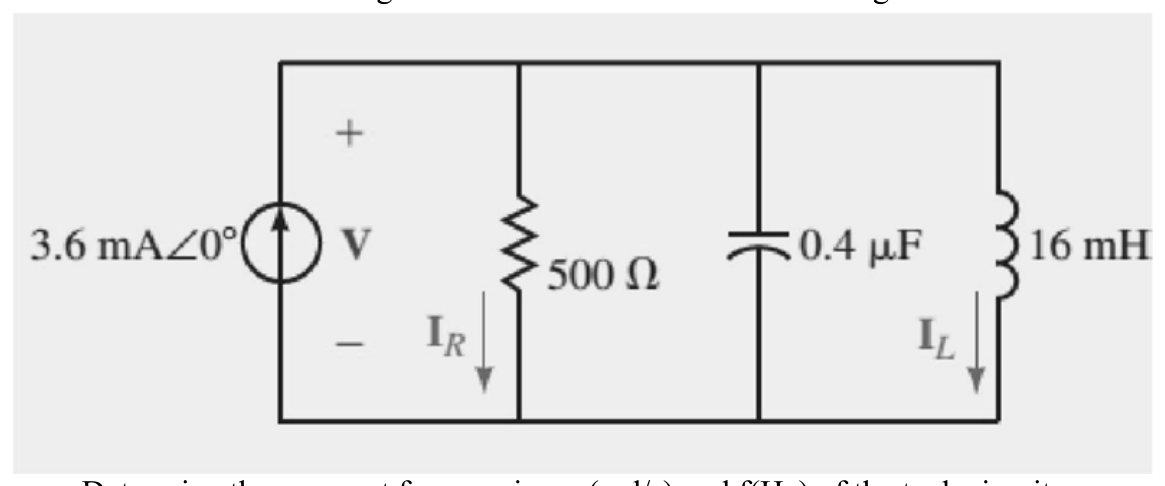
Consider the circuit shown in figure below and calculate the following.
No verified answer or solution is available for this question.
Basic Electrical and Electronics Engineering
Solve for currents through the inductor and the resistor at resonance. 0 0 BASIC ELECTRICAL ENGINEERING
No verified answer or solution is available for this question.
Basic Electrical and Electronics Engineering
Draw and explain the characteristics of a battery. Calculate the backup of a battery of 150AH connected to load of 150 watts, and the supply voltage is 12V.
No verified answer or solution is available for this question.
Basic Electrical and Electronics Engineering
- 2024
- 2022
Also asked in AKTU B.Tech — Fundamentals Of Electrical Engineering (BEE101), Semester 1, 2024 (2024).
What are the common problems that occur during electrical installations?
No verified answer or solution is available for this question.
Basic Electrical and Electronics Engineering
. Determine the current through A-B in the given circuit using Norton’s theorem.
No verified answer or solution is available for this question.
Basic Electrical and Electronics Engineering
Why is linearity important in circuits?
No verified answer or solution is available for this question.
Basic Electrical and Electronics Engineering
Why the average power consumed in purely inductive circuit is zero?
No verified answer or solution is available for this question.
Basic Electrical and Electronics Engineering
The total copper losses on full load (ii) The efficiency while supplying full load at 0.9 power factor lagging (iii) The efficiency while supplying half load at 0.8 power factor leading. Assume total iron losses equal to 60 W.
No verified answer or solution is available for this question.
Basic Electrical and Electronics Engineering
Equivalent resistance, reactance and impedance referred to primary (ii) Supply current (iii) Total copper loss Draw approximate equivalent circuit.
No verified answer or solution is available for this question.
Basic Electrical and Electronics Engineering
A 20kVA, 2000V/200V, single-phase, 50 Hz transformer has a primary resistance of 1.5 Ω and reactance of 2 Ω. The secondary resistance and reactance are 0.015 Ω and 0.02 Ω respectively. The no load current of transformer is 1A at 0.2 power factor. Determine:
No verified answer or solution is available for this question.
Basic Electrical and Electronics Engineering
Derive mathematically dynamic impedance (ZD) offered by RLC parallel circuit under resonance. Also, draw its phasor diagram.
No verified answer or solution is available for this question.
Basic Electrical and Electronics Engineering
Derive an expression for torque in DC motor. A 230V DC series motor draws a 50A current. Armature and series field winding resistances are 0.2 Ω and 0.1 Ω, respectively. Calculate
No verified answer or solution is available for this question.
Basic Electrical and Electronics Engineering
How do you calculate energy consumption per kWh? Calculate the electricity bill amount for a leap year, if the following devices are used as specified. (A) 3 Bulbs of 40W for 6 hours per day (B) 4 Tube lights of 50W for 8 hours per day Given the rate of electricity is Rs. 7.50 per unit.
No verified answer or solution is available for this question.
Basic Electrical and Electronics Engineering
Why is an induction motor called a generalized transformer? Compare the induction motor with the transformer.
No verified answer or solution is available for this question.
Basic Electrical and Electronics Engineering
Two coils having resistance 5 Ω and 10 Ω and inductances 0.04 H and 0.05 H respectively are connected in parallel across a 200 V, 50 Hz supply. Calculate:
No verified answer or solution is available for this question.
Basic Electrical and Electronics Engineering
What is the purpose of an equivalent circuit of a transformer? Obtain the approximate equivalent circuit of a transformer as referred to the primary with all necessary parameters.
No verified answer or solution is available for this question.
Basic Electrical and Electronics Engineering
Conductance, susceptance and admittance of each coil. ii. Total current drawn by the circuit and its power factor. iii. Power absorbed by the circuit. 0 0 BASIC ELECTRICAL ENGINEERING
No verified answer or solution is available for this question.
Basic Electrical and Electronics Engineering
brush voltage and (ii) back EMF.
No verified answer or solution is available for this question.
Basic Electrical and Electronics Engineering
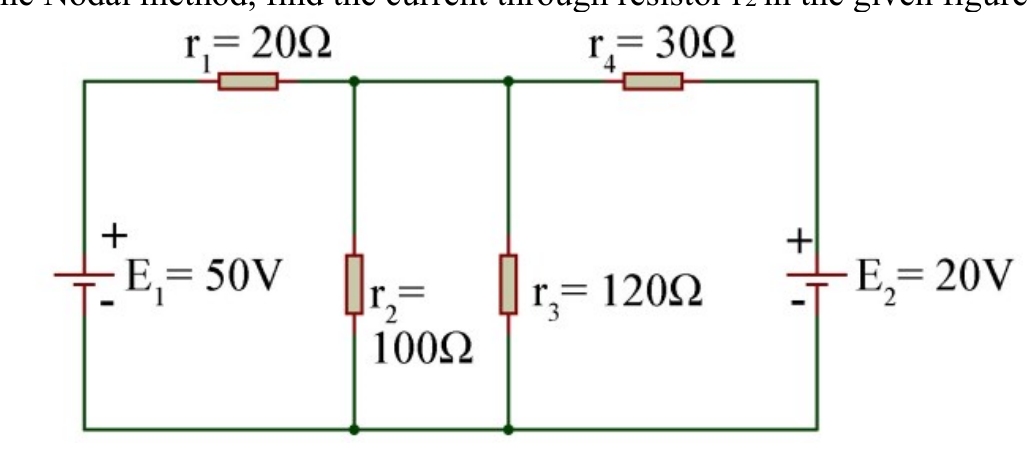
Using the Nodal method, find the current through resistor r2 in the given figure below.
No verified answer or solution is available for this question.
Basic Electrical and Electronics Engineering
Explain the construction, rating, specific applications of at least two types of wires and cables used in electrical installations.
No verified answer or solution is available for this question.