
// Dr. A.P.J. Abdul Kalam Technical University, Uttar Pradesh / 2024
AKTU B.Tech — Fundamentals Of Electrical Engineering (BEE101), Semester 1, 2024
Fundamentals Of Electrical Engineering · BEE101 · B.Tech Computer Science and Engineering · Semester 1
Questions
22
Has an official figure
Work through the questions
22 questions
No verified answers are available for this paper.
Fundamentals of Electrical and Electronics Engineering
Find the inductance of a coil in which a current of 0.2A increasing at a rate of 0.4 A/sec represents a power flow of 0.4 watt
No verified answer or solution is available for this question.
Fundamentals of Electrical and Electronics Engineering
Derive that the average power consumed by a pure inductor is zero
No verified answer or solution is available for this question.
Fundamentals of Electrical and Electronics Engineering
Describe briefly the following elements with examples: (i) Unilateral and Bilateral elements. (ii) Active and Passive elements
No verified answer or solution is available for this question.
Fundamentals of Electrical and Electronics Engineering
What is the function of slip rings in 3-phase induction motor?
No verified answer or solution is available for this question.
Fundamentals of Electrical and Electronics Engineering
In a series RLC circuit, R = 2 ohm, L = 2 mH, C = 10 microF. Find the resonant frequency and Q-factor.
No verified answer or solution is available for this question.
Fundamentals of Electrical and Electronics Engineering
Differentiate between ideal voltage source and practical voltage source
No verified answer or solution is available for this question.
Fundamentals of Electrical and Electronics Engineering
Calculate the current across 20 ohm resistor using nodal analysis in the following circuit: a 20 V source with 5 ohm and 10 ohm resistors, a 20 ohm resistor and a 4 A current source.
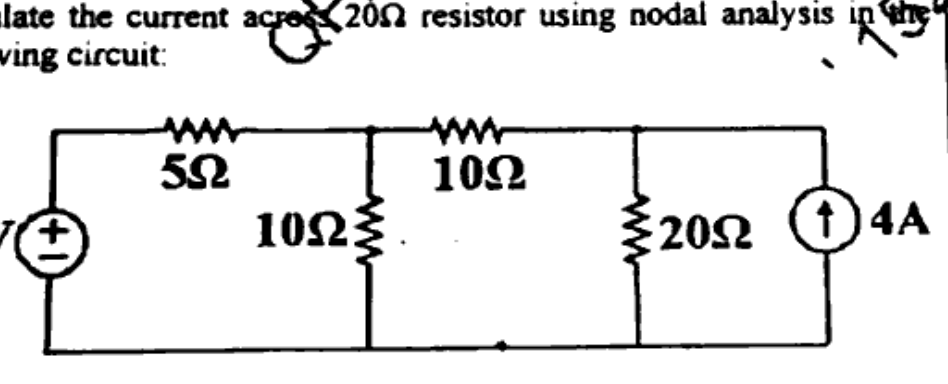
No verified answer or solution is available for this question.
Fundamentals of Electrical and Electronics Engineering
What is the difference between earthing and grounding? Also discuss the different methods of earthing?
No verified answer or solution is available for this question.
Fundamentals of Electrical and Electronics Engineering
Describe the working principle and torque-slip characteristics of 3-phi induction motor.
No verified answer or solution is available for this question.
Fundamentals of Electrical and Electronics Engineering
Derive the expression of torque for DC motor. A 6 pole lap wound DC shunt motor has 500 conductors in the armature. The resistance of the armature path is 0.05 ohm. The resistance of the shunt field is 25 ohm. Find the speed of the motor when it takes 120 A from DC mains of 100 V. Flux per pole is 0.02 Wb.
No verified answer or solution is available for this question.
Fundamentals of Electrical and Electronics Engineering
Draw the phasor diagram of ideal and practical transformer at no-load conditions.
No verified answer or solution is available for this question.
Fundamentals of Electrical and Electronics Engineering
Why 1-phi induction motor is not self-starting? What are the methods of starting? Explain any one of them.
No verified answer or solution is available for this question.
Fundamentals of Electrical and Electronics Engineering
Discuss briefly the types of batteries and explain any one type of secondary battery with the necessary diagram.
No verified answer or solution is available for this question.
Fundamentals of Electrical and Electronics Engineering
Explain the procedure of mesh analysis with the help of an example.
No verified answer or solution is available for this question.
Fundamentals of Electrical and Electronics Engineering
- 2024
- 2022
Also asked in AKTU B.Tech — Basic Electrical Engineering (KEE201T), Semester 2, 2022 (2022).
What are the common problems that occur during electrical installations?
No verified answer or solution is available for this question.
Fundamentals of Electrical and Electronics Engineering
Calculate the form factor and peak factor for a half-wave rectified voltage signal.
No verified answer or solution is available for this question.
Fundamentals of Electrical and Electronics Engineering
Derive the relation between line and phase voltages in a 3-phi, star-connected circuit. A balanced star-connected load of (3+j4) ohm/phase is connected to a 3-phi, 400 V supply. Calculate the line current, power factor, active and reactive power drawn from the supply.
No verified answer or solution is available for this question.
Fundamentals of Electrical and Electronics Engineering
A 100 kVA, 1-phi transformer has iron loss of 600 W and a copper loss of 1.5 kW at full-load current. Calculate the efficiency at (i) full load and 0.8 pf (lagging), and (ii) half load and unity pf?
No verified answer or solution is available for this question.
Fundamentals of Electrical and Electronics Engineering
A 20 kVA, 2000V/200V, 1-phi, 50 Hz transformer has a primary resistance of 1.5 ohm and reactance of 2 ohm. The secondary resistance and reactance are 0.015 ohm and 0.02 ohm respectively. The no-load current of transformer is 1A at 0.2 power factor. Determine: (i) Equivalent resistance and reactance referred to primary (ii) Total copper loss.
No verified answer or solution is available for this question.
Fundamentals of Electrical and Electronics Engineering
Explain the following with neat and labelled diagram: (i) Earth Leakage Circuit Breaker (ii) Miniature Circuit Breaker
No verified answer or solution is available for this question.
Fundamentals of Electrical and Electronics Engineering
Derive an expression of bandwidth, upper and lower half power frequency of a series resonating circuit.
No verified answer or solution is available for this question.
Fundamentals of Electrical and Electronics Engineering
Calculate the current across 6 ohm resistor in the following circuit using: (i) Mesh Analysis (ii) Nodal Analysis. The circuit has a 18 V source with 1 ohm, a 6 ohm resistor, a 12 V source with 3 ohm and 4 ohm.
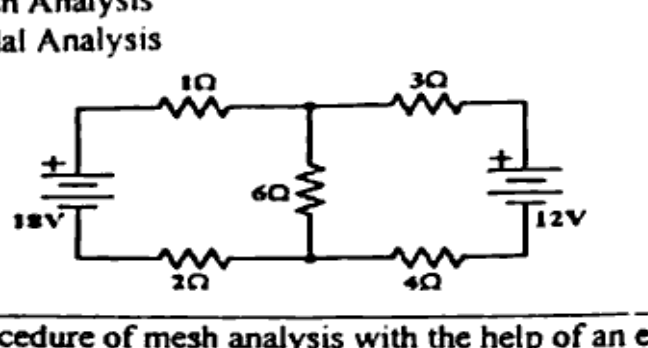
No verified answer or solution is available for this question.