
// THE QUESTION BANK
A little focus.
A better attempt.
Find your topic. Work through a few questions. Open the official answer when one is available.
Loading your next set of questions…
// THE QUESTION BANK
Find your topic. Work through a few questions. Open the official answer when one is available.
YOUR SELECTION
Showing 1–12 · 14 papers
Question 45
From JEE (Main) 2026 Session 1, 21 January 2026, Shift 1 — Paper 1 (B.E / B.Tech) Physics
A light wave described by E = 60[sin(3 × 10¹⁵)t + sin(12 × 10¹⁵)t] (in SI units) falls on a metal surface of work function 2.8 eV. The maximum kinetic energy of ejected photoelectron is (approximately) ______ eV. (h = 6.6 × 10⁻³⁴ J.s. and e = 1.6 × 10⁻¹⁹ C)
Choose an option first, then open the answer.
Question from the source paper. Answer from the official final answer key (the key rows carrying this paper's Question IDs), version of 2026-02-16. Published documents are listed by the exam body at its document index.
Question 46
From JEE (Main) 2026 Session 1, 21 January 2026, Shift 2 — Paper 1 (B.E / B.Tech) Physics
A particle having electric charge 3 × 10⁻¹⁹ C and mass 6 × 10⁻²⁷ kg is accelerated by applying an electric potential of 1.21 V. Wavelength of the matter wave associated with the particle is α × 10⁻¹² m. The value of α is ______. (Take Planck's constant = 6.6 × 10⁻³⁴ J.s)
This question was printed without answer options.
Open the answer when you are ready.
Question from the source paper. Answer from the official final answer key (the key rows carrying this paper's Question IDs), version of 2026-02-16. Published documents are listed by the exam body at its document index.
Question 26
From JEE (Main) 2026 Session 1, 22 January 2026, Shift 2 — Paper 1 (B.E / B.Tech) Physics — 2 questions withheld: source figures unavailable
Light is incident on a metallic plate having work function 110 × 10⁻²⁰ J. If the produced photoelectrons have zero kinetic energy then the angular frequency of the incident light is ______ rad/s. (h = 6.63 × 10⁻³⁴ J.s).
Choose an option first, then open the answer.
Question from the source paper. Answer from the official final answer key (the key rows carrying this paper's Question IDs), version of 2026-02-16. Published documents are listed by the exam body at its document index.
Question 33
From JEE (Main) 2026 Session 1, 23 January 2026, Shift 1 — Paper 1 (B.E / B.Tech) Physics — 1 question withheld: source figures unavailable
The de Broglie wavelength of an oxygen molecule at 27°C is x × 10⁻¹² m. The value of x is (take Planck's constant = 6.63 × 10⁻³⁴ J.s, Boltzmann constant = 1.38 × 10⁻²³ J/K, mass of oxygen molecule = 5.31 × 10⁻²⁶ kg)
Choose an option first, then open the answer.
Question from the source paper. Answer from the official final answer key (the key rows carrying this paper's Question IDs), version of 2026-02-16. Published documents are listed by the exam body at its document index.
Question 35
From JEE (Main) 2026 Session 1, 24 January 2026, Shift 2 — Paper 1 (B.E / B.Tech) Physics — 1 question withheld: source figures unavailable
When a light of a given wavelength falls on a metallic surface the stopping potential for photoelectrons is 3.2 V. If a second light having wavelength twice of first light is used, the stopping potential drops to 0.7 V. The wavelength of first light is ______ m. (h = 6.63 × 10⁻³⁴ J.s, e = 1.6 × 10⁻¹⁹ C, c = 3 × 10⁸ m/s)
Choose an option first, then open the answer.
Question from the source paper. Answer from the official final answer key (the key rows carrying this paper's Question IDs), version of 2026-02-16. Published documents are listed by the exam body at its document index.
Question 48
From JEE (Main) 2026 Session 1, 28 January 2026, Shift 1 — Paper 1 (B.E / B.Tech) Physics
The ratio of de Broglie wavelength of a deuteron with kinetic energy E to that of an alpha particle with kinetic energy 2E, is n : 1. The value of n is ____. (Assume mass of proton = mass of neutron) :
This question was printed without answer options.
Open the answer when you are ready.
Question from the source paper. Answer from the official final answer key (the key rows carrying this paper's Question IDs), version of 2026-02-16. Published documents are listed by the exam body at its document index.
Question 33
From JEE (Main) 2026 Session 1, 28 January 2026, Shift 2 — Paper 1 (B.E / B.Tech) Physics
Number of photons of equal energy emitted per second by a 6 mW laser source operating at 663 nm is ________. (Given : h = 6.63 × 10⁻³⁴ J.s and c = 3 × 10⁸ m/s)
Choose an option first, then open the answer.
Question from the source paper. Answer from the official final answer key (the key rows carrying this paper's Question IDs), version of 2026-02-16. Published documents are listed by the exam body at its document index.
Question 42
From JEE (Main) 2026 Session 2, 2 April 2026, Shift 1 — Paper 1 (B.E / B.Tech) Physics
For a certain metal, when monochromatic light of wavelength λ is incident, the stopping potential for photoelectrons is 3V₀. When the same metal is illuminated by light of wavelength 2λ, then the stopping potential becomes V₀. The threshold wavelength for photoelectric emission for the given metal is αλ. The value of α is ________.
Choose an option first, then open the answer.
Question from the source paper. Answer from the official final answer key (For Centers in India), version of 2026-04-20. Published documents are listed by the exam body at its document index.
Question 32
From JEE (Main) 2026 Session 2, 4 April 2026, Shift 1 — Paper 1 (B.E / B.Tech) Physics — 1 question withheld: source figures unavailable
The graph shows variation of stopping potential V₀ with the frequency ν of the incident radiation for three photosensitive metals X₁, X₂ and X₃. Which metal will give out electrons with greater kinetic energy, for the same wavelength of incident radiation? [Figure: graph of stopping potential V₀ (vertical axis) versus frequency ν (horizontal axis) showing three parallel straight lines labelled X₁, X₂ and X₃; the lines cut the ν axis at 1.0, 1.5 and 2 (× 10¹⁴ Hz) respectively.]
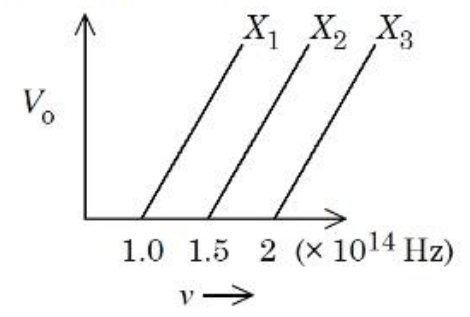
Choose an option first, then open the answer.
Question from the source paper. Answer from the official final answer key (For Centers in India), version of 2026-04-20. Published documents are listed by the exam body at its document index.
Question 26
From JEE (Main) 2026 Session 2, 4 April 2026, Shift 2 — Paper 1 (B.E / B.Tech) Physics
Match the LIST-I with LIST-II List-I: A. Planck's constant; B. Stopping potential; C. Work function; D. Threshold frequency List-II: I. ML²T⁻²; II. T⁻¹; III. ML²T⁻¹; IV. ML²T⁻³A⁻¹ Choose the correct answer from the options given below:
Choose an option first, then open the answer.
Question from the source paper. Answer from the official final answer key (For Centers in India), version of 2026-04-20. Published documents are listed by the exam body at its document index.
Question 44
From JEE (Main) 2026 Session 2, 4 April 2026, Shift 2 — Paper 1 (B.E / B.Tech) Physics
The de Broglie wavelength associated with an electron accelerated through a potential difference V is λe and the de Broglie wavelength associated with a proton accelerated through the same potential difference is λt. If their corresponding masses are mₑ and mₚ, respectively, then the ratio of their de Broglie wavelengths (λe/λt) is ______.
Choose an option first, then open the answer.
Question from the source paper. Answer from the official final answer key (For Centers in India), version of 2026-04-20. Published documents are listed by the exam body at its document index.
Question 35
From JEE (Main) 2026 Session 2, 5 April 2026, Shift 1 — Paper 1 (B.E / B.Tech) Physics
An electron of mass m is moving in an electric field Ē = −2E₀ î (E₀ = constant > 0), with an initial velocity V̄ = v₀ ĵ (v₀ = constant > 0). If λ₀ = h/(4mv₀), its de Broglie wavelength at time t is ______. (e = charge of electron)
Choose an option first, then open the answer.
Question from the source paper. Answer from the official final answer key (For Centers in India), version of 2026-04-20. Published documents are listed by the exam body at its document index.
Questions the exam body withdrew, and questions that need unavailable source figures, are stored with their papers and withheld here. Each served question links to its source paper.
This is self-study practice. It does not issue assessment results, certificates or profile proof. Attempts on this page reset when you leave it.