
// Anna University, Chennai / 2023
Anna University — PROBABILITY AND RANDOM PROCESSES (MA8451), November/December 2023
Probability and Random Processes · MA8451 · R2017 · B.E./B.Tech. Engineering (common paper) · Semester 4
Files open in a new tab. Use your browser's download or save option to keep a copy.
Work through the questions
15 questions
No verified answers are available for this paper.
Probability and Random Processes
- 2024
- 2023
Also asked in Anna University — Random Processes and Linear Algebra (MA3355), April/May 2024 (2024).
State the axioms of probability.
No verified answer or solution is available for this question.
Probability and Random Processes
If P(A) = 1/3, P(B) = 3/4 and P(A ∪ B) = 11/12. Find P(A/B) and P(B/A).
No verified answer or solution is available for this question.
Probability and Random Processes
The joint probability density function of (X,Y) is given by f(x,y) = e^(-(x+y)), 0 ≤ x, y < ∞. Are the random variables X and Y independent? Why?
No verified answer or solution is available for this question.
Probability and Random Processes
State the central limit theorem
No verified answer or solution is available for this question.
Probability and Random Processes
Write the classification of random process.
No verified answer or solution is available for this question.
Probability and Random Processes
What is meant by evolutionary process?
No verified answer or solution is available for this question.
Probability and Random Processes
The autocorrelation function for a stationary ergodic process with no periodic components is R_XX(τ) = 25 + 4/(1+6τ²). Find the mean of the process {X(t)}.
No verified answer or solution is available for this question.
Probability and Random Processes
State any two properties of the power spectral density function.
No verified answer or solution is available for this question.
Probability and Random Processes
When is the system Y(t) = ∫ from −∞ to ∞ of h(u)X(t-u)du said to be stable?
No verified answer or solution is available for this question.
Probability and Random Processes
The short-time moving average of a process {X(t)} is defined as Y(t) = (1/T) ∫ from (t-T) to t of X(s)ds. Prove that X(t) and Y(t) are related by means of a convolution type integral.
No verified answer or solution is available for this question.
Probability and Random Processes
(a) (i) Customers are used to evaluate preliminary product designs. In the past, 95% of highly successful products received good reviews, 60% of moderately successful products received good reviews, and 10% of poor products received good reviews. In addition, 40% of products have been highly successful, 35% have been moderately successful and 25% have been poor products. (1) What is the probability of a new design attains a good review? (2) If a new design attains a good review, what is the probability that it will be a highly successful product? (8) (ii) A random variable X has the following probability distribution. (8) x : -2 -1 0 1 2 3 p(x) : 0.1 K 0.2 2K 0.3 3K Evaluate the following (1) K (2) P(-2 < X < 2) (3) the cdf of (4) mean of X. (OR) (b) (i) Obtain the MGF of the Binomial distribution and hence find its mean and variance. (8) (ii) The mileage which car owners get with a certain kind of radial tire is a random variable having an exponential distribution with mean 40,000 km. Find the probabilities that one of these tires will last (1) at least 20000 km and (2) at most 30,000 km. (8)

Q11(a)(ii) - probability distribution of the random variable X (x and p(x) rows) No verified answer or solution is available for this question.
Probability and Random Processes
(a) (i) The joint probability mass function of (X,Y) is given by f(x,y) = C(2x+3y), x = 0,1,2; y = 1,2,3. Find the marginal probability distributions of X and Y. (8) (ii) Compute the co-efficient of correlation between X and Y, using the following data : (8) X : 1 2 3 4 5 Y : 2 5 9 13 14 (OR) (b) (i) The joint probability density function of a two-dimensional random variable (X,Y) is given by (8) f(x,y) = xy² + x²/8, 0 ≤ x ≤ 2, 0 ≤ y ≤ 1. Compute (1) P(X > 1, Y < 1/2) (2) P(Y < 1/2) (3) P(X < Y) (ii) If X and Y are independent RVs each following N(0, 2), find the pdf of Z = 2X + 3Y . (8)
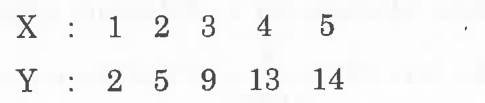
Q12(a)(ii) - data table of X and Y used for the co-efficient of correlation No verified answer or solution is available for this question.
Probability and Random Processes
(a) (i) The probability distribution of the process {X(t)} is given by (8) P(X(t) = n) = { (at)^(n-1)/(1+at)^(n+1), n = 1,2,3,... ; at/(1+at), n = 0 }. Show that it is not stationary. (ii) The transition probability matrix of a Markov chain {X_n}, n = 1,2,3..., having 3 states 1, 2 and 3 is P = [ 0.1 0.5 0.4 ; 0.6 0.2 0.2 ; 0.3 0.4 0.3 ] and the initial distribution is P^(0) = (0.7, 0.2, 0.1). Find P(X_2 = 3) and P(X_2 = 3, X_1 = 3, X_0 = 2). (8) (OR) (b) (i) Show that the random process X(t) = A cos(ωt + θ) is wide sense stationary if A and ω are constant and θ is uniformly distributed random variable in (0, 2π). (8) (ii) Prove that the difference of two independent Poisson processes is not a Poisson process. (8)
No verified answer or solution is available for this question.
Probability and Random Processes
(a) (i) If {X(t)} is a wide-sense stationary process with autocorrelation R(τ) = A e^(-a|τ|), determine the second-order moment of the RV X(8) - X(5). (8) (ii) If the power spectral density of a WSS process is given by S(ω) = { (b/a)(a - |ω|), |ω| ≤ a ; 0, |ω| > a }. Find the autocorrelation function of the process. (8) (OR) (b) (i) The autocorrelation function of the random telegraph signal process is given by R(τ) = a² e^(-2|τ|). Determine the power density spectrum of the random telegraph signal. (8) (ii) If the WSS process {X(t)} is given by X(t) = 10 cos(100t + θ), where θ is uniformly distributed over (−π, π), prove that {X(t)} is correlation ergodic. (8)
No verified answer or solution is available for this question.
Probability and Random Processes
(a) State and prove Wiener-khinchine theorem for a linear system with random inputs. (16) (OR) (b) (i) The process {X(t)} is normal with μ_t = 0 and R_X(τ) = 4e^(-3|τ|). Find a memory less system g(x) such that the first order density f_Y(y) of the resulting output Y(t) = g[X(t)] is uniform in the interval (3, 6). (8) (ii) Consider a white Gaussian noise of zero mean and power spectral density N₀/2 applied to a low pass RC filter whose transfer function is H(f) = 1/(1+i2πf RC). Find the auto correlation function of the output random process. (8)
No verified answer or solution is available for this question.