
// Anna University, Chennai / 2025
Anna University — Random Processes and Linear Algebra (MA3355), November/December 2025
Random Processes and Linear Algebra · MA3355 · R2021 · B.E. Electronics and Communication Engineering · Semester 3
Files open in a new tab. Use your browser's download or save option to keep a copy.
Work through the questions
15 questions
No verified answers are available for this paper.
Random Processes and Linear Algebra
An integrated circuit factory has three machines X, Y and Z. Test one integrated circuit produced by each machine. Either a circuit is acceptable (a) or it fails (f). An observation is a sequence of three test results corresponding to the circuits from machines X, Y and Z, respectively. What are the elements of the sample space of this experiment?
No verified answer or solution is available for this question.
Random Processes and Linear Algebra
Consider a binary code with 5 bits (0 or 1) in each code word. An example of a code word is 01010. In each code word, a bit is a zero with probability 0.8, independent of any other bit. What is the probability that a code word contains exactly three ones?
No verified answer or solution is available for this question.
Random Processes and Linear Algebra
The joint probability mass function of two random variables X and Y is given by P_XY(x,y) = k(2x + y) for x = 1, 2 and y = 1, 2, and 0 otherwise, where k is a constant. What is the value of k?
No verified answer or solution is available for this question.
Random Processes and Linear Algebra
Prove that cov(X,Y) = 0 if X and Y are independent random variables.
No verified answer or solution is available for this question.
Random Processes and Linear Algebra
Cars, trucks and buses arrive at a toll booth as independent Poisson processes with rates λ꜀ = 1.2 cars/minute, λₜ = 0.9 trucks/minute and λᵦ = 0.7 buses/minute. In a 10-minute interval, what is the PMF of N, the number of vehicles (cars, trucks, or buses) that arrive?
No verified answer or solution is available for this question.
Random Processes and Linear Algebra
Identify the transient states and recurrent states whose state-transition diagram is shown in the following figure.
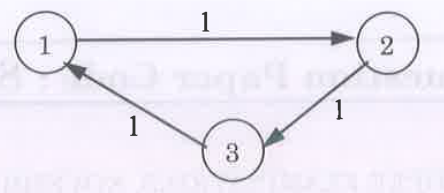
Q6 — state-transition diagram No verified answer or solution is available for this question.
Random Processes and Linear Algebra
Prove that any two intersection of subspaces of vector space V is a subspace of V.
No verified answer or solution is available for this question.
Random Processes and Linear Algebra
Is it possible to write the vector (−2,0,3) as a linear combination of the two vectors (1,3,0) and (2,4,−1)? Justify.
No verified answer or solution is available for this question.
Random Processes and Linear Algebra
Is the function T: ℝ² → ℝ² defined by T(x,y) = (x + 2y, 3x − y) where (x,y) ∈ ℝ² a linear operator?
No verified answer or solution is available for this question.
Random Processes and Linear Algebra
Let T: ℝ³ → ℝ³ be the orthogonal projection onto the XY-plane. Identify the kernel and range of T.
No verified answer or solution is available for this question.
Random Processes and Linear Algebra
(a) (i) Suppose traffic engineers have coordinated the timing of two traffic lights to encourage a run of green lights. In particular, the timing was designed so that with probability 0.8 a driver will find the second light to have the same colour as the first. Assuming the first light is equally likely to be red or green, what is the probability P(G₂) that the second light is green? Also, what is P(W), the probability that you wait for at least one light? Lastly, what is P(G₁ / R₂), the conditional probability of a green first light given a red second light? (8) (ii) The number of hits at a Web site in any time interval is a Poisson random variable. A particular site has on average λ = 2 hits per second. What is the probability that there are no hits in an interval of 0.25 seconds? What is the probability that there are no more than two hits in an interval of one second? (8) (OR) (b) (i) The input voltage to a rectifier is a random variable U with a uniform distribution on [−1,1]. The rectifier output is a random variable W defined by W = g(U) = 0 for U < 0 and U for U ≥ 0. Find the cumulative distribution function F_w(w) and the expected value E[W]. (8) (ii) The weights in pounds of parcels arriving at a package delivery company’s warehouse can be modelled by an N(5;16) normal random variable, X. What is the probability that a randomly selected parcel weighs between 1 and 10 pounds? What is the probability that a randomly selected parcel weighs more than 9 pounds? (8)
No verified answer or solution is available for this question.
Random Processes and Linear Algebra
(a) The joint probability density function of the random variables X and Y is defined as follows: f_XY(x,y) = 25e^(−5y) for 0 < x < 0.2 and y > 0, and 0 otherwise. Find the marginal density function of X and Y. Find the covariance of X and Y. (OR) (b) Associated with a job are two random variables: CPU time required (Y) and the number of disk I/O operations (X). Given the following data, compute the sample correlation coefficient: Number (X): 398, 390, 410, 502, 590, 305, 210, 252, 398, 392 Time (Y): 40, 38, 42, 50, 60, 30, 20, 25, 40, 39 Does a linear fit seem reasonable? Assuming that we wish to predict the CPU time requirement given an I/O request count, perform a linear regression: Y = a + bX.
No verified answer or solution is available for this question.
Random Processes and Linear Algebra
(a) (i) At the receiver of an AM radio, the received signal contains a cosine carrier signal at the carrier frequency f꜀ with a random phase θ that is a sample value of the uniform (0,2π) random variable. The received carrier signal is X(t) = A cos(2πf꜀t + θ). What are the expected value and autocorrelation of the process X(t)? (8) (ii) Xₙ is a wide sense stationary random sequence with autocorrelation function R_X[k]. The random sequence Yₙ is obtained from Xₙ by reversing the sign of every other random variable in Xₙ: Yₙ = −1ⁿXₙ. Express the autocorrelation function of Yₙ in terms of R_X[k] and express the cross-correlation function of Xₙ and Yₙ in terms of R_X[k]. Is Yₙ wide sense stationary? (8) (OR) (b) Find the transition probability matrix and the limiting-state probabilities of the process represented by the state-transition diagram shown in Figure.
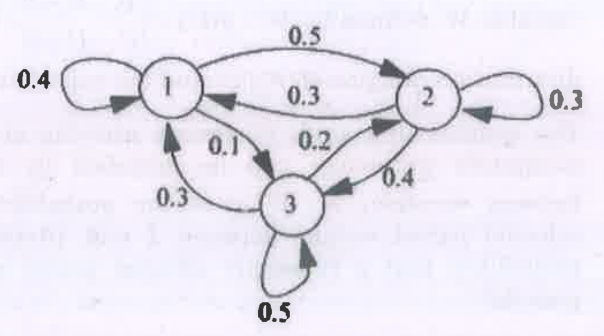
Q13(b) — state-transition diagram No verified answer or solution is available for this question.
Random Processes and Linear Algebra
(a) Let V denote the set of ordered pairs of real numbers. If (a₁,b₁) and (a₂,b₂) are elements of V and c ∈ ℝ, define (a₁,b₁) + (a₂,b₂) = (a₁ + a₂, b₁b₂) and c(a₁,b₁) = (ca₁,b₁). Determine whether V is a vector space over ℝ with these operations. If not, list the axioms that fail to hold. (OR) (b) (i) Obtain the solution space, basis of the solution space, and its dimension of the system given below. A = [[1, −3, 4, −2, 5, 4], [2, −6, 9, −1, 8, 2], [2, −6, 9, −1, 9, 7], [−1, 3, −4, 2, −5, −4]]. (10) (ii) Show that the three vectors u = (0,3,1,−1), v = (6,0,5,1) and w = (4,−7,1,3) form a linearly dependent set in ℝ⁴. (6)
No verified answer or solution is available for this question.
Random Processes and Linear Algebra
(a) Assume that the vector space ℝ³ has the Euclidean inner product. Apply the Gram-Schmidt process to transform the basis vectors u₁(1,−1,1), u₂ = (1,0,1), u₃ = (1,1,2) into an orthogonal basis {v₁,v₂,v₃} and then normalize the orthogonal basis vectors to obtain an orthonormal basis u₁, u₂ and u₃. [Transcription note: The first vector is printed without an equals sign.] (OR) (b) Find the least squares solutions, the least squares error vector and the least squares error of the linear system 3x₁ + 2x₂ − x₃ = 2, x₁ − 4x₂ + 3x₃ = −2, x₁ + 10x₂ − 7x₃ = 1.
No verified answer or solution is available for this question.