
// Anna University, Chennai / 2023
Anna University — Random Processes and Linear Algebra (MA3355), April/May 2023
Random Processes and Linear Algebra · MA3355 · R2021 · B.E. Bio Medical Engineering
Files open in a new tab. Use your browser's download or save option to keep a copy.
Work through the questions
15 questions
No verified answers are available for this paper.
Random Processes and Linear Algebra
Two fair dice are tossed. Find the probability of the outcome of the second die is greater than the outcome of the first die.
No verified answer or solution is available for this question.
Random Processes and Linear Algebra
- 2024
- 2023
Also asked in Anna University — PROBABILITY AND RANDOM PROCESSES (MA8451), November/December 2024 (2024).
A bag contains eight red balls, four green balls, and eight yellow balls. A ball is drawn at random from the bag, and it is not a red ball. What is the probability that it is a green ball?
No verified answer or solution is available for this question.
Random Processes and Linear Algebra
Given two random variables X and Y with the joint CDF F_XY(x,y) and marginal CDFs F_X(x) and F_Y(y), respectively, compute the joint probability that X is greater than a and Y is greater than b.
No verified answer or solution is available for this question.
Random Processes and Linear Algebra
The joint PMF of two random variables X and Y is given by P_XY(x,y) = (1/18)(2x + y) for x = 1, 2 and y = 1, 2, and 0 otherwise. What is the marginal PMF of X?
No verified answer or solution is available for this question.
Random Processes and Linear Algebra
Customers arrive at a grocery store in a Poisson manner at an average rate of 10 customers per hour. The amount of money that each customer spends is uniformly distributed between $8.00 and $20.00. What is the average total amount of money that customers who arrive over a two-hour interval spend in the store?
No verified answer or solution is available for this question.
Random Processes and Linear Algebra
What are the four basic types of Markov processes?
No verified answer or solution is available for this question.
Random Processes and Linear Algebra
Consider the vectors u = (1,2,−1) and v = (6,4,2) in ℝ³. Show that w = (9,2,7) is a linear combination of u and v.
No verified answer or solution is available for this question.
Random Processes and Linear Algebra
Determine whether the vectors v₁ = (1,−2,3), v₂ = (5,6,−1), v₃ = (3,2,1) are linearly independent or linearly dependent in ℝ³.
No verified answer or solution is available for this question.
Random Processes and Linear Algebra
Let T: ℝ³ → ℝ³ be the orthogonal projection onto the xy-plane. Find the range and kernel of the transformation.
No verified answer or solution is available for this question.
Random Processes and Linear Algebra
Prove that the vectors u = (1,1) and v = (1,−1) are orthogonal with respect to the Euclidean inner product on ℝ².
No verified answer or solution is available for this question.
Random Processes and Linear Algebra
(a) (i) A student buys 1000 integrated circuits (ICs) from supplier A, 2000 ICs from supplier B, and 3000 ICs from supplier C. He tested the ICs and found that the conditional probability of an IC being defective depends on the supplier from whom it was bought. Specifically, given that an IC came from supplier A, the probability that it is defective is 0.05; given that an IC came from supplier B, the probability that it is defective is 0.10; and given that an IC came from supplier C, the probability that it is defective is 0.10. If the ICs from the three suppliers are mixed together and one is selected at random, what is the probability that it is defective? (8) (ii) State and prove the “forgetfulness” Property of the Geometric Distribution. (8) (OR) (b) (i) The weights in pounds of parcels arriving at a package delivery company’s warehouse can be modeled by an N(5;16) normal random variable, X. (8) (1) What is the probability that a randomly selected parcel weighs between 1 and 10 pounds? (2) What is the probability that a randomly selected parcel weighs more than 9 pounds? (ii) The lengths of phone calls at a certain phone booth are exponentially distributed with a mean of 4 minutes. I arrived at the booth while Tom was using the phone, and I was told that he had already spent 2 minutes on the call before I arrived. (1) What is the average time I will wait until he ends his call? (2) What is the probability that Tom’s call with last between 3 minutes and 6 minutes after my arrival? (8)
No verified answer or solution is available for this question.
Random Processes and Linear Algebra
(a) The joint CDF of two discrete random variables X and Y is given as follows: (16) F_xy(1,1) = 1/8, F_xy(1,2) = 5/8, F_xy(2,1) = 1/4, F_xy(2,2) = 1. Determine the joint PMF of X and Y; Marginal PMF of X and Marginal PMF of Y. (OR) (b) The joint PDF of the random variables X and Y is defined as follows: f_x,y(x,y) = 25e^(−5y) for 0 < x < 0.2 and y > 0, and 0 elsewhere. What is the covariance of X and Y? (16)
No verified answer or solution is available for this question.
Random Processes and Linear Algebra
(a) A company cafeteria opens daily on weekdays at 8 a.m. Studies indicate that the employees arrive at the cafeteria over its normal business hours in a Poisson manner. However, the arrival rate varies with the time of the day. In particular, the following observation has been made: (i) During the first three hours from when the cafeteria opens for business, there is a steady increase in the customer arrival rate from 4 per hour to 16 per hour. (ii) Then the arrival rate remains constant at 16 customers per hour for the next two hours. (iii) Finally the arrival rate uniformly declines to 0 per hour in the next 2 hours. (1) What is the probability that no employee arrives at the cafeteria during the first two hours? (2) What is the expected number of arrivals during the first four hours? (16) (OR) (b) Find the transition probability matrix and the limiting-state probabilities of the process represented by the state-transition diagram shown in the below diagram. (16)
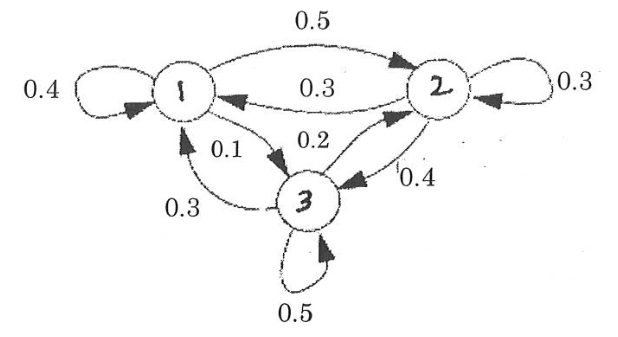
Q13(b) — state-transition diagram No verified answer or solution is available for this question.
Random Processes and Linear Algebra
(a) Determine whether the set of all pairs of real numbers of the form (1,x) with the operations (1,y) + (1,y′) = (1,y + y′) and k(1,y) = (1,ky) is a vector space or not. If not, identify the vector space axioms that fail to hold. (16) (OR) (b) Find a basis and the dimension of the solution space of the homogeneous system x₁ + 3x₂ − 2x₃ + 2x₅ = 0; 2x₁ + 6x₂ − 5x₃ − 2x₄ + 4x₅ − 3x₆ = 0; 5x₃ + 10x₄ + 15x₆ = 0; 2x₁ + 6x₂ + 8x₄ + 4x₅ + 18x₆ = 0. (16)
No verified answer or solution is available for this question.
Random Processes and Linear Algebra
(a) Assume that the vector space ℝ³ has the Euclidean inner product. Apply the Gram-Schmidt process to transform the basis vectors u₁ = (1,1,1), u₂ = (0,1,1), u₃ = (0,0,1) into an orthogonal basis {v₁,v₂,v₃}, and then normalize the orthogonal basis vectors to obtain an orthonormal basis {q₁,q₂,q₃}. (16) (OR) (b) Find the least squares solution, the least squares error vector, and the least squares error of the linear system (16) x₁ − x₂ = 4 3x₁ + 2x₂ = 1 −2x₁ + 4x₂ = 3
No verified answer or solution is available for this question.