
// Anna University, Chennai / 2022
Anna University — Discrete Mathematics (MA3354), November/December 2022
Discrete Mathematics · MA3354 · R2021 · B.E. Computer Science and Engineering · Semester 3
Files open in a new tab. Use your browser's download or save option to keep a copy.
Work through the questions
15 questions
No verified answers are available for this paper.
Prove that (p → (p ∨ q)) is a tautology.
No verified answer or solution is available for this question.
Symbolize the statement “All men are mortal”.
No verified answer or solution is available for this question.
Among 200 people, how many of them were born on the same month?
No verified answer or solution is available for this question.
Find the first four terms of the sequence defined by the recurrence relations and initial condition aₙ = (aₙ₋₁)², a₁ = 2.
No verified answer or solution is available for this question.
Define the pseudograph with an example.
No verified answer or solution is available for this question.
Draw the graph of the adjacency matrix [[0,1,1,1], [1,0,1,0], [1,1,0,1], [1,0,1,0]].
No verified answer or solution is available for this question.
Define monoid.
No verified answer or solution is available for this question.
Define the homomorphism of groups.
No verified answer or solution is available for this question.
Draw Hasse diagram for ≤ relation on {0,2,5,10,11,15}.
No verified answer or solution is available for this question.
Define lattice.
No verified answer or solution is available for this question.
(a) (i) Show that ¬(p ∧ (¬p ∧ q)) and (¬p ∧ ¬q) are logically equivalent without using truth table. (8) (ii) Using the indirect method, show that p → q, q → r, ¬(p ∧ r), p ∨ r ⇔ r. (8) [Transcription note: The first equivalence and the relation in (a)(ii) are reproduced as printed.] (OR) (b) (i) Find a conjunctive normal form of p → [(p → q) ∧ ¬(¬q ∨ ¬p)]. (8) (ii) Establish the validity of the following argument: “All integers are rational numbers. Some integers are powers of 2. Therefore, some rational numbers are powers of 2”. (8)
No verified answer or solution is available for this question.
(a) (i) In a class of 50 students, 20 students play football, and 16 students play hockey. It is found that 10 students play both the games. Find the number of students who play neither. (8) (ii) Use generating functions to solve the recurrence relation aₙ − 2aₙ₋₁ − 3aₙ₋₂ = 0, n ≥ 2 with a₀ = 3, a₁ = 1. (8) (OR) (b) (i) Use mathematical induction to prove that 1² + 3² + 5² + … + (2n + 1)² = (n + 1)(2n + 1)(2n + 3)/3, whenever n is positive integer. (8) (ii) Solve the recurrence relation aₙ = 8aₙ₋₁ − 16aₙ₋₂ for n ≥ 2, a₀ = 16, a₁ = 80. (8)
No verified answer or solution is available for this question.
(a) (i) Show that the maximum number of edges in a simple graph with ‘n’ vertices is n(n − 1)/2. (8) (ii) Establish the isomorphism of the following pairs of graphs, by considering their adjacency matrices. (8) (OR) (b) (i) In any graph G, prove that the total number of odd-degree vertices is even. (8) (ii) Find an Euler path or an Euler circuit, if it exits in each of the following three graphs. If it does not exist, explain why? (8)
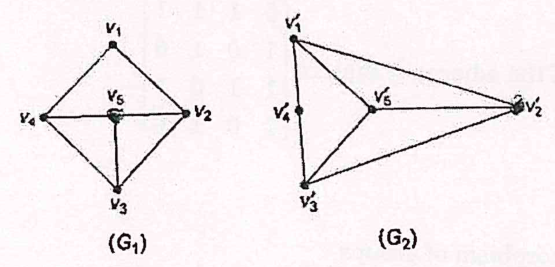
Q13(a)(ii) — graphs G₁ and G₂ 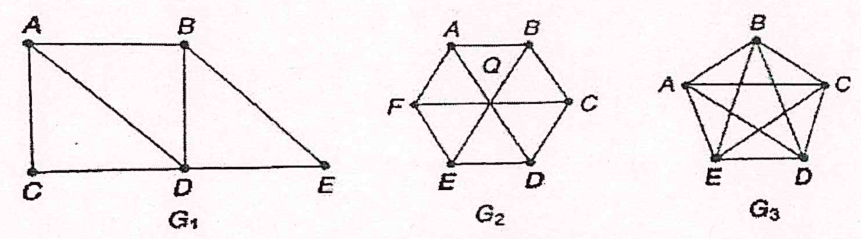
Q13(b)(ii) — Euler path graphs No verified answer or solution is available for this question.
(a) (i) A subgroup H of a group G is a normal subgroup in G iff each left coset of H in G is equal to the right coset of H in G. (8) (ii) Show that (Z,∗) is a group, where ∗ is defined by a ∗ b = a + b + 1. (8) (OR) (b) (i) Show that the group G = {1,−1,i,−i} is cyclic and find its generators. (6) (ii) Show that the set Z₄ = {0,1,2,3} is a commutative ring with respect to the binary operations additive modulo 4 (+₄) and multiplicative modulo 4 (×₄). (10)
No verified answer or solution is available for this question.
(a) (i) Show that every chain is a distributive lattice. (8) (ii) Verify whether the lattices given by the Hasse diagrams in following are distributive. (8) (OR) (b) (i) State and prove De Morgan’s law in any Boolean Algebra. (8) (ii) If Sₙ is the set of all divisors of the positive integers ‘n’ and “aDb” if and only if ‘a’ divides ‘b’, prove that {S₂₄,D} is a lattice. Find also all the sublattices of D₂₄ that contain 5 or more elements. (8)
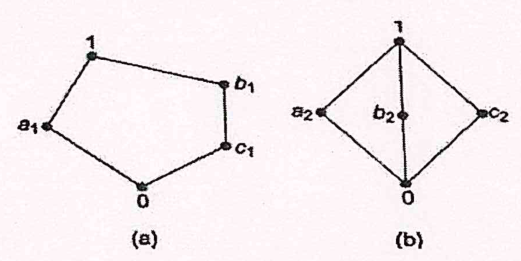
Q15(a)(ii) — Hasse diagrams No verified answer or solution is available for this question.