
// Anna University, Chennai / 2025
Anna University — Matrices and Calculus (MA3151), April/May 2025
Matrices and Calculus · MA3151 · R2021 · B.E./B.Tech. Engineering (common paper) · Semester 1
Files open in a new tab. Use your browser's download or save option to keep a copy.
Work through the questions
15 questions
No verified answers are available for this paper.
Can a real matrix have complex eigenvalues? Justify the answer.
No verified answer or solution is available for this question.
What is diagonalization? Why is the matrix A = [[0, 1], [0, 0]] not diagonalizable?
No verified answer or solution is available for this question.
Find lim as x → 1 of (x − 1)/(x^(2) − 1).
No verified answer or solution is available for this question.
If x = a(cos t + t sin t) and y = a(sin t − t cos t), find d^(2)y/dx^(2).
No verified answer or solution is available for this question.
Find the second-order partial derivatives of z = x^(3) + y^(3) − 3axy.
No verified answer or solution is available for this question.
Using Jacobians, verify that ∂(x, y)/∂(r, θ) = r, where x = r cos θ and y = r sin θ.
No verified answer or solution is available for this question.
Obtain the value of the definite integral ∫ from −1 to 1 of 3x^(2)√(x^(3) + 1) dx.
No verified answer or solution is available for this question.
For what values of p is ∫ from 1 to ∞ of 1/x^(p) dx convergent?
No verified answer or solution is available for this question.
Evaluate the double integral of [sin(x)/x] dA over the triangle in the xy-plane bounded by the x-axis, y = x and x = 1.
No verified answer or solution is available for this question.
Find the area enclosed by the lemniscate r^(2) = 4 cos(2θ) shown in the figure.
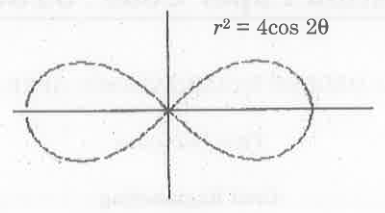
Lemniscate for Q10 No verified answer or solution is available for this question.
(a) State the Cayley–Hamilton theorem. Verify it for A = [[1, 2, 3], [2, 4, 5], [3, 5, 6]] and hence find A⁻¹. Also find A^(4). (OR) (b) Reduce 3x^(2) + 5y^(2) + 3z^(2) − 2yz + 2zx − 2xy to canonical form and specify the transformation matrix.
No verified answer or solution is available for this question.
(a) (i) Find lim as x → 0 of (tan x − x)/x^(3). (8 marks) (ii) Find equations for the tangent and normal lines to f(x) = (x^(2) − 1)/(x^(2) + x + 1) at (1, 0). (8 marks) (OR) (b) (i) Find the maximum and minimum values of f(x) = 3x^(4) − 2x^(3) − 6x^(2) + 6x + 1 on (0, 2). (8 marks) (ii) Water runs into a conical tank at 9 cubic feet per minute. The tank stands point down, is 10 feet high and has a base radius of 5 feet. How fast is the water level rising when the water is 6 feet deep? (8 marks)
No verified answer or solution is available for this question.
(a) (i) Using Euler’s theorem, prove that x(∂u/∂x) + y(∂u/∂x) = 2u log u, where log u = (x^(3) + y^(3))/(3x + 4y). (8 marks) (ii) Use Taylor’s formula to find the cubic approximation of f(x) = ln(x) about x = 1. Hence evaluate ln(1.1) correct to four decimal places. (8 marks) (OR) (b) (i) Find the absolute maximum and minimum values of f(x, y) = 2 + 2x + 4y − x^(2) − y^(2) on the triangular region in the first quadrant bounded by x = 0, y = 0 and y = 9 − x. (8 marks) (ii) Use Lagrange multipliers to find the maximum and minimum values of f(x, y) = 3x + 4y on x^(2) + y^(2) = 1. (8 marks)
No verified answer or solution is available for this question.
(a) Evaluate the following using appropriate substitutions: (i) ∫ from 0 to 1 of log(1 + x)/(1 + x^(2)) dx. (8 marks) (ii) ∫ from 0 to π of [x sin^(3)(x)]/[1 + cos^(2)(x)] dx. (8 marks) (OR) (b) Use partial fractions to evaluate: (i) ∫ (x^(2) + 2x + 1)/[(x − 1)(x − 2)(x − 3)] dx. (8 marks) (ii) ∫ x^(2)/[(x − 1)(x^(2) + 2x + 1)] dx. (8 marks)
No verified answer or solution is available for this question.
(a) (i) Find the area of the shaded region in the figure by double integration. (8 marks) (ii) Sketch the region of integration for ∫ from 0 to 2 ∫ from x^(2) to 2x (4x + 2) dy dx. Write and evaluate an equivalent double integral with the order reversed. (8 marks) (OR) (b) (i) Find the volume between z = y^(2) and the xy-plane, bounded by x = 0, x = 1, y = −1 and y = 1. (8 marks) (ii) Find the center of mass of a solid of constant density bounded below by the disk R: x^(2) + y^(2) ≤ 4 in the plane z = 0 and above by the paraboloid z = 4 − x^(2) − y^(2), as shown. (8 marks)
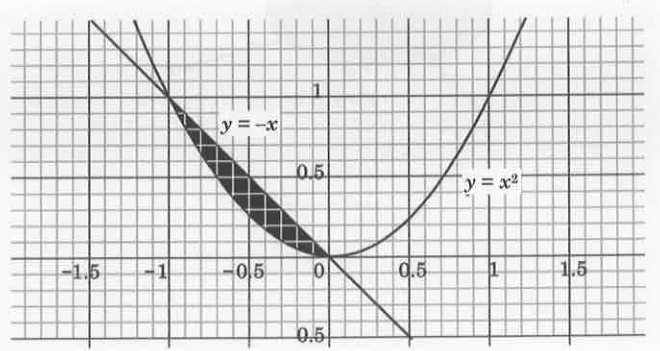
Shaded area between y = −x and y = x² for Q15(a)(i) 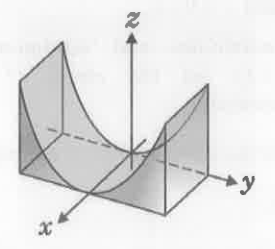
Parabolic cylinder for Q15(b)(i) 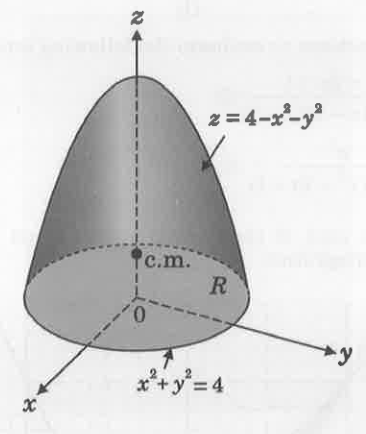
Paraboloid and base disk for Q15(b)(ii) No verified answer or solution is available for this question.