
// Anna University, Chennai / 2025
Anna University — Solid State Drives (EE8601), April/May 2025
Solid State Drives · EE8601 · R2017 · B.E. Electrical and Electronics Engineering · Semester 6
Files open in a new tab. Use your browser's download or save option to keep a copy.
Work through the questions
16 questions
No verified answers are available for this paper.
List the advantages of electrical drive over mechanical drive.
No verified answer or solution is available for this question.
Draw the speed-torque characteristics for traction loads.
No verified answer or solution is available for this question.
What is the function of free-wheeling diode used in a phase-controlled rectifier?
No verified answer or solution is available for this question.
A 230V, 960 rpm, 200A separately excited dc motor has an armature resistance of 0.02 Ω. Calculate the duty ratio of chopper for motoring operation at rated torque and 350 rpm.
No verified answer or solution is available for this question.
Write the condition for maximum torque occur in induction motor
No verified answer or solution is available for this question.
What is meant by v/f control?
No verified answer or solution is available for this question.
State the advantages of permanent magnet synchronous motor
No verified answer or solution is available for this question.
Compare VSI and CSI fed synchronous motor drive
No verified answer or solution is available for this question.
What are the advantages of closed loop speed control?
No verified answer or solution is available for this question.
Write down the transfer function of speed controller
No verified answer or solution is available for this question.
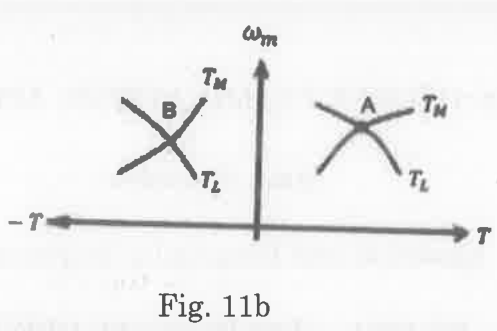
(a) (i) Discuss the multi-quadrant operation of electrical drives. (8) (ii) Sketch the functional block diagram of electric drive and explain the essential parts. (5) (OR) (b) (i) What is meant by steady state stability? Derive the mathematical condition for steady state stability analysis of equilibrium operating point. (10) (ii) In the figure 11b. Discuss the stability of the equilibrium point A and B. (3)
Q11 - chopper fed DC motor drive circuit No verified answer or solution is available for this question.
(a) (i) A 200 V, 875 rpm, 1 50 A separately excited dc motor has an armature resistance of 0.06 Ω. It is fed from a single phase fully controlled rectifier with an ac source voltage of 220 V, 50 Hz Assuming continuous conduction, calculate (5) (1) firing angle for rated motor torque and 750 rpm (2) firing angle for rated motor torque and (-500) rpm (ii) Derive the expression related to speed and torque of a single-phase full converter fed separately excited dc motor drive operating in the continuous conduction mode. (8) (OR) (b) (i) Discuss the control strategy used for class C chopper drives. (5) (ii) Explain the four-quadrant operation of a dc chopper with neat diagram. (8)
No verified answer or solution is available for this question.
(a) (i) Describe the speed control of three-phase induction motor using stator voltage control method. (6) (ii) Explain in detail the speed control scheme for a three-phase induction motor using rotor resistance control. (7) (OR) (b) (i) Elaborate the speed control of three-phase slip ring induction motor drive using slip power recovery schemes. (10) (ii) Draw the block diagram of vector-controlled drive. (3)
No verified answer or solution is available for this question.
(a) Explain the operation of self-controlled synchronous motor with neat diagrams. (13) (OR) (b) (i) Explain the power factor control of synchronous motor with relevant vector diagrams. (8) (ii) Draw and explain the three-phase CSI fed synchronous motor drive. (5)
No verified answer or solution is available for this question.
(a) Describe the armature voltage control of dc motor with constant field and field weakening modes. (13) (OR) (b) Explain in detail the design of current controller of closed loop speed control for DC separately excited motor. (13)
No verified answer or solution is available for this question.
(a) (i) What are heating and cooling curves? Starting from the basic principles derive the expressions for heating and cooling curves for an electrical machine. Also mention the assumptions made. (10) (ii) Half hour rating of a motor is 100 kW. Heating time constant is 80 minutes and the maximum efficiency occurs at 70 % of full, load. Determine the continuous rating of the motor. (5) (OR) (b) (i) Derive the transfer function of separately excited dc motor. (10) (ii) Describe briefly the converter selection and characteristics. (5)
No verified answer or solution is available for this question.