
// Anna University, Chennai / 2023
Anna University — Power Electronics (EE8552), April/May 2023
Power Electronics · EE8552 · R2017 · B.E. Electrical and Electronics Engineering · Semester 5
Files open in a new tab. Use your browser's download or save option to keep a copy.
Work through the questions
16 questions
No verified answers are available for this paper.
Define ODF in a power BJT.
No verified answer or solution is available for this question.
"Snubber circuit for an SCR should primarily consist of capacitor only But, in actual practice, a resistor is used in series with the capacitor"- Interpret.
No verified answer or solution is available for this question.
- 2023
- 2021
Also asked in Anna University — Power Electronics (EE8552), November/December 2021 (2021).
What is the relation between α, β and γ in single-phase fully controlled rectifier when operating with RL load?
No verified answer or solution is available for this question.
What are the influences of pulse number of phase-controlled rectifiers on their output voltage ripple content?
No verified answer or solution is available for this question.
- 2023
- 2022
- 2021
Also asked in Anna University — Power Electronics (EE8552), November/December 2022 (2022), Anna University — Power Electronics (EE8552), November/December 2021 (2021).
What is a time ratio control?
No verified answer or solution is available for this question.
- 2025
- 2024
- 2023
Also asked in Anna University — Power Electronics (EE8552), April/May 2025 (2025), Anna University — Power Electronics (EE8552), April/May 2024 (2024).
A chopper is operating at a frequency of 2kHz on a 230V DC input, if the load voltage is 150V, calculate the conduction and non-conduction periods of thyristor in each cycle.
No verified answer or solution is available for this question.
Mention the types of UPS.
No verified answer or solution is available for this question.
What is meant by overmodulation in SPWM? Mention its necessity.
No verified answer or solution is available for this question.
A single-phase voltage controller has input voltage of 230V, 50Hz and a load of R=15 Ω. For 6 cycles ON and 4 cycles OFF, determine the rms value of output voltage.
No verified answer or solution is available for this question.
- 2023
- 2021
Also asked in Anna University — Power Electronics (EE8552), November/December 2021 (2021).
A three phase six-pulse, 50 kVA, 415 V cycloconverter is operating at a firing angle of 450 and supplying load of 0.8 power factor. Determine input current to the converters.
No verified answer or solution is available for this question.
(a) (i) Discuss the basic structure and working of power IGBT. (6) (ii) Draw the two-transistor model of SCR and derive an expression for anode current. (7) (OR) (b) (i) Explain in details the different SCR commutation methods. (9) (ii) The figure shown beneath shows a thyristor controlling the power in a load resistance R_L. The supply voltage is 240 V dc and the specified limits for di/dt and dv/dt for the SCR are 50 A/μs and 300 V/μs respectively. Determine the values of the di/dt inductance and the snubber circuit parameters Rs and Cs. (4)
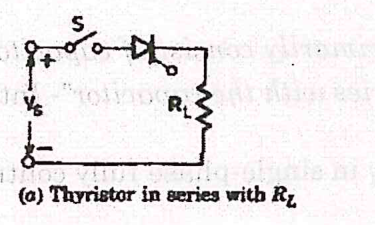
Q11(b)(ii)(a) - thyristor in series with R_L 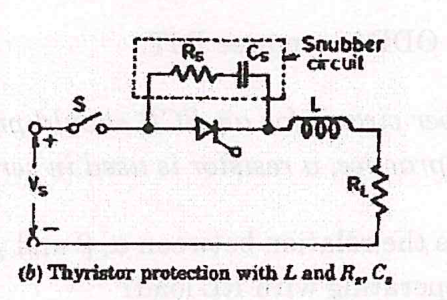
Q11(b)(ii)(b) - thyristor protection with L, Rs and Cs No verified answer or solution is available for this question.
(a) Explain the single phase fully controlled rectifier while feeding a load current of severe discontinuity. (13) (OR) (b) (i) Explain the effect of source inductance in the performance of the single-phase fully controlled rectifier. (9) (ii) Discuss the involvement of phase-controlled rectifiers in light dimmer application. (4)
No verified answer or solution is available for this question.
(a) (i) With help of circuit diagram and waveforms explain the principle of working of boost converter. (8) (ii) For a class chopper working with resistive load of R ohms, input voltage of Vdc and duty cycle α, express the following variables as functions of R, Vdc and α. (1 x 5 = 5) (1) Average output voltage and current (2) Output current at the commutation (3) Average and RMS freewheeling diode currents (4) RMS value of output voltage (5) Average and RMS load currents (OR) (b) (i) Describe the working of L-type ZCS resonant dc to dc converter. (5) (ii) Explain the working of class A chopper and arrive the output voltage relation. Also perform the steady state time domain analysis and obtain the output current equation. (8)
No verified answer or solution is available for this question.
(a) (i) Draw the circuit diagram of 1Φ auto sequential commutated current source inverter and explain its operation with equivalent circuits for different modes and necessary waveforms. (10) (ii) Write short notes on the principle of UPS. (3) (OR) (b) Explain the principle of space vector PWM applied to three phase VSI using the space vector diagram. (13)
No verified answer or solution is available for this question.
(a) Explain the basic principle of operation of a three-phase to single phase cycloconverter with circuit diagram and waveforms. Identify and mark the durations of rectification and inversion modes of converter groups for the assumed load angle. Obtain the fundamental rms value of output voltage/phase for an m-pulse cycloconverter. (13) (OR) (b) (i) With the suitable circuit, discuss about the matrix converter. (7) (ii) A 1-Φ AC voltage controller has, a resistive load of R=10 Ω and input voltage is Vs=120 V, 60 Hz the delay angle of thyristor T1 is α=π/2. Determine, (6) (1) the rms value of output voltage V0 (2) the input PF and (3) the average input current.
No verified answer or solution is available for this question.
(a) (i) The buck regulator has an input range of Vs=12 V. The regulated average output voltage is Va=5 V at R=500 Ω and the peak to peak output ripple voltage is 20 mV. The switching frequency is 25 kHz if the peak to peak ripple current of inductor is limited to 0.8 A determine (10) (1) The duty cycle, K (2) The filter inductance, L (3) The filter capacitance, C and the critical value of L and C. (ii) A single phase two pulse bridge converter feeds power to RLE load with R=10 Ω, L=10 mH E=100 V, ac voltage is 250V, 50 Hz for continuous conduction. Find the average value of load current for a firing angle of 50°. In case one of the SCR's gets open circuited, find the new value of average load current assuming the output current as continuous. (5) (OR) (b) (i) A three-phase to single-phase cycloconverter employs a six-pulse bridge circuit and fed from 400V, 50Hz supply through a delta/star connected transformer whose per phase turns ratio 3:1. For a output frequency of 2Hz, the load reactance is ωoL=3 Ω. The load resistance is 4 Ω. The commutation overlap and thyristor turn-off limit the firing angle in the inversion mode to 165°. Compute (7) (1) Peak value of rms output voltage (2) rms output current (3) output power (ii) For a single-phase voltage controller feeding a resistive load, show that power factor is given by the expression [ (1/π) { (π − α) + (1/2) sin 2α } ]^(1/2) (8)
No verified answer or solution is available for this question.