
// Anna University, Chennai / 2020
Anna University — Power System Analysis (EE1351A), November/December 2020
Power System Analysis · EE1351A · R2008 · B.E./B.Tech. Electrical and Electronics Engineering · Semester 6
Files open in a new tab. Use your browser's download or save option to keep a copy.
Work through the questions
15 questions
No verified answers are available for this paper.
- 2024
- 2020
Also asked in Anna University — Power System Analysis (EE3501), November/December 2024 (2024).
What is a single line diagram ?
No verified answer or solution is available for this question.
What is bus impedance matrix ?
No verified answer or solution is available for this question.
How are the buses classified in a power system ?
No verified answer or solution is available for this question.
Why is reference bus necessary for power flow analysis ?
No verified answer or solution is available for this question.
What is the need for short circuit studies ?
No verified answer or solution is available for this question.
What is bus admittance matrix ?
No verified answer or solution is available for this question.
Define positive sequence impedance.
No verified answer or solution is available for this question.
Write the boundary conditions in single line to ground fault.
No verified answer or solution is available for this question.
What is transient stability ?
No verified answer or solution is available for this question.
Define steady state stability limit.
No verified answer or solution is available for this question.
a) Find the bus impedance matrix for the system whose reactance diagram is shown in fig. All impedances are in p.u. (OR) b) Determine the bus admittance matrix of the system whose reactance diagram is shown below. The currents and admittances are given in p.u. Determine the reduced bus admittance matrix after eliminating node-3.
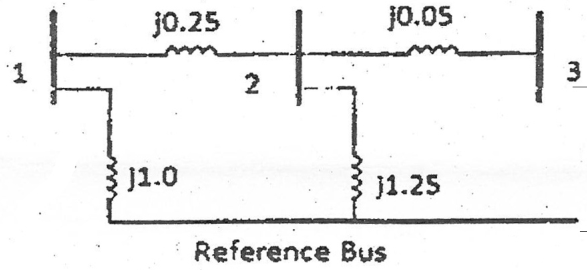
Q11(a) - reactance diagram with buses 1, 2, 3, j0.25, j0.05, j1.0, j1.25 and Reference Bus 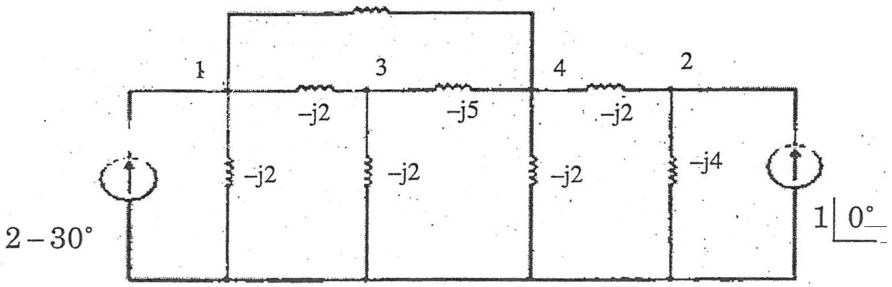
Q11(b) - network diagram with buses 1, 3, 4, 2, -j2, -j5 branches and injections 2 - 30 degrees and 1 angle 0 degrees No verified answer or solution is available for this question.
a) The figure given below shows a three bus power system. Bus (1) slack bus E_specified = 1.05 ∠ 0° Bus (2) PV bus |E|_specified = 1.2 p.u. P_G = 3 p.u. Bus (3) PQ bus P_L = 4 p.u., Q_L = 2 p.u. Carry out one iteration of load flow solution by Gauss-Seidal method. Take Q limits of generator 2 as 0 ≤ Q ≤ 4. Take α = 1. (OR) b) Write the procedure for load flow solution by Newton-Raphson method with flow chart.
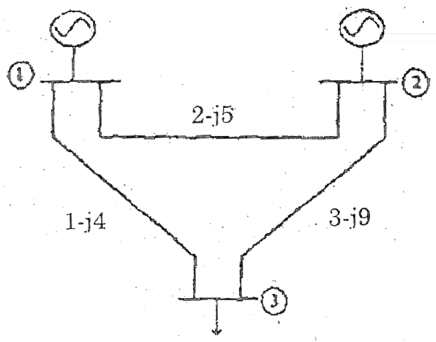
Q12(a) - three bus power system with buses 1, 2, 3 and lines 2-j5, 1-j4 and 3-j9 No verified answer or solution is available for this question.
a) i) What is meant by sequence impedance ? Explain the sequence network of an unloaded generator. (6) ii) Derive the formula to determine the fault current for a line to line fault on an unloaded generator. Draw an equivalent network showing the interconnection between sequence of networks to simulate line to line fault. (10) (OR) b) A three phase, 5 MVA, 6.6 kV alternator with a reactance of 8% is connected to a feeder of series impedance of 0.12 + j0.48 ohms/phase/km. The transformer is rated at 3 MVA, 6.6 kV/33 kV and has a reactance of 5%. Determine the fault current supplied by the generator operating under no load with a voltage of 6.9 kV when a three phase symmetrical fault occurs at a point 15 km along the feeder.
No verified answer or solution is available for this question.
a) Derive the relationship for fault currents in terms of symmetrical components when there is double line to ground fault. (16) (OR) b) A salient pole generator without dampers is rated 20 MVA, 13.8 kV and has a direct axis sub transient reactance of 0.25 per unit. The negative and zero sequence reactance are 0.35 and 0.1 per unit respectively. The neutral of the generator is solidly grounded. Determine the sub transient current in the generator and the line to line voltage for sub transient conditions when a single line to ground fault occurs at the generator terminals with generator operating unloaded at rated voltage. Neglect resistance. (16)
No verified answer or solution is available for this question.
a) What is meant by Equal Area Criterion ? Explain it with a neat diagram and prove it mathematically. Explain Equal Area Criterion as applied to the stability study of fault and subsequent circuit isolation. (16) (OR) b) With necessary steps, explain the modified Euler method to solve swing equation for a multi-machine system. (16)
No verified answer or solution is available for this question.