
// Anna University, Chennai / 2020
Anna University — Linear Integrated Circuits (EC2254), November/December 2020
Linear Integrated Circuits · EC2254 · R2008 · B.E. Electronics and Communication Engineering · Semester 4
Files open in a new tab. Use your browser's download or save option to keep a copy.
Work through the questions
15 questions
No verified answers are available for this paper.
Name the different methods used in fabrication of integrated resistors.
No verified answer or solution is available for this question.
What is the maximum undistorted amplitude, that a sine wave input of 10 kHz, can produce, at the output of an op-amp whose slew rate is 0.5 V/μs ?
No verified answer or solution is available for this question.
Draw the circuit diagram of an op-amp integrator circuit.
No verified answer or solution is available for this question.
How does precision rectifier differ from the conventional rectifier ?
No verified answer or solution is available for this question.
With the equations, show how is a multiplier can be used for finding phase angle difference between two signals.
No verified answer or solution is available for this question.
Define pull-in time as referred to PLL.
No verified answer or solution is available for this question.
Mention the significance of sample and Hold circuit.
No verified answer or solution is available for this question.
Define gain error and monotonicity with respect to data converters.
No verified answer or solution is available for this question.
Give the formula for period of oscillations in an op-amp astable circuit.
No verified answer or solution is available for this question.
Define duty cycle of a periodic pulse wave form.
No verified answer or solution is available for this question.
a) i) Describe the following with respect to integrated circuit fabrication. 1) Silicon wafer preparation (6) 2) Dielectric isolation. (6) ii) Explain why inductors are difficult to fabricate in ICs. (4) (OR) b) i) Draw the circuit diagram of a basic current mirror and explain its operation. (8) ii) For the current mirror circuit shown in fig. (11 b) (ii), determine the emitter current in transistor Q₃ if β = 100 and V_BE = 0.75 V. (8)
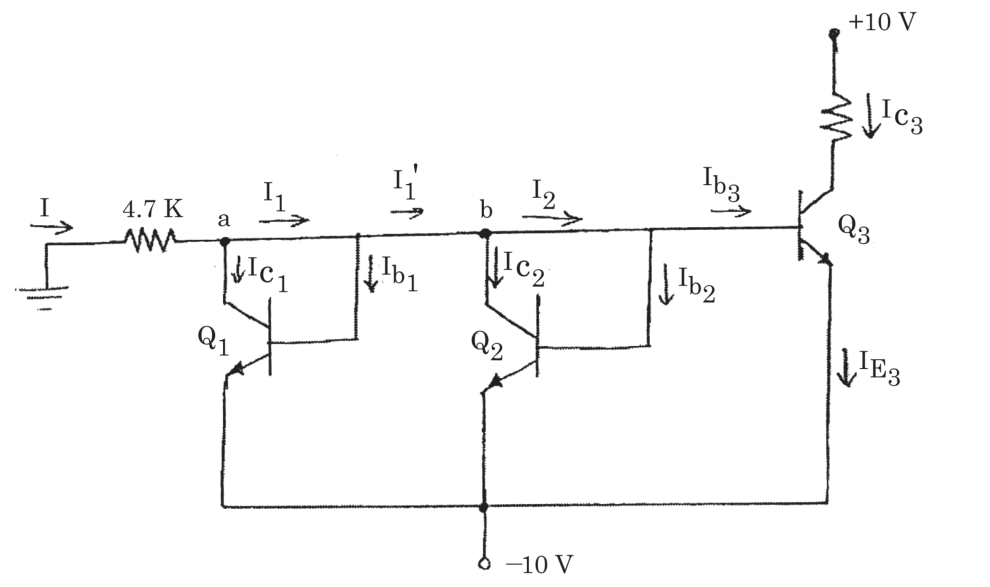
Q11(b)(ii) - current mirror circuit with Q1, Q2 and Q3, a 4.7 K series resistor and ±10 V supplies (Figure 11 b) (ii)) No verified answer or solution is available for this question.
a) i) What do you understand by an Instrumentation Amplifier ? (2) ii) State the requirements of a good Instrumentation Amplifier. (4) iii) Draw the circuit diagram and explain the working of instrumentation Amplifier. (6) iv) Mention the specific advantages of three op-amp Instrumentation Amplifier circuit. (4) (OR) b) i) What do you understand by an Integrator ? (2) ii) Draw and explain an ideal active op-amp Integrator ckt. (4) iii) Draw the I/O waveforms for integrator (3×½=1½) 1) Step input signal 2) Square wave input signal 3) Sine wave input signal. iv) Derive the expression for change in output voltage. (3) v) List the applications of practical integrator. (1½) vi) Design a practical integrator circuit with a dc gain of 10, to integrate a square wave of 10KHz. (4)
No verified answer or solution is available for this question.
a) i) Explain, with-necessary equations, the basic circuits of 'Linearized transconductance multiplier' and 'Differential V-I converter'. Hence explain the 'Four quadrant variable transconductance multiplier' circuit. (10) ii) Explain the working of a divider circuit using multiplier IC. (6) (OR) b) i) Draw the block diagram of VCO and explain its operation. Also derive the frequency of oscillator. (10) ii) Draw the circuit of a PLL used as AM detector and explain its operation. (6)
No verified answer or solution is available for this question.
a) Explain the following types of digital to analog converters, with suitable circuit diagrams i) Binary weighted resistor DAC. (6) ii) R-2R Ladder DAC. (5) iii) Inverted R-2R Ladder DAC. (5) (OR) b) i) With a neat block diagram, explain, in detail, the successive approximation type A/D converter. (8) ii) Explain the over sampling A/D converter with functional block diagram. (8)
No verified answer or solution is available for this question.
a) i) Describe the astable mode of operation of IC 555 timer and discuss any two applications. (10) ii) Explain how opto-couplers can be used in circuits for isolation. (6) (OR) b) i) Draw the function diagram for a low voltage regulator using IC 723 and explain its operation. (8) ii) State the protection circuit used in voltage regulators and explain them with characteristic curve. (8)
No verified answer or solution is available for this question.