
// Anna University, Chennai / 2019
Anna University — Theory of Computation (CS8501), November/December 2019
Theory of Computation · CS8501 · R2017 · B.E. Computer Science and Engineering · Semester 5
Files open in a new tab. Use your browser's download or save option to keep a copy.
Work through the questions
16 questions
No verified answers are available for this paper.
Prove by induction on n ≥ 1 that Σ(i=1 to n) 1/(i(i+1)) = n/(n+1).
No verified answer or solution is available for this question.
Formally define deterministic finite automata.
No verified answer or solution is available for this question.
Construct regular expression corresponding to the state diagram.
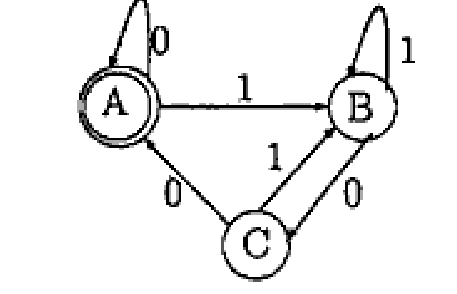
The state diagram. No verified answer or solution is available for this question.
State pumping lemma for regular languages.
No verified answer or solution is available for this question.
When do you say a CFG is ambiguous ?
No verified answer or solution is available for this question.
Give a formal definition of PDA.
No verified answer or solution is available for this question.
What are the advantages of having a normal form for a grammar ?
No verified answer or solution is available for this question.
Define the language recognized by the Turing machine.
No verified answer or solution is available for this question.
When do you say a Turing machine is an algorithm ?
No verified answer or solution is available for this question.
Define NP-Class.
No verified answer or solution is available for this question.
(a) Construct DFA equivalent to NFA ({p, q, r, s}, {0, 1}, δ, p, {s}), where δ is defined as δ 0 1 p {p, q} {p} q {r} {r} r {s} - s {s} {s} (OR) (b) Give non-deterministic finite automata accepting the set of strings in (0+1)* such that two 0's are separated by a string whose length is 4i, for some i ≥ 0.
No verified answer or solution is available for this question.
(a) i) Prove that any language accepted by a DFA can be represented by a regular expression. (7) ii) Construct a finite automata for the regular expression 10+(0+11)0*1. (6) (OR) (b) Prove that the following languages are not regular : i) {w ∈ {a, b}* | w = w^R} (7) ii) Set of strings of 0's and 1's, beginning with a 1, whose value treated as a binary number is a prime. (6)
No verified answer or solution is available for this question.
(a) Suppose L = L(G) for some CFG G = (V, T, P, S), then prove that L − {ε} is L(G') for a CFG G' with no useless symbols or ε-productions. (OR) (b) Prove that the languages accepted by PDA using empty stack and final states are equivalent.
No verified answer or solution is available for this question.
(a) State and prove Greibach normal form. (OR) (b) Design a Turing machine to compute proper subtraction.
No verified answer or solution is available for this question.
(a) Prove that Post Correspondence Problem is undecidable. (OR) (b) Prove that the universal language Lu is recursively enumerable but not recursive.
No verified answer or solution is available for this question.
(a) i) Suppose L = N(M) for some PDA M, then prove that L is a CFL. (7) ii) Give a CFG for the language N(M) where M = ({q0, q1}, {0, 1}, {Z0, X}, δ, q0, Z0, Φ) and δ is given by δ(q0, 1, Z0) = {(q0, XZ0)} δ(q0, ∈, Z0) = {(q0, ∈)} δ(q0, 1, X) = {(q0, XX)} δ(q1, 1, X) = {(q1, ∈)} δ(q0, 0, X) = {(q1, X)} δ(q1, 0, Z0) = {(q0, Z0)} (8) (OR) (b) i) Design a Turing machine to compute multiplication of two positive integers. (8) ii) Design a Turing machine to recognize the language {0ⁿ1ⁿ0ⁿ | n ≥ 1}. (7)
No verified answer or solution is available for this question.