
// Anna University, Chennai / 2021
Anna University — Data Structures (CS8391), November/December 2021
Data Structures · CS8391 · R2017 · B.E./B.Tech. (shared paper)
Files open in a new tab. Use your browser's download or save option to keep a copy.
Work through the questions
16 questions
No verified answers are available for this paper.
When arrays are better than linked list? Give an example.
No verified answer or solution is available for this question.
What is the benefit of circularly linked list over singly linked list in search applications?
No verified answer or solution is available for this question.
What are the necessary conditions for insertion and deletion operations on static Stack?
No verified answer or solution is available for this question.
What conversion is required for a queue data structure to behave as a circular queue?
No verified answer or solution is available for this question.
Give the structure of a node in a B+ tree.
No verified answer or solution is available for this question.
Mention some problems for which heaps are more applicable.
No verified answer or solution is available for this question.
Differentiate between weakly connected graph and strongly connected graph.
No verified answer or solution is available for this question.
What is the significance of articulation points in graphs?
No verified answer or solution is available for this question.
Write the procedure for shell sort algorithm.
No verified answer or solution is available for this question.
What is the reason for collision in hashing technique?
No verified answer or solution is available for this question.
(a) Write procedures or pseudo codes for the following operations on circular linked lists: (i) insertion. (4) (ii) deletion. (5) (iii) count. (4) (OR) (b) Implement the polynomial addition using singly linked list. Have procedures for insertion, comparison and addition of node values of this polynomial application. (4+5+4)
No verified answer or solution is available for this question.
(a) Write procedures for significant operations on a Stack data structure. Apply stack, to convert the following infix expression to the corresponding postfix expression: a + b / (d - e) – f. (9+4) (OR) (b) Write procedures for significant operations on a Queue data structure. List any four applications of queue data structure. (9+4)
No verified answer or solution is available for this question.
(a) Construct a binary search tree by inserting 3, 1, 4, 9, 6, 5, 2, 8, and 7 into an initially empty tree. Show the results of deleting the nodes 1 6 and 7 one after the other of the constructed tree. (8+5) (OR) (b) (i) Illustrate the construction procedure of Expression trees with suitable example. (8) (ii) Distinguish between binary trees and threaded binary tree. (5)
No verified answer or solution is available for this question.
(a) (i) Give the graph traversal procedures for DFS and BFS. (9) (ii) Give the order of traversing the nodes of the graph given in figure: Q.14(a), when DFS and BFS are applied on the same. (4) (OR) (b) (i) What are Eulerian circuits and Eulerian paths? (4) (ii) Give the procedure to determine Euler circuit. (5) (iii) Does the figure: Q.14(b) has Euler circuit(s)? (2) (iv) Does it have any Euler path. If so, list. (2)
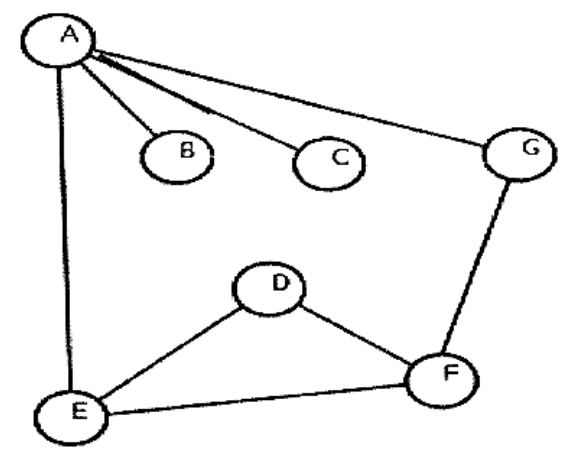
Q14(a) — traversal graph 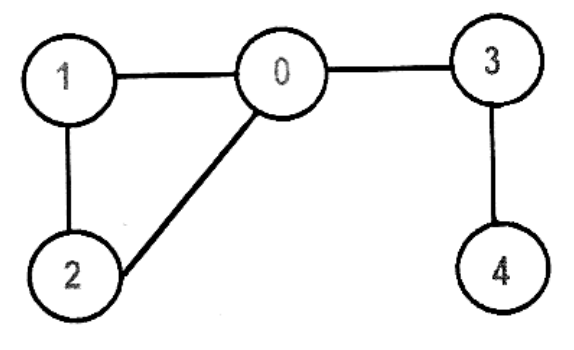
Q14(b) — Euler circuit graph No verified answer or solution is available for this question.
(a) (i) Illustrate the linear search algorithm with suitable example. (6) (ii) Trace the working of insertion sod algorithm on an unordered dataset of size. (7) (OR) (b) Explain the various collision resolution strategies followed in hashing techniques. (13)
No verified answer or solution is available for this question.
(a) Construct an AVL tree by inserting 4, 1, 2, 5, 6, 17, 3, and 7 into an initially empty tree. Show the results of deleting the nodes 1, 6 and 7 one after the other of the constructed tree. Give the order of visiting the nodes by applying the post order traversal algorithm. (6+6+3) (OR) (b) Consider the following problem scenario: In recording scores for a golf tournament, we enter the name and score of the player as the player finishes. This information is to be retrieved in each of the following ways: * Scores and names can be printed in order by ascending or by descending scores. * Given the name of a player, other players with the same score can be printed. Give procedures by using the doubly linked list data structure, for implementing a solution for the problem. (8+7)
No verified answer or solution is available for this question.