
// Anna University, Chennai / 2023
Anna University — Theory of Computation (CS3452), April/May 2023
Theory of Computation · CS3452 · R2021 · B.E. Computer Science and Engineering · Semester 4
Files open in a new tab. Use your browser's download or save option to keep a copy.
Work through the questions
16 questions
No verified answers are available for this paper.
Differentiate NFA and DFA.
No verified answer or solution is available for this question.
Convert the given NFA to an DFA.
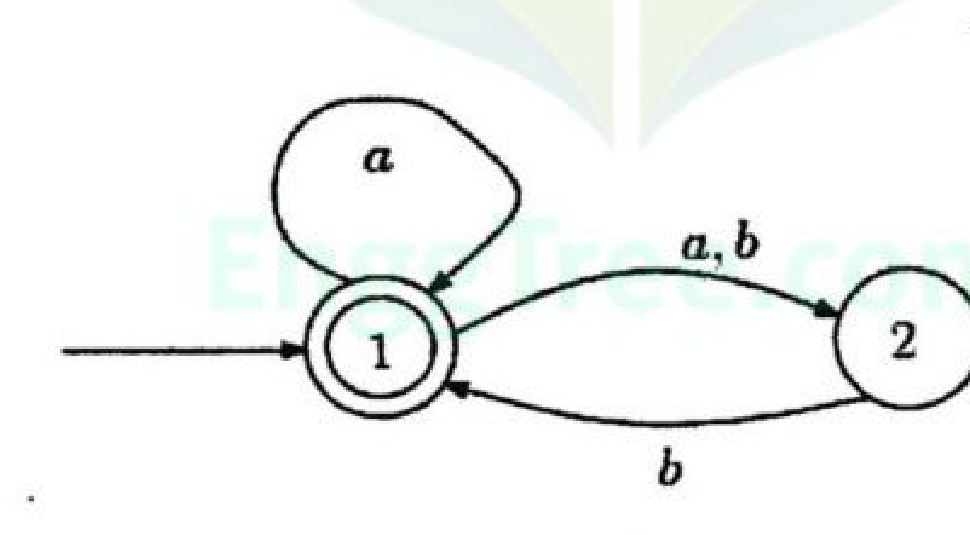
The NFA to convert. No verified answer or solution is available for this question.
Prove that reversal of any regular language is also regular.
No verified answer or solution is available for this question.
Write a regular expression that recognizes the set of all strings (0 + 1)* that do not contain the substrings 00 and 11 over the alphabet Σ = {0, 1}.
No verified answer or solution is available for this question.
State the Pumping Lemma for Context Free Languages.
No verified answer or solution is available for this question.
What is a Deterministic Push Down Automata?
No verified answer or solution is available for this question.
Give the instantaneous description of a TM.
No verified answer or solution is available for this question.
What do you mean by useless symbol? Explain with an example.
No verified answer or solution is available for this question.
- 2023
- 2019
Also asked in Anna University — Theory of Computation (CS6503), November/December 2019 (2019).
When is a language L recursively enumerable?
No verified answer or solution is available for this question.
What are tractable problems?
No verified answer or solution is available for this question.
(a) Construct NFA accepting the set of strings Σ = {0, 1} such that two 0's are separated by a string whose length is 4i, for some i>=0. (OR) (b) Prove that for every L recognized by an NFA, there exists an equivalent DFA accepting the same language L.
No verified answer or solution is available for this question.
(a) Prove that regular expressions are closed under union, concatenation, Kleene closure, complement. (OR) (b) Prove that any language accepted by a DFA can be represented by a regular expression and also construct a finite automata for the regular expression 10+(0+11)0*1.
No verified answer or solution is available for this question.
(a) Let G = (V, E, R, S) be the CFG, where V = {A, B, S}, E = {a, b}, S is the start variable and R consists of the rules S → aB | bA A → a | aS | BAA B → b | bS | ABB (i) Prove that ababba ∈ L(G) (7) (ii) Prove that L(G) is the set of all non-empty strings w over the alphabet {a, b} such that the number a's in w is equal to the number of b's in w. (6) (OR) (b) (i) Design a PDA that will accepts strings (a + b)* in which the number of a's is greater than the number of b's given the alphabet Σ = {a, b}. (7) (ii) Convert the above PDA to its equivalent CFG. (6)
No verified answer or solution is available for this question.
(a) (i) Convert the following grammar to CNF (7) S → ASB | ε A → aAS | a B → SbS | A | bb (ii) Design a Turing machine to compute proper subtraction. (6) (OR) (b) (i) Convert the following grammar to GNF (7) A1 → A3A2 | A2A3 A2 → A3A3 | A2A2 | a A3 → A2A2 | b (ii) Design a Turing machine that takes a binary number as input and increments the number by 1. (6)
No verified answer or solution is available for this question.
(a) (i) Prove that Post Correspondence Problem is undecidable. (7) (ii) Write short notes on P and NP completeness. (6) (OR) (b) (i) Explain about Universal Turing Machine. (7) (ii) Discuss Travelling Salesman Problem in terms of P and NP completeness. (6)
No verified answer or solution is available for this question.
(a) Consider the NFA N = (Q, Σ, δ, q, F), where Q = {1, 2, 3}, Σ = {a, b}, q = 1, F = {2}, and δ is given by the following table: a b c 1 {3} ϕ {2} 2 {1} ϕ ϕ 3 {2} {2, 3} ϕ Convert the NFA (N) into DFA (M) that accepts the same language. (OR) (b) (i) Write the regular expression for the set of all strings of 0's and 1's not containing 101 as substring. (5) (ii) Design a Turing machine to recognize the language {0^n1^n0^n | n >= 0}. (10)
No verified answer or solution is available for this question.