
// Anna University, Chennai / 2025
Anna University — C Programming and Data Structures (CS3353), April/May 2025
C Programming and Data Structures · CS3353 · R2021 · B.E. Electronics and Communication Engineering · Semester 3
Files open in a new tab. Use your browser's download or save option to keep a copy.
Work through the questions
16 questions
No verified answers are available for this paper.
C Programming and Data Structures
Define Data Types.
No verified answer or solution is available for this question.
C Programming and Data Structures
Write a Program to find whether the given number is odd or even.
No verified answer or solution is available for this question.
C Programming and Data Structures
State the purpose of “typedef” in C Programming.
No verified answer or solution is available for this question.
C Programming and Data Structures
What will be the output of the following C code? #include <stdio.h> union { int x; char y; } p; int main() { p.x = 10; printf("%d\n", sizeof(p)); }
No verified answer or solution is available for this question.
C Programming and Data Structures
Why doubly linked list is more useful than a singly linked list.
No verified answer or solution is available for this question.
C Programming and Data Structures
Name any two applications of priority queues.
No verified answer or solution is available for this question.
C Programming and Data Structures
Write short note on Hash Table.
No verified answer or solution is available for this question.
C Programming and Data Structures
State the importance of Sorting.
No verified answer or solution is available for this question.
C Programming and Data Structures
What is the worst case time complexity of Insertion sort and when it will occur?
No verified answer or solution is available for this question.
C Programming and Data Structures
Find the time complexity and space complexity of the following code #include <stdio.h> void main() { int i, n = 8; for (i = 1; i <= n; i++) { printf("Hello World !!!\n"); } }
No verified answer or solution is available for this question.
C Programming and Data Structures
(a) (i) Write a program to find whether the entered character is a vowel or note. (5) (ii) Develop a program to print the position of the smallest number of “n” numbers using arrays. (5) (iii) Differentiate between while and do-while loops. (3) (OR) (b) (i) What are decision control statements? Explain with examples. (6) (ii) Given an array int marks[] = {99,67,78,56,88,90,34,85}, calculate the address of marks[4] if the base address = 1000. (4) (iii) Differentiate between call by value and call by reference. (3)
No verified answer or solution is available for this question.
C Programming and Data Structures
(a) (i) How a structure can be created by initializing the variables and how it can be accessed. (4) (ii) Write a program to find smallest of three numbers using structures. (5) (iii) Differentiate between structure and array. (4) (OR) (b) (i) Differentiate between a binary file and a text file. (4) (ii) Specify the various attributed that can be used in a file system. (5) (iii) Write a program to add two integers using pointers and functions. (4)
No verified answer or solution is available for this question.
C Programming and Data Structures
(a) (i) Create a linked list which stores names of the employees. Then sort these names and re-display the contents of the linked list. (5) (ii) Give the linked representation of the following polynomial: 7x³y² − 8x²y + 3xy + 11x − 4. (4) (iii) Write an algorithm for evaluation of a prefix expression. (4) (OR) (b) (i) Devise an algorithm to insert and delete an element from a linked queue. (5) (ii) Write a function that accepts two stacks. Copy the contents of first stack in the second stack by preserving the order of the elements. (5) (iii) Differentiate between peek() and pop() functions. (3)
No verified answer or solution is available for this question.
C Programming and Data Structures
(a) (i) Consider the following binary search tree. Find the Preorder, Inorder and Postorder traversal and show the deletion of rootnote. (4) (ii) Explain the steps involved in the multiplication method of hash function. (4) (iii) Calculate the hash value for keys 1234 and 5642 using the mid-square method. The hash table has 100 memory locations. (5) (OR) (b) (i) Describe the working principle of open Hashing Technique and provide the type declaration in C for open hash table. (5) (ii) Consider a list of size 20 (m = 20). The elements are {96,48,63,29,87,77,48,65,69,94,61}. Display the Hash Table using double hashing technique. (5) (iii) State the advantage of Quadratic Probing. (3)
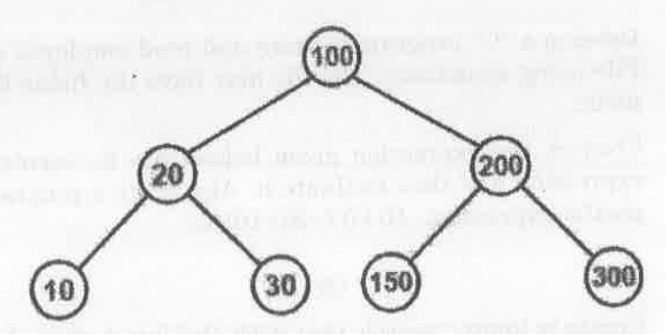
Q14(a)(i) — binary search tree No verified answer or solution is available for this question.
C Programming and Data Structures
(a) (i) Perform the insertion sort on the following elements and show the various passes to do it. The elements are 39,9,45,63,18,81,108,54,72,36. (5) (ii) Explain the working principle of Merge Sort algorithm. (4) (iii) Compare heap sort and quick sort. (4) (OR) (b) (i) If the following sequence of numbers is to be sorted using quick sort, then show the iterations of the sorting process. 42,34,75,23,21,18,90,67,78. (5) (ii) Using Binary Search, search the number 26 from the list of numbers and give its steps. The numbers are 10,7,17,26,32,92. (5) (iii) Compare Binary Search and Linear Search. (3)
No verified answer or solution is available for this question.
C Programming and Data Structures
(a) (i) Develop a “C” program to store and read employee data in a binary File using structures. The file may have the fields Employee id and name. (8) (ii) Convert the expression given below into its corresponding postfix expression and then evaluate it. Also write a program to evaluate a postfix expression. 10 + ((7 − 5) + 10)/2. (7) (OR) (b) (i) Create a binary search tree with the input given below: 98,2,48,12,56,32,4,67,23,87,23,55,46 (1) Insert 21,39,45,54, and 63 into the tree (2) Delete values 23,56,2, and 45 from the tree. (8) (ii) Sort the elements 81,89,9,11,14,76,54,22 using HeapSort and explain the steps involved in it. (7)
No verified answer or solution is available for this question.