
// Anna University, Chennai / 2025
Anna University — Digital Principles and Computer Organization (CS3351), November/December 2025
Digital Principles and Computer Organization · CS3351 · R2021 · B.E./B.Tech. Engineering (common paper) · Semester 3
Files open in a new tab. Use your browser's download or save option to keep a copy.
Work through the questions
16 questions
No verified answers are available for this paper.
Digital Principles and Computer Organization
- 2025
- 2023
Also asked in AKTU B.Tech IT — Digital Electronics (KOE049), Semester 4, 2023 (2023), AKTU B.Tech IT — Vlsi Design (KEC072), Semester 7, 2023 (2023).
Differentiate between combinational and sequential circuits.
No verified answer or solution is available for this question.
Digital Principles and Computer Organization
Convert the above logic circuit into NOR gates only.
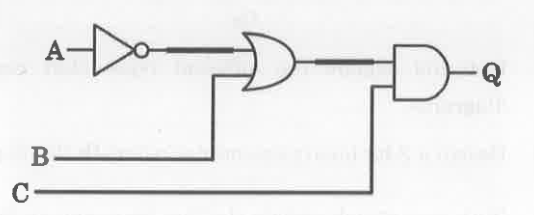
Q2 logic circuit No verified answer or solution is available for this question.
Digital Principles and Computer Organization
State the difference between synchronous and ripple counters.
No verified answer or solution is available for this question.
Digital Principles and Computer Organization
Draw the characteristic table of a JK flip-flop.
No verified answer or solution is available for this question.
Digital Principles and Computer Organization
Mention the role of memory location in instruction execution.
No verified answer or solution is available for this question.
Digital Principles and Computer Organization
Differentiate between direct and indirect addressing.
No verified answer or solution is available for this question.
Digital Principles and Computer Organization
Define data path.
No verified answer or solution is available for this question.
Digital Principles and Computer Organization
List the causes a control hazard.
No verified answer or solution is available for this question.
Digital Principles and Computer Organization
List any two cache mapping techniques.
No verified answer or solution is available for this question.
Digital Principles and Computer Organization
Draw the circuit diagram of DMA (direct memory access).
No verified answer or solution is available for this question.
Digital Principles and Computer Organization
(a) (i) Explain the construction and working of a 4-bit magnitude comparator. (7 marks) (ii) Minimize the following function using K-map and design a circuit: F = Σ(0, 2, 4, 5, 8, 9, 12) + d(1, 7, 13). (6 marks) (OR) (b) (i) Construct a 4 to 16 line decoder with an enable input using 2 to 4 line decoders with enable inputs. (7 marks) (ii) Draw a 4-bit binary adder-subtractor circuit using full adders and an XOR gate. (6 marks)
No verified answer or solution is available for this question.
Digital Principles and Computer Organization
(a) (i) Design a simple sequence detector using both Moore and Mealy models. (7 marks) (ii) Illustrate the process of state minimization in sequential circuit design with an example. (6 marks) (OR) (b) (i) List and explain the different types shift registers with block diagrams. (7 marks) (ii) Design a 2-bit binary up-counter using JK flip-flops. (6 marks)
No verified answer or solution is available for this question.
Digital Principles and Computer Organization
(a) (i) With neat sketch explain the Von Neumann architecture. (7 marks) (ii) Explain in detail about encoding of machine instruction with suitable example. (6 marks) (OR) (b) Describe the various addressing modes used in modern computers with suitable examples.
No verified answer or solution is available for this question.
Digital Principles and Computer Organization
(a) (i) Describe the various steps involved in instruction execution cycle. (7 marks) (ii) With a neat block diagram, explain the working of a microprogrammed control unit. (6 marks) (OR) (b) (i) Draw and explain a basic instruction pipeline with 5 stages. (7 marks) (ii) Describe delayed branching as a method to handle control hazards. (6 marks)
No verified answer or solution is available for this question.
Digital Principles and Computer Organization
(a) (i) With a neat diagram, explain the functioning of memory management in a system using segmentation and paging. (7 marks) (ii) Explain the three cache mapping techniques with examples. (6 marks) (OR) (b) (i) Discuss the concept of virtual memory with suitable scenario. (7 marks) (ii) List and explain any two interconnection standards. (6 marks)
No verified answer or solution is available for this question.
Digital Principles and Computer Organization
(a) (i) Design the combinational circuit with 3 inputs and 1 output. The output is 1 when the binary value of the input is less than 3. The output is 0 otherwise. (10 marks) (ii) Design the circuit by using NAND gates F = ABC′ + DE + AB′D′. (5 marks) (OR) (b) Design a modulo-6 counter using JK flip-flops.
No verified answer or solution is available for this question.