
// Anna University, Chennai / 2019
Anna University — Basic Electrical, Electronics and Measurement Engineering (BE8255), April/May 2019
Basic Electrical, Electronics and Measurement Engineering · BE8255 · R2017 · B.E./B.Tech. Engineering (common paper) · Semester 2
Files open in a new tab. Use your browser's download or save option to keep a copy.
Work through the questions
16 questions
No verified answers are available for this paper.
Basic Electrical, Electronics and Measurement Engineering
An inductive circuit has an inductance of 0.4 henry and takes a current of 0.5 amp when connected to 200 V, 50 Hz supply. Determine the resistance of the circuit.
No verified answer or solution is available for this question.
Basic Electrical, Electronics and Measurement Engineering
State Thevenin’s theorem and draw its equivalent circuit.
No verified answer or solution is available for this question.
Basic Electrical, Electronics and Measurement Engineering
What is stepper motor?
No verified answer or solution is available for this question.
Basic Electrical, Electronics and Measurement Engineering
- 2025
- 2019
Also asked in Anna University — Electrical and Instrumentation Engineering (BE3254), November/December 2025 (2025).
Define all day efficiency of a transformer.
No verified answer or solution is available for this question.
Basic Electrical, Electronics and Measurement Engineering
How does the sodium vapour lamp works?
No verified answer or solution is available for this question.
Basic Electrical, Electronics and Measurement Engineering
What are renewable energy sources?
No verified answer or solution is available for this question.
Basic Electrical, Electronics and Measurement Engineering
Why do BJT’s are called bipolar transistors?
No verified answer or solution is available for this question.
Basic Electrical, Electronics and Measurement Engineering
Distinguish between Zener breakdown and avalanche breakdown.
No verified answer or solution is available for this question.
Basic Electrical, Electronics and Measurement Engineering
Compare moving coil and moving iron instruments based on any two salient features.
No verified answer or solution is available for this question.
Basic Electrical, Electronics and Measurement Engineering
What is the basic requirement of a transducer?
No verified answer or solution is available for this question.
Basic Electrical, Electronics and Measurement Engineering
(a) In the circuit shown in Fig. (i), find the current in the load resistance Rₗ = 200 Ω. (OR) (b) Consider a resistive circuit having two meshes with one voltage source in each mesh and derive the steps involved in solving through (i) mesh analysis (6 marks) (ii) superposition theorem. (7 marks)
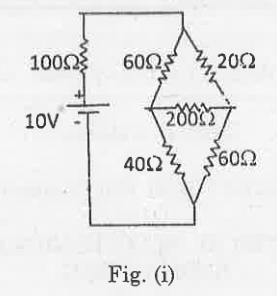
Fig. (i) No verified answer or solution is available for this question.
Basic Electrical, Electronics and Measurement Engineering
(a) Explain the principle of operation of DC motor and derive its torque equation. (OR) (b) With a neat diagram explain the construction and working principle of transformer.
No verified answer or solution is available for this question.
Basic Electrical, Electronics and Measurement Engineering
(a) Describe the various components of the refrigerator in detail. (OR) (b) (i) What is the importance for earthing, fuses and circuit breaker in an electrical circuit? (6 marks) (ii) Discuss the working of the circuit breaker. (7 marks)
No verified answer or solution is available for this question.
Basic Electrical, Electronics and Measurement Engineering
(a) (i) What is maximum forward current and peak inverse voltage in a PN junction diode? (4 marks) (ii) Discuss the V-I characteristics of Zener diode. (9 marks) (OR) (b) What are the essential functions of analog DAC? Discuss in detail the R-2R ladder type DAC.
No verified answer or solution is available for this question.
Basic Electrical, Electronics and Measurement Engineering
(a) With a neat sketch explain the construction and principle of operation of energy meter. (OR) (b) Write short notes on (i) LVDT (7 marks) (ii) LDR. (6 marks)
No verified answer or solution is available for this question.
Basic Electrical, Electronics and Measurement Engineering
(a) Construct the resistive circuit on your own and assign the values of resistances and voltages. Evaluate the current in the load resistor (assume) of the circuit using Thevenin’s theorem and compare the result using mesh analysis technique (by direct inspection). (OR) (b) How does the tariff support energy efficiency and demand-side management? Explain in detail.
No verified answer or solution is available for this question.