
// Anna University, Chennai / 2022
Anna University — Basic Electrical and Electronics Engineering (BE3251), November/December 2022
Basic Electrical and Electronics Engineering · BE3251 · R2021 · B.E./B.Tech. Engineering (common paper) · Semester 2
Files open in a new tab. Use your browser's download or save option to keep a copy.
Work through the questions
16 questions
No verified answers are available for this paper.
Basic Electrical and Electronics Engineering
Parallel combination of three 3 Ω resistors, connected in series with parallel combination of two 2 Ω resistors. Find the equivalent resistance of the circuit.
No verified answer or solution is available for this question.
Basic Electrical and Electronics Engineering
Write the equation for 25 cycles sine wave current having RMS value of 30 A.
No verified answer or solution is available for this question.
Basic Electrical and Electronics Engineering
A 4 pole lap wound DC shunt generator rotates at the speed of 1500 rpm, has a flux of 0.4 mWb and the total number of conductors are 1000. Find the value of emf generated.
No verified answer or solution is available for this question.
Basic Electrical and Electronics Engineering
Differentiate step-up transformer and step-down transformer.
No verified answer or solution is available for this question.
Basic Electrical and Electronics Engineering
Draw the circuit for Zener voltage regulator.
No verified answer or solution is available for this question.
Basic Electrical and Electronics Engineering
JFET is a voltage operated device. Justify.
No verified answer or solution is available for this question.
Basic Electrical and Electronics Engineering
What do you mean by weighted binary code? Give an example.
No verified answer or solution is available for this question.
Basic Electrical and Electronics Engineering
What is meant by combinational logic circuits? Give examples.
No verified answer or solution is available for this question.
Basic Electrical and Electronics Engineering
Mention the functional elements of a measuring system.
No verified answer or solution is available for this question.
Basic Electrical and Electronics Engineering
What do mean by resolution of a data acquisition system?
No verified answer or solution is available for this question.
Basic Electrical and Electronics Engineering
(a) Using mesh analysis, determine the current and potential difference across each resistor in the given circuit. The battery has 90 V and the current source 5 A. (OR) (b) Discuss about the working of RLC series circuit and derive the relationships. Give the necessary phasor diagrams.
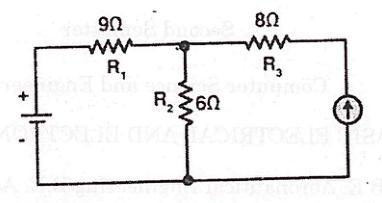
Q11(a) circuit No verified answer or solution is available for this question.
Basic Electrical and Electronics Engineering
(a) Describe the principle of working of DC motor. (OR) (b) Describe about the construction of core type and shell type single phase transformers.
No verified answer or solution is available for this question.
Basic Electrical and Electronics Engineering
(a) Explain the operation of BJT in common emitter mode with its characteristics. (OR) (b) Describe the working of bridge rectifier. Derive its ripple factor.
No verified answer or solution is available for this question.
Basic Electrical and Electronics Engineering
(a) Explain about the error detection and correction codes. (OR) (b) Simplify the Boolean function, f(W, X, Y, Z) = WX′Y′ + WY + W′YZ′ using K-map.
No verified answer or solution is available for this question.
Basic Electrical and Electronics Engineering
(a) Describe the construction, working principle of PMMC instruments. Also derive the torque equation. (OR) (b) Describe the method to measure three phase power by two wattmeter method.
No verified answer or solution is available for this question.
Basic Electrical and Electronics Engineering
(a) An AC circuit is composed of a serial connection of a resistor with resistance 50 Ω, a coil with inductance 0.3 H and a capacitor with capacitance 15 μF. The circuit is connected to an AC voltage source with amplitude 25 V and frequency 50 Hz. Determine the amplitude of electric current in the circuit and a phase difference between the voltage and the current. Draw the phasor diagram of voltages and current in the circuit. (OR) (b) Design and explain the operation of full adder from its truth table.
No verified answer or solution is available for this question.