
// Anna University, Chennai / 2026
Anna University — Basic Electrical and Electronics Engineering (BE3251), April/May 2026
Basic Electrical and Electronics Engineering · BE3251 · R2021 · B.E./B.Tech. Engineering (common paper) · Semester 2
Files open in a new tab. Use your browser's download or save option to keep a copy.
Work through the questions
16 questions
No verified answers are available for this paper.
Basic Electrical and Electronics Engineering
- 2026
- 2025
Also asked in Anna University — Electric Circuit Analysis (EE3251), November/December 2025 (2025).
State Kirchhoff’s voltage law and Kirchhoff’s current law.
No verified answer or solution is available for this question.
Basic Electrical and Electronics Engineering
Differentiate between real power and reactive power.
No verified answer or solution is available for this question.
Basic Electrical and Electronics Engineering
Write the EMF equation of DC generator.
No verified answer or solution is available for this question.
Basic Electrical and Electronics Engineering
Mention the applications of synchronous motor.
No verified answer or solution is available for this question.
Basic Electrical and Electronics Engineering
How does a transistor act as a switch?
No verified answer or solution is available for this question.
Basic Electrical and Electronics Engineering
Compare JFET with BJT.
No verified answer or solution is available for this question.
Basic Electrical and Electronics Engineering
Convert the decimal code (72.45)₁₀ into binary.
No verified answer or solution is available for this question.
Basic Electrical and Electronics Engineering
Write the basic properties of Boolean algebra.
No verified answer or solution is available for this question.
Basic Electrical and Electronics Engineering
List out the common errors present in energy meter.
No verified answer or solution is available for this question.
Basic Electrical and Electronics Engineering
List the functions of CT and PT.
No verified answer or solution is available for this question.
Basic Electrical and Electronics Engineering
(a) (i) Find the loop currents I₁, I₂ and I₃ for the network of Fig. 1 by mesh analysis. (7 marks) (ii) Find the voltage across A and B in the circuit shown in Fig. 2. (6 marks) (OR) (b) (i) A series RLC circuit consists of R = 10 Ω, L = 0.1 H and C = 100 μF is connected to a 230 V, 50 Hz AC supply. Calculate the impedance, power and power factor. (7 marks) (ii) Find the average and RMS values of the waveform shown in Fig. 3. (6 marks)
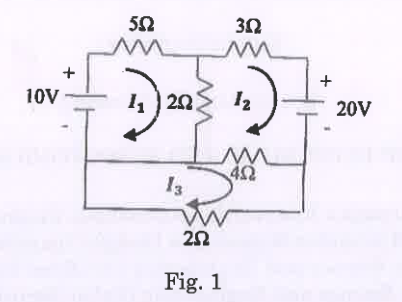
Fig. 1 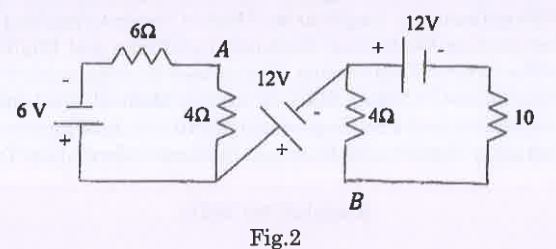
Fig. 2 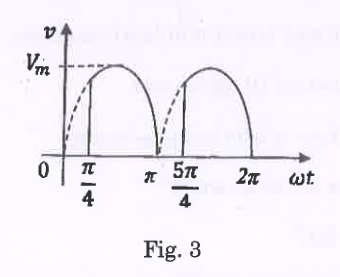
Fig. 3 No verified answer or solution is available for this question.
Basic Electrical and Electronics Engineering
(a) Discuss the principle of working and functions of various parts present in DC machine construction by using suitable diagram. (OR) (b) (i) Derive an expression for the EMF equation of transformer. (7 marks) (ii) Compare the synchronous motor with induction motor. (6 marks)
No verified answer or solution is available for this question.
Basic Electrical and Electronics Engineering
(a) (i) Describe the operation of full-wave rectifier with suitable diagram. (7 marks) (ii) Compare the PNP and NPN transistors. (6 marks) (OR) (b) (i) Describe the working and V-I characteristics of SCR with suitable diagram. (7 marks) (ii) Describe how FET act as voltage controlled resistor with suitable diagram. (6 marks)
No verified answer or solution is available for this question.
Basic Electrical and Electronics Engineering
(a) Reduce the following expression in SOP and POS forms using K-map technique and implement the minimal expression using suitable logic gates. f(A, B, C, D) = Σm(0, 2, 4, 6, 7, 8, 10, 12, 13, 15) (OR) (b) (i) Write the function of error correction code and explain how Hamming code corrects the errors with suitable example. (7 marks) (ii) Implement the half adder using suitable logic gates and realize the expressions. (6 marks)
No verified answer or solution is available for this question.
Basic Electrical and Electronics Engineering
(a) (i) Discuss the functional elements of an instrument with a neat block diagram. (7 marks) (ii) Compare the Moving Coil (MC) and Moving Iron (MI) instrumentation. (6 marks) (OR) (b) Discuss the construction and working of digital storage oscilloscope (DSO) with neat block diagram.
No verified answer or solution is available for this question.
Basic Electrical and Electronics Engineering
(a) Analyse the breakdown operation of PN junction diode and Zener diode with suitable V-I characteristics and compare the features and applications of PN junction and Zener diode. (OR) (b) Derive an expression for the torque equation of DC motor and analyze the performance of DC shunt and series motor by using the mechanical characteristics and mention their applications.
No verified answer or solution is available for this question.