
// Dr. A.P.J. Abdul Kalam Technical University, Uttar Pradesh / 2022
AKTU B.Tech — Basic Electrical Engineering (REE101), Semester 1, 2022
Basic Electrical Engineering · REE101 · B.Tech Computer Science and Engineering · Semester 1
Questions
24
Has an official figure
Work through the questions
24 questions
No verified answers are available for this paper.
Basic Electrical and Electronics Engineering
Draw and explain the torque-slip characteristics of a 3-Φ induction motor indicating the starting torque, the maximum torque and operating region. BL-4
No verified answer or solution is available for this question.
Basic Electrical and Electronics Engineering
Explain series resonance in R-L-C circuit. A series R-L-C circuit has R=10 , L=0.1H and C=8F. Determine
No verified answer or solution is available for this question.
Basic Electrical and Electronics Engineering
Formulate the average value, rms value & form factor and peak factor of half wave rectified alternating current having maximum value of 100 A. BL-5
No verified answer or solution is available for this question.
Basic Electrical and Electronics Engineering
A 3-phase 440 V, 50 Hz induction motor has a 4% slip. What will be the frequency of the rotor current? BL-3
No verified answer or solution is available for this question.
Basic Electrical and Electronics Engineering
Write the applications of split ring and brush in DC machines. BL-1
No verified answer or solution is available for this question.
Basic Electrical and Electronics Engineering
What is the condition of maximum efficiency of single transformer? BL-1
No verified answer or solution is available for this question.
Basic Electrical and Electronics Engineering
Using mesh analysis, find the current through 6 resistances in the following circuit. BL-3 0 0 BASIC ELECTRICAL ENGG
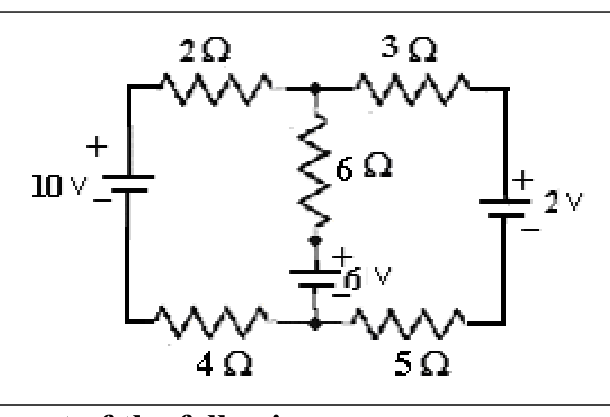
No verified answer or solution is available for this question.
Basic Electrical and Electronics Engineering
Find the current in 8Ω resistance using nodal analysis. BL-3
No verified answer or solution is available for this question.
Basic Electrical and Electronics Engineering
What the relationship between line and phase, voltage and current for a 3-Φ star connected balanced system? BL-2
No verified answer or solution is available for this question.
Basic Electrical and Electronics Engineering
Find the relationship between line and phase, voltage and current for a 3-Φ delta connected balanced system. A balanced 3-Phase star connected load takes 30KW at a leading current of 48A from a 3-ϕ source of 500V, 50Hz. Find the circuit parameters per phase. BL-4
No verified answer or solution is available for this question.
Basic Electrical and Electronics Engineering
Determine the form factor and peak factor of pure sine wave voltage of 220 Volt. BL-3
No verified answer or solution is available for this question.
Basic Electrical and Electronics Engineering
State and Explain Thevenin`s theorem and find the current in 40 resistance in the following network using Thevenin`s theorem. BL-4
No verified answer or solution is available for this question.
Basic Electrical and Electronics Engineering
A balanced star connected load of (8 + j6) per phase is connected to a balanced 3- phase, 400 V supply. Find the line current, phase current, power factor, power and total volt-amperes. BL-3
No verified answer or solution is available for this question.
Basic Electrical and Electronics Engineering
Why series resonant circuit is known as acceptor circuit & parallel resonant circuit as rejecter circuit? BL-1
No verified answer or solution is available for this question.
Basic Electrical and Electronics Engineering
resonant frequency (ii) Q factor of the circuit at resonance (iii) the half power frequencies. BL-4
No verified answer or solution is available for this question.
Basic Electrical and Electronics Engineering
Establish the analogy between electric circuit and magnetic circuit. BL-5
No verified answer or solution is available for this question.
Basic Electrical and Electronics Engineering
Compare active and passive elements with examples. BL-2
No verified answer or solution is available for this question.
Basic Electrical and Electronics Engineering
Explain the causes of low power factor. What are the disadvantages of low power factor? Explain any two methods to improve the power factor. BL-2
No verified answer or solution is available for this question.
Basic Electrical and Electronics Engineering
Explain the construction details and working of a Permanent magnet moving coil PMMC instruments along with the deflecting torque and controlling torque. BL-2
No verified answer or solution is available for this question.
Basic Electrical and Electronics Engineering
Why 1-Φ induction motor is not self-starting? Discuss any one method of starting. (ii) A 250 V dc shunt motor takes 41 A at full load. Armature resistance and shunt field winding resistances are 0.1 Ω and 250 Ω respectively. Find the back emf on full load. BL-3
No verified answer or solution is available for this question.
Basic Electrical and Electronics Engineering
Why synchronous motor is not self-starting? Discuss any two methods to start the synchronous motor. What are the various applications of synchronous motor? BL-5
No verified answer or solution is available for this question.
Basic Electrical and Electronics Engineering
Explain the working principle and emf equation of transformer. A 40 KVA transformer has iron loss of 450W and full load copper loss of 850W. if the power factor of the load is 0.8 lagging, calculate:
No verified answer or solution is available for this question.
Basic Electrical and Electronics Engineering
Explain single phase auto transformer and give its advantages over two winding transformers. Mention the various applications of auto transformer. BL-2
No verified answer or solution is available for this question.
Basic Electrical and Electronics Engineering
Full load efficiency (ii) The load at which the maximum efficiency occurs and (iii) The maximum efficiency. BL-4
No verified answer or solution is available for this question.