
// Dr. A.P.J. Abdul Kalam Technical University, Uttar Pradesh / 2022
AKTU B.Tech — Basic Electrical Engineering (NEE101), Semester 1, 2022
Basic Electrical Engineering · NEE101 · B.Tech Computer Science and Engineering · Semester 1
Questions
26
- 1(a)
- 1(j)
- 2(b)
- 5(a)
- 4(a)
- 1(i)
- 1(h)
- 1(f)
- 3(a)
- 1(b)
- 4(b)
- 1(g)
- 6(i)
- 1(e)
- 1(d)
- 5(b)
- 2(c)
- 1(c)
- 2(d)
- 6(a)
- 2(a)
- 3(b)
- 2(e)
- 7(b)
- 6(b)
- 7(a)
Has an official figure
Work through the questions
26 questions
No verified answers are available for this paper.
Basic Electrical and Electronics Engineering
What is the limitation of superposition theorem?
No verified answer or solution is available for this question.
Basic Electrical and Electronics Engineering
What is the function of slip rings in 3-ϕ induction motor?
No verified answer or solution is available for this question.
Basic Electrical and Electronics Engineering
What are the various methods of power factor improvement? Discuss one of them in brief.
No verified answer or solution is available for this question.
Basic Electrical and Electronics Engineering
Derive the relation between line and phase voltages for a star-connected 3-ϕ balanced system. A balanced star-connected load of (12+ j9) Ω/phase is connected to 3-ϕ, 400 V supply. Calculate line current, power factor, and power drawn by it.
No verified answer or solution is available for this question.
Basic Electrical and Electronics Engineering
Derive an expression of bandwidth in case of series resonating circuit. If the bandwidth of resonant circuit is 10 kHz and the lower half power frequency is 120 kHz. Find out the value of upper half power frequency and the quality factor of the circuit.
No verified answer or solution is available for this question.
Basic Electrical and Electronics Engineering
How the synchronous speed is related to frequency of supply and number of poles?
No verified answer or solution is available for this question.
Basic Electrical and Electronics Engineering
What is the condition of maximum efficiency of transformer?
No verified answer or solution is available for this question.
Basic Electrical and Electronics Engineering
What is the need of highly permeable core in transformer?
No verified answer or solution is available for this question.
Basic Electrical and Electronics Engineering
Derive an expression of delta (Δ) to star (Υ) transformation and star (Υ) to delta (Δ) transformation with example.
No verified answer or solution is available for this question.
Basic Electrical and Electronics Engineering
Define linear and non-linear elements with example.
No verified answer or solution is available for this question.
Basic Electrical and Electronics Engineering
Two impedances given by Z1 = (10+j15) Ω and Z2 = (6-j8) Ω are connected in parallel. If the total current supplied is 15 A, calculate the current and power absorbed by each branch.
No verified answer or solution is available for this question.
Basic Electrical and Electronics Engineering
How MMF is related to reluctance?
No verified answer or solution is available for this question.
Basic Electrical and Electronics Engineering
the number of turns in primary and secondary, (ii) the net cross-sectional area of core for a maximum flux density of 1.5T.
No verified answer or solution is available for this question.
Basic Electrical and Electronics Engineering
How the line current is related to phase current in 3-ϕ delta (Δ) connected circuit.
No verified answer or solution is available for this question.
Basic Electrical and Electronics Engineering
A series RLC circuit has R = 12Ω, L = 0.01 H and C =2.5 µF. Calculate the quality factor of the circuit.
No verified answer or solution is available for this question.
Basic Electrical and Electronics Engineering
Explain the construction of a permanent magnet moving coil (PMMC) instruments with a neat sketch.
No verified answer or solution is available for this question.
Basic Electrical and Electronics Engineering
A 3-ϕ, 500 V motor has a power factor of 0.4 (lagging). Two wattmeters are connected to measure the input and show the total input power to be 30 kW. Find out the readings of each wattmeter.
No verified answer or solution is available for this question.
Basic Electrical and Electronics Engineering
Explain the term “dynamic impedance” in AC circuits.
No verified answer or solution is available for this question.
Basic Electrical and Electronics Engineering
A 40 kVA transformer has core loss of 400 W and full-load copper loss of 800 W. If the power factor of the load is 0.9 (lagging) then calculate the efficiency of transformer at full load.
No verified answer or solution is available for this question.
Basic Electrical and Electronics Engineering
Derive an expression of EMF equation of transformer. The EMF per turn of 1-ϕ 10 kVA, 2200/220 V, 50 Hz transformer is 10. Calculate
No verified answer or solution is available for this question.
Basic Electrical and Electronics Engineering
What is the utility of thevenin’s theorem. Draw the thevenin’s equivalent circuit across the 2 kΩ resistor shown in Fig.1. Fig.1. Electric circuit
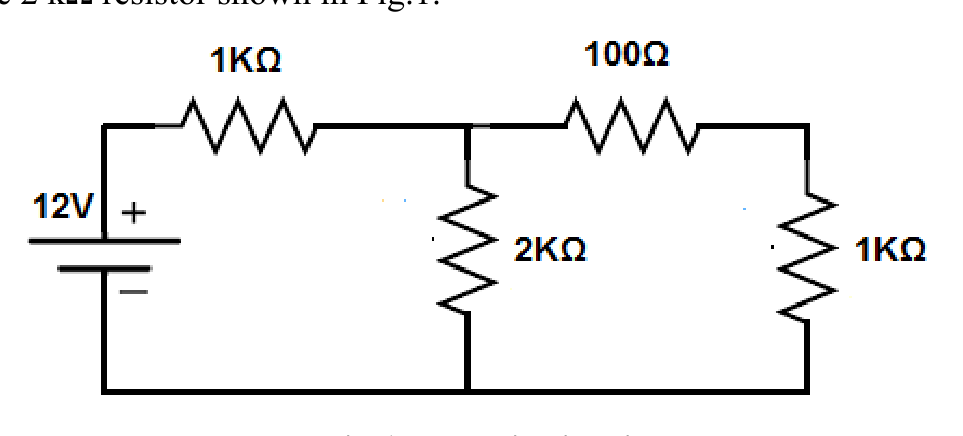
No verified answer or solution is available for this question.
Basic Electrical and Electronics Engineering
Determine the current flowing through 5Ω resistor in the following circuit (Fig.2) using superposition theorem. Fig.2. Electric circuit
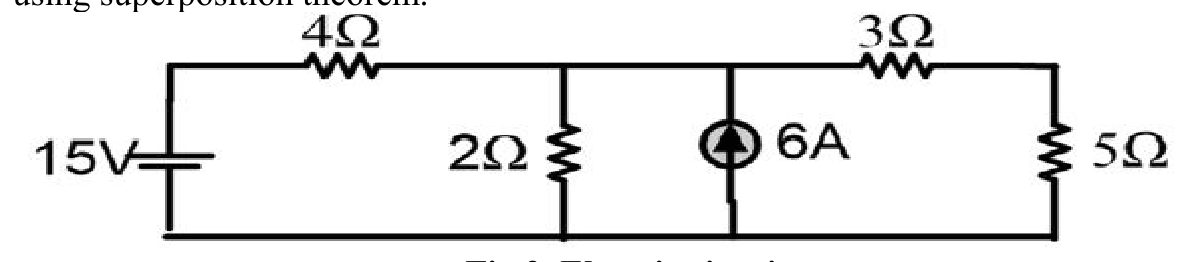
No verified answer or solution is available for this question.
Basic Electrical and Electronics Engineering
Why 1-ϕ induction motor is not self-starting? Explain different methods of starting of 1-ϕ induction motor. 0 0 BASIC ELECTRICAL ENGG
No verified answer or solution is available for this question.
Basic Electrical and Electronics Engineering
Motor taking 25 kW input.
No verified answer or solution is available for this question.
Basic Electrical and Electronics Engineering
Explain the need of earthing of electrical equipment. What are the different methods of earthing?
No verified answer or solution is available for this question.
Basic Electrical and Electronics Engineering
A 25 kW, 250 V DC shunt generator has armature and field resistances of 0.06 Ω and 100 Ω respectively. Determine the armature power developed when working as:
No verified answer or solution is available for this question.