
// Dr. A.P.J. Abdul Kalam Technical University, Uttar Pradesh / 2023
AKTU B.Tech — Basic Electrical Engineering (KEE101), Semester 1, 2023
Basic Electrical Engineering · KEE101 · B.Tech Computer Science and Engineering · Semester 1
Questions
27
- 1(f)
- 1(h)
- 1(i)
- 1(e)
- 1(d)
- 1(a)
- 1(c)
- 1(b)
- 1(g)
- 7(b)
- 4(i)
- 4(b)
- 2(i)
- 6(a)
- 2(b)
- 5(b)
- 3(a)
- 7(a)
- 2(d)
- 2(c)
- 5(a)
- 2(e)
- 2(a)
- 1(j)
- 3(b)
- 4(a)
- 6(b)
Has an official figure
Work through the questions
27 questions
No verified answers are available for this paper.
Basic Electrical and Electronics Engineering
How can eddy current loss be minimized?
No verified answer or solution is available for this question.
Basic Electrical and Electronics Engineering
What is value of slip when rotor is standstill; rotate at synchronous speed in 3 phase induction motor?
No verified answer or solution is available for this question.
Basic Electrical and Electronics Engineering
Why Earthing is provided?
No verified answer or solution is available for this question.
Basic Electrical and Electronics Engineering
Why the transformer is also called the static device?
No verified answer or solution is available for this question.
Basic Electrical and Electronics Engineering
What do you mean by Bandwidth & quality factor in series RLC circuit?
No verified answer or solution is available for this question.
Basic Electrical and Electronics Engineering
Explain Unilateral and Bilateral Elements with example.
No verified answer or solution is available for this question.
Basic Electrical and Electronics Engineering
What is the problem of low power factor?
No verified answer or solution is available for this question.
Basic Electrical and Electronics Engineering
Explain the source transformation technique.
No verified answer or solution is available for this question.
Basic Electrical and Electronics Engineering
What is need of commutator?
No verified answer or solution is available for this question.
Basic Electrical and Electronics Engineering
What are the primary and secondary battery? Explain different types of battery with construction and working with neat diagrams.
No verified answer or solution is available for this question.
Basic Electrical and Electronics Engineering
The value of capacitance to produce resonance (ii) The voltage across the capacitance and inductance.(iii) The Q-factor of the circuit.
No verified answer or solution is available for this question.
Basic Electrical and Electronics Engineering
Derive the relation between line and phase voltage and current for a delta connected 3 phase balanced system. A balanced delta-connected load of impedance, Z=20 ∟50° Ω is connected to line voltage of 440 V. Obtain the currents and power supplied to load.
No verified answer or solution is available for this question.
Basic Electrical and Electronics Engineering
an inductor, and (ii) a capacitor. A voltage v(t) = 220 √2 sin 100 t is applied to the circuit shown. What is the rms value of current through the resistor R of 100 Ω?
No verified answer or solution is available for this question.
Basic Electrical and Electronics Engineering
What are the different types of dc motors? Also write the applications of each. A dc shunt generation delivers 50 KW at 250 V and 400 rpm. The armature and field resistances are 0.02 Ω and 50 Ω respectively. Calculate the speed of the machine running as shunt motor and taking 50 KW input at 250 V. Allow brush contact drop of 1 V per brush.
No verified answer or solution is available for this question.
Basic Electrical and Electronics Engineering
Describe the phasor relationship between current and voltage for
No verified answer or solution is available for this question.
Basic Electrical and Electronics Engineering
How is B-H curve of a ferromagnetic material different from that of a non- magnetic material? Draw and name all the salient regions of B-H curve of magnetic material.
No verified answer or solution is available for this question.
Basic Electrical and Electronics Engineering
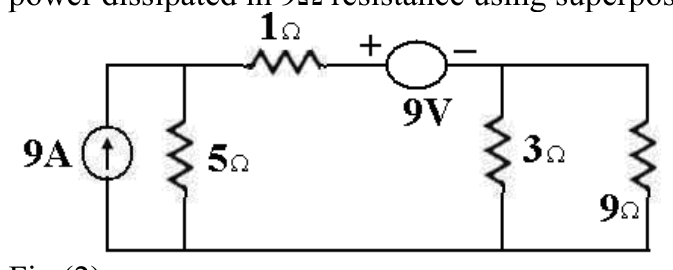
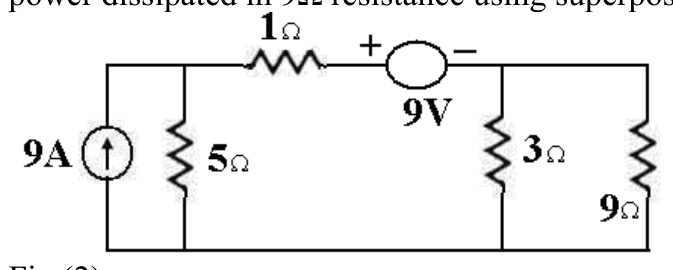
State and explain superposition theorem. For the circuit shown in Fig.(2), find the power dissipated in 9Ω resistance using superposition theorem. Fig (2)
No verified answer or solution is available for this question.
Basic Electrical and Electronics Engineering
What is MCCB and how does it differ from MCB? Explain its operation mechanism.
No verified answer or solution is available for this question.
Basic Electrical and Electronics Engineering
Explain the working principle and applications of single phase shaded pole motors. It is possible to reverse the direction of rotation of such a motor? If yes, how? If not, why?
No verified answer or solution is available for this question.
Basic Electrical and Electronics Engineering
A single-phase, 150 KVA, 5000 V/250 V, 50 Hz transformer has the full load copper losses of 1.8 KW and core losses of 1.5 KW. Find
No verified answer or solution is available for this question.
Basic Electrical and Electronics Engineering
Derive the EMF equation of a single phase transformer. Explain various losses occurring in transformer.
No verified answer or solution is available for this question.
Basic Electrical and Electronics Engineering
What are the different types of cables? Briefly give their construction and application. Sub Code: KEE -101 233105 QP23DP2_128 | 22-03-2023 08:52:27 | 103.248.120.3 QP23DP2_128 | 22-03-2023 08:52:27 | 103.248.120.3
No verified answer or solution is available for this question.
Basic Electrical and Electronics Engineering
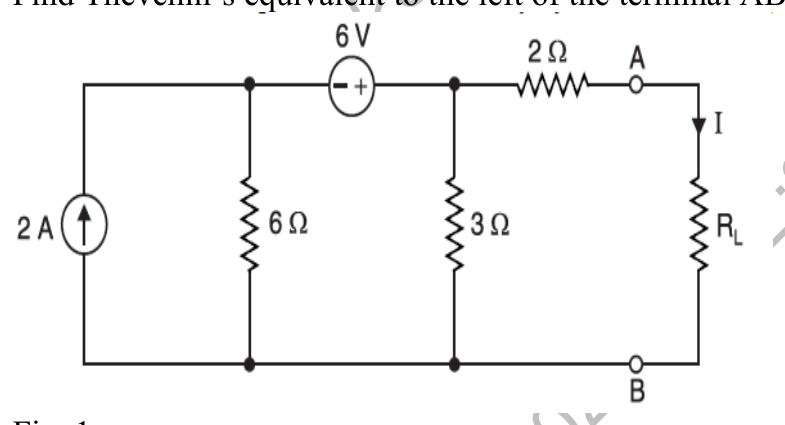
Find Thevenin’s equivalent to the left of the terminal AB as shown in Fig.1 Fig .1
No verified answer or solution is available for this question.
Basic Electrical and Electronics Engineering
What are the factors that affect the battery capacity?
No verified answer or solution is available for this question.
Basic Electrical and Electronics Engineering
What is the criterion for star-Delta transformation? Develop the relationship for delta-to-star and star-to-delta transformation.
No verified answer or solution is available for this question.
Basic Electrical and Electronics Engineering
Explain Series Resonance in RLC circuit? A circuit of a resistance of 10Ω, and inductance of 0.1 H and a variable capacitance in series across a 230 V, 50 Hz supply. Calculate :
No verified answer or solution is available for this question.
Basic Electrical and Electronics Engineering
Explain the principle of rotating flux in three phase induction motor also explain & draw the torque- slip characteristics.
No verified answer or solution is available for this question.