
// Dr. A.P.J. Abdul Kalam Technical University, Uttar Pradesh / 2023
AKTU B.Tech — Data Compression (KCS064), Semester 6, 2023
Data Compression · KCS064 · B.Tech Computer Science and Engineering · Semester 6
Questions
25
- 1(a)
- 1(b)
- 1(c)
- 1(d)
- 1(e)
- 1(f)
- 1(g)
- 1(h)
- 1(i)
- 1(j)
- 2(a)
- 2(b)
- 2(c)
- 2(d)
- 2(e)
- 3(a)
- 3(b)
- 4(a)
- 4(b)
- 5(a)
- 5(b)
- 6(a)
- 6(b)
- 7(a)
- 7(b)
Has an official figure
Work through the questions
25 questions
No verified answers are available for this paper.
What are the different measures of performance of data compression algorithm?
No verified answer or solution is available for this question.
Given an Alphabet A = {a1, a2, a3, a4}, find the first-order entropy in the following cases: P(a1) = P(a2) = P(a3) = P(a4) = 1/4
No verified answer or solution is available for this question.
What are the applications of Huffman Coding?
No verified answer or solution is available for this question.
Calculate Golomb Code for n=9 and n=13 with parameter m=5.
No verified answer or solution is available for this question.
List out the applications of dictionary based data compression techniques.
No verified answer or solution is available for this question.
Compare Binary code with Huffman code.
No verified answer or solution is available for this question.
What are the various distortion criteria?
No verified answer or solution is available for this question.
Explain mismatch effect.
No verified answer or solution is available for this question.
Define Code Vectors.
No verified answer or solution is available for this question.
What is the concept of pruning?
No verified answer or solution is available for this question.
How do uniquely decodable codes differ from prefix codes? Explain with example. Describe the procedure for coding a uniquely decodable code. Are the following codes {0, 10, 110, 111} {1, 10, 110, 111} uniquely decodable?
No verified answer or solution is available for this question.
Explain the difference between Minimum variance Huffman code and Huffman code with example. From an alphabet A = {a1, a2, a3, a4, a5} with probabilities P(a1) = 0.15, P(a2) = 0.04, P(a3) = 0.26, P(a4) = 0.05 and P(a5) = 0.50. (i) Calculate the entropy of this source. (ii) Find the Huffman Code for this source. (iii) Find the average length of the code in (ii) and its redundancy.
No verified answer or solution is available for this question.
Explain the basic algorithm behind prediction with partial match (ppm). What is Facsimile Encoding? Explain Run-Length Coding technique used earlier for Facsimile.
No verified answer or solution is available for this question.
- 2023
- 2022
Also asked in AKTU B.Tech — Data Compression (RCS087), Semester 6, 2022 (2022), AKTU B.Tech — Data Compression (RCS087), Semester 7, 2022 (2022), AKTU B.Tech — Data Compression (RCS087), Semester 8, 2022 (2022).
What do you understand by Adaptive quantization? Explain the various approaches to Adapting the Quantizer Parameters.
No verified answer or solution is available for this question.
What do you understand by Vector Quantization? Discuss the advantages of vector quantization over scalar.
No verified answer or solution is available for this question.
Define two-state Markov model for binary images. Also define ignorance model and how it is related with probability models?
No verified answer or solution is available for this question.
Discuss the importance of modeling and coding in the compression process with example. How does information theory relate to lossless compression? Can you explain some key concepts in information theory and their relevance to compression?
No verified answer or solution is available for this question.
Given an alphabet {a1, a2, ..., a26} of size 26. The letter ak is encoded as per the following rules: (i) ak is encoded as 5 bit binary representation of k-1, if 1≤k≤20 (ii) ak is encoded as 4 bit binary representation of k-11 for all k>20. Decode the following string using Adaptive Huffman procedure. Show updated Huffman tree for each step. 000001010001000001100010110.
No verified answer or solution is available for this question.
How Rice code can be viewed? Explain the implementation of the Rice code in the recommendation for lossless compression from the Consultative Committee on Space Data Standard.
No verified answer or solution is available for this question.
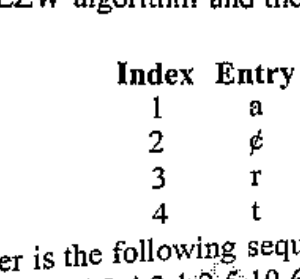
A sequence is encoded using LZW algorithm and the initial dictionary shown in table: 1=a, 2=e, 3=r, 4=t. The output of the LZW encoder is the following sequence: 3 1 4 6 8 4 2 1 2 5 10 6 11 13 6. Decode this sequence. Discuss relative advantages of LZ77, LZ78 and LZW Compression schemes.
No verified answer or solution is available for this question.
Explain Burrows-Wheeler transform (BWT) in detail. Given the sequence: thisisisthe Encode using the BWT and move-to-front coding.
No verified answer or solution is available for this question.
What do you understand by Uniform Quantizer? How uniform quantization of a uniformly distributed sources and uniform quantization of non-uniform sources is done?
No verified answer or solution is available for this question.
Consider the following lossy compression scheme for binary sequences. We divide the binary sequence into blocks of size M. For each block we count the number of 0s.If this number is greater than or equal to M/2, we send as 0; otherwise, we send a 1. (i) If the sequence is random with P(0) = 0.8, compute the rate and distortion for M = 1, 2, 4, 8, 16.Compare your results with the rate distortion function for binary sources. (ii)Repeat assuming that the output of the encoder is encoded at a rate equal to the entropy of the output.
No verified answer or solution is available for this question.
Explain the various functions involved in the Linde-Buzo-Gray(LBG) Algorithm. Also explain the initializing of LBG algorithm.
No verified answer or solution is available for this question.
Write a short note on: (i) Tree structured Vector Quantizers (ii) Lattice Vector Quantizers
No verified answer or solution is available for this question.