
// Dr. A.P.J. Abdul Kalam Technical University, Uttar Pradesh / 2025
AKTU B.Tech — Fundamentals Of Electrical Engineering (BEE101), Semester 1, 2025
Fundamentals Of Electrical Engineering · BEE101 · B.Tech Computer Science and Engineering · Semester 1
Questions
23
Has an official figure
Work through the questions
23 questions
No verified answers are available for this paper.
Fundamentals of Electrical and Electronics Engineering
Draw the phasor diagram of practical transformer at no load condition.
No verified answer or solution is available for this question.
Fundamentals of Electrical and Electronics Engineering
Write the condition for maximum efficiency of transformer.
No verified answer or solution is available for this question.
Fundamentals of Electrical and Electronics Engineering
Define the commutator in DC machine.
No verified answer or solution is available for this question.
Fundamentals of Electrical and Electronics Engineering
A resistance of 15Ω, choke coil of 0.05 H and the capacitor of 0.03 F are connected in series. Find the impedance of the circuit if frequency is 50 Hz.
No verified answer or solution is available for this question.
Fundamentals of Electrical and Electronics Engineering
Define the RMS value and write the formula.
No verified answer or solution is available for this question.
Fundamentals of Electrical and Electronics Engineering
What is Switch fuse unit(SFU)?
No verified answer or solution is available for this question.
Fundamentals of Electrical and Electronics Engineering
Define bilateral and unilateral element.
No verified answer or solution is available for this question.
Fundamentals of Electrical and Electronics Engineering
Derive series resonance frequency in R-L-C circuit. A series R-L-C circuit has R=20 , L=0.1H and C=0.09F. Determine
No verified answer or solution is available for this question.
Fundamentals of Electrical and Electronics Engineering
Calculate the emf generated by a 6 pole DC generator having 480 conductors and driven at a speed of 1200 rpm. The flux per pole is 0.012 Wb. Assume the generator to be
No verified answer or solution is available for this question.
Fundamentals of Electrical and Electronics Engineering
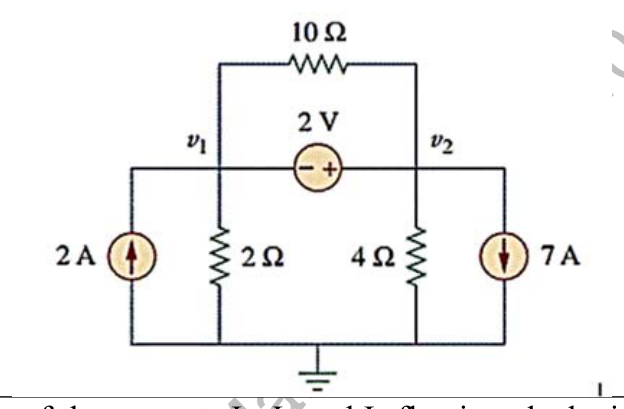
Find the voltage V1 and V2 using nodal analysis.
No verified answer or solution is available for this question.
Fundamentals of Electrical and Electronics Engineering
Explain construction of underground cable? Explain each layer of cable with neat diagram. Why used of bedding in cable?
No verified answer or solution is available for this question.
Fundamentals of Electrical and Electronics Engineering
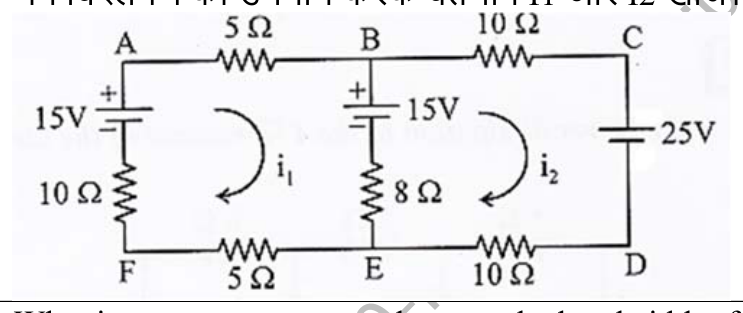
Find the current I1 and I2 using the Mesh analysis.
No verified answer or solution is available for this question.
Fundamentals of Electrical and Electronics Engineering
The primary and secondary windings of a 600 kVA transformer have resistance of 0.4 Ω and 0.001 Ω respectively. The primary and secondary voltages are 6000 V and 200 V respectively. The iron loss is 3200 W. Calculate the efficiency on full load at the load power factor being 0.8.
No verified answer or solution is available for this question.
Fundamentals of Electrical and Electronics Engineering
What is Bus-bars in power system? Write the type of Bus-bars. Explain the single Bus-bars system.
No verified answer or solution is available for this question.
Fundamentals of Electrical and Electronics Engineering
Why does not use of transformer in DC supply and derive the EMF equation?
No verified answer or solution is available for this question.
Fundamentals of Electrical and Electronics Engineering
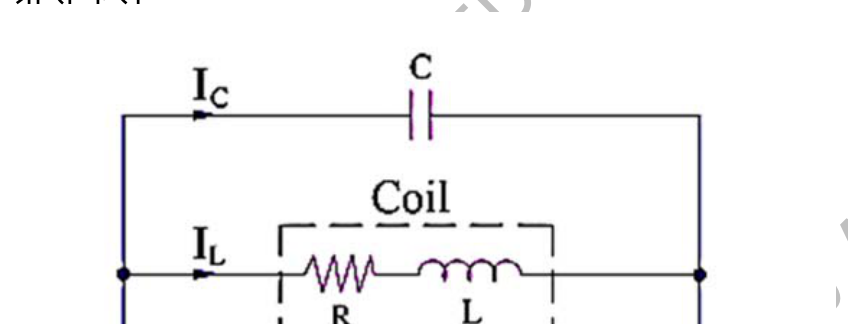
Explain the phenomenon of parallel resonance circuit. Also derive the formula for resonant frequency of the circuit with a pure capacitor in parallel with a coil having resistance and inductanceas shown figure.
No verified answer or solution is available for this question.
Fundamentals of Electrical and Electronics Engineering
What is ELCB and why it is used? Explain the Voltage type of ELCB with suitable diagram.
No verified answer or solution is available for this question.
Fundamentals of Electrical and Electronics Engineering
Explain the working principle of DC generator and also Derive the EMF equation of DC generator.
No verified answer or solution is available for this question.
Fundamentals of Electrical and Electronics Engineering
A three phase 50Hz ,2 pole induction motor has a full speed of 2860 rpm. What is the
No verified answer or solution is available for this question.
Fundamentals of Electrical and Electronics Engineering
Resonant frequency QP25DP2_145 0 0 FUNDAMENTALS OF ELECTRICAL ENGINEERING 2 | P a g e (ii) Q factor of the circuit at resonance. (iii) Bandwidth
No verified answer or solution is available for this question.
Fundamentals of Electrical and Electronics Engineering
What is resonance curve and prove the bandwidth of resonant frequency is 𝑓ଶെ𝑓ଵൌ ோ ଶగ. ோ
No verified answer or solution is available for this question.
Fundamentals of Electrical and Electronics Engineering
Find the value of the currents I1, I2 and I3 flowing clockwise in the first, second and third mesh respectively. QP25DP2_145 0 0 FUNDAMENTALS OF ELECTRICAL ENGINEERING 3 | P a g e
No verified answer or solution is available for this question.
Fundamentals of Electrical and Electronics Engineering
A series RLC circuit containing a resistance of 12Ω, an inductance of 0.15H and a capacitor of 100uF are connected in series across a 100V, 50Hz supply. Calculate the total circuit impedance, the circuits current, power factor and draw the voltage phasor diagram. QP25DP2_145 0 0 FUNDAMENTALS OF ELECTRICAL ENGINEERING 4 | P a g e
No verified answer or solution is available for this question.